
Non-FictionMental WealthRole Transition
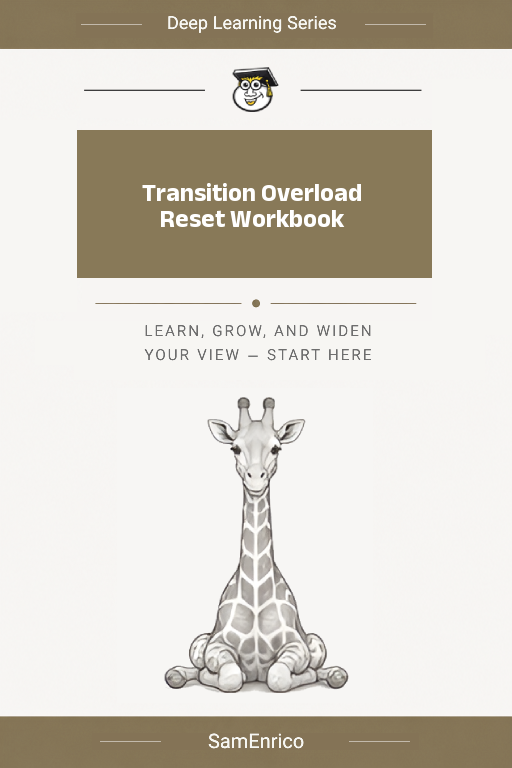
Transition Overload Reset Workbook eBook
Regulate between multiple daily roles employee to
Regulate between multiple daily roles employee to parent to partner using 90 second nervous system nomads.
Formats
Free sample
Chapter 1: The 6:17 PM Meltdown--–- You leave work at 5:30 PM. You were in the middle of something—an email thread that required careful politics, a budget revision that was due yesterday, a conversation with a colleague that left you feeling vaguely dismissed. You packed your bag quickly, said a rushed goodbye, and walked to your car. Or perhaps you closed your laptop on the kitchen table, the same table where you will later serve dinner. Either way, you did not reset.
You carried the afternoon with you like a second skin.The drive home—or the walk from your home office to the living room—was not silent. It was loud with rehearsal. You ran through the argument you should have had with your boss. You replayed the moment you stayed quiet when you should have spoken up. You mentally scanned the refrigerator to see if there was anything for dinner.
You felt the weight of the unanswered emails still pulsing in your pocket.At 6:17 PM, you walked through the door.Your toddler immediately ran toward you, clutching a half-eaten banana that had begun to brown. They thrust it toward you with the urgency of a small person who has been waiting all day for your attention. Your partner looked up from their phone and said, without preamble, "We need to talk about the credit card bill. And also, the pediatrician called about the appointment we missed last week." Your work phone buzzed—a Slack message from your boss's boss, marked "urgent."Something inside you cracked.You did not handle it well. You snapped at the toddler to "please just put the banana down." Your voice came out sharper than you intended.
You glared at your partner as if the credit card bill were their fault alone. You ignored the work phone, but the ignoring felt violent—a clenched jaw, a turned shoulder. The toddler started crying. Your partner went silent. You stood in the entryway, keys still in your hand, and felt the hot wash of shame climb up your neck.Later that night, after the bath that felt like a negotiation and the bedtime that felt like a hostage situation, you collapsed onto the couch.
You picked up your phone. You scrolled. You do not remember what you scrolled through. You only remember the numbness—the vague, gray exhaustion that made your partner's attempt at conversation feel like one more demand.You thought: What is wrong with me?This book is the answer to that question. And the answer is not what you think.Nothing is wrong with you.
You are not broken. You are not a bad parent, a failing partner, or an incompetent employee. You are a human being with a nervous system that was never designed to switch between employee, parent, and partner in rapid succession without a reset. The 6:17 PM meltdown is not a moral failure. It is a biological inevitability—unless you learn to work with your nervous system instead of against it.This chapter is the diagnosis.
By the time you finish it, you will understand why "trying harder" has made everything worse, why shame is not the path to improvement but the trap that keeps you stuck, and why the solution is not better time management but better state management. You will also take your first step out of the 6:17 PM meltdown: a single, 10-minute audit that will reveal which role actually owns your nervous system right now—and it is probably not the one you are physically performing.Let us begin.The Industrial-Age Worker Who Never Existed Imagine, for a moment, the person for whom the modern workplace was designed. This person works from 9 AM to 5 PM, uninterrupted. They have no children. They have a partner who manages all domestic labor.
They do not experience hormonal cycles, sleep deprivation, or the need to leave early for a soccer game. They eat lunch at their desk. They answer emails at 10 PM without resentment. They are, in other words, a fiction.The industrial-age work model was built for a worker without a body, without a family, and without a nervous system. That worker never existed.
But we have spent decades pretending they do. We have built our schedules, our expectations, and our self-worth around a myth. And then we have wondered why we feel like failures when we cannot live up to it.Here is what the myth demands of you:As an employee, you must be always on, always responsive, always productive. Your value is measured in output. Your attention must be undivided.
Your emotions must be managed—not felt, but managed—so that you never bring "personal problems" into the workplace.As a parent, you must be always available, always patient, always attuned. Your child's emotional development depends on your presence. Every sharp word is a potential wound. Every distracted moment is a missed opportunity for connection.As a partner, you must be intimate, supportive, and engaged. You must remember birthdays and anniversaries.
You must listen without fixing. You must want sex even when you are exhausted.Here is what is impossible: doing all three of these things simultaneously. And yet, that is what you attempt every single day. You leave a work meeting and walk directly into a toddler's meltdown. You end a difficult conversation with your partner and open your laptop to a passive-aggressive email from your boss.
You switch roles not in hours or minutes but in seconds—and your nervous system was never built for that.Why "Trying Harder" Makes It Worse When you snapped at your toddler at 6:17 PM, what did you do next? If you are like most people, you told yourself to try harder. You made a mental note: Tomorrow, I will be more patient. Tomorrow, I will leave work earlier. Tomorrow, I will not let the email get to me.This is the most common response to Transition Overload.
It is also the most damaging.Here is why. Your nervous system has three primary states, which we will explore in depth in Chapter 2. For now, you only need to understand two of them:Sympathetic state (fight/flight): This is your accelerator. It is useful for deadlines, emergencies, and performance. But when you live here chronically, you become irritable, rushed, and reactive.
You snap at people. You cannot sit still.Dorsal vagal state (shutdown/freeze): This is your brake. It is useful for conserving energy after trauma or exhaustion. But when you live here chronically, you become numb, dissociated, and hopeless. You scroll on your phone for hours.
You cannot feel anything.Here is the cruel irony: "Trying harder" is a Sympathetic solution. It asks you to accelerate when you are already speeding. It asks you to white-knuckle your way through exhaustion, which only deepens the eventual Dorsal collapse. The more you try, the more you fail. The more you fail, the more shame you feel.
The more shame you feel, the more your nervous system tips into Dorsal shutdown.You are not failing because you lack discipline. You are failing because you are trying to solve a neurological problem with a calendar solution.The Shame Trap (And Why It Feels Like Truth)Let us return…
This is the end of the free sample. Get the eBook to keep going. Buy now
About this book
Details
- Author
- Purnell Pearlie
- Publisher
- SamEnrico
- Language
- English
- Genre
- Non-Fiction, Mental Wealth, Role Transition
- Released
- 2026-06-01
- Pages (approx.)
- 141
- Available as
- eBook, Audiobook

Read better in the ZLOADR app
Your eBooks on your phone or tablet. Sign in with your SamEnrico account and start reading.
More by Purnell Pearlie
 Dream Journaling for ScientistsPurnell Pearlie$11.99
 De escalate Angry Parent GuidePurnell Pearlie$11.99
 Hinton Meeting His HeroesPurnell Pearlie$11.99
 Sepoy Grievances ListPurnell Pearlie$11.99
 Medical Procedure Dream PrepPurnell Pearlie$11.99
 Osborn Checklist GuidePurnell Pearlie$11.99
 British Army Imperial PolicingPurnell Pearlie$11.99
 Procrastination and Imposter SyndromePurnell Pearlie$11.99
 Guernica: The Sky That BurnedPurnell Pearlie$11.99
 Nefertiti's Veil: The Lost Pharaoh's SecretPurnell Pearlie$11.99
 Grape: Table Grape HarvestingPurnell Pearlie$11.99
 Grant Writing Acronyms GlossaryPurnell Pearlie$12.99
You may also like
 Hong Kong Handover 1997Dunn Johnnie$11.99
 Zumba For Postnatal Recovery CourseNeal Christian$11.99
 Zumba for BeginnersLadner Nikia$11.99
 YouTube Comment Mining GuideHumes Pandora$12.99
 Worry Box MeditationCarlin Rudy$11.99
 Workplace Stress MeditationNguyen Lynn$11.99
 Workplace Stress and Sleep RepairHawley Ivory$11.99
 Workplace Perfectionism CureDelaney Jeffry$11.99
 Workplace Injustice Anger GuideWallen Isabelle$11.99
 Work Addiction and Burnout LinkGreenwood Ester$11.99
 Women in Yoga and WellnessBeattie Galina$11.99
 Women in Stand Up ComedyChun Evangeline$11.99