
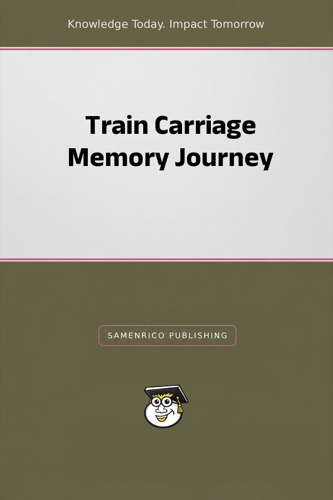
Non-FictionSelf-HelpJourney Memory
Train Carriage Memory Journey eBook
Use seats and windows along a train route for line
by Moe Kali
Use seats and windows along a train route for linear recall.
Formats
Free sample
Chapter 1: The Forgetting Crisis...--–- It happens to everyone at least once a week, usually more. You walk into a room and forget why. You meet a new colleague and their name vanishes the moment you shake hands. You deliver a presentation and realize halfway through that you have skipped an entire section. You study for an exam for three hours, yet when the test lands on your desk, the facts you “knew” have evaporated like morning dew.
This is not a sign of a bad memory. This is a sign of a bad system.For centuries, human beings have been told that memory is a gift—something you either have or you lack. The “good memory” people are the ones who can recite poetry, remember birthdays, and never need a grocery list. The rest of us fumble with sticky notes, smartphone alerts, and the embarrassing confession of “I’m just not good with names.” This binary view of memory—haves and have-nots—is not only false, it is destructive. It has prevented millions of people from discovering that memory is not a talent.
It is a skill. And like any skill, it can be learned, practiced, and mastered.The question is not whether you have a good memory. The question is whether you have been using the wrong tool for the job.The Palace That Crumbles You have probably heard of the Memory Palace. It is the darling of memory champions, TED Talks, and every “improve your brain” book published in the last decade. The technique is ancient, dating back to the Greek poet Simonides of Ceos around 477 BCE.
According to legend, Simonides attended a banquet, stepped outside momentarily, and the building collapsed behind him, crushing all the guests beyond recognition. He was able to identify every single body because he remembered exactly where each person had been sitting. From this tragedy, the Method of Loci—the Memory Palace—was born.The idea is simple: you visualize a familiar building (your childhood home, your office, a church), and you place the things you want to remember in specific locations within that building. To recall, you take a mental walk through the building and “see” what you left behind. It works brilliantly for memory athletes who compete in championships.
It works for medical students memorizing thousands of terms. It works for polyglots learning vocabulary.But here is the problem that no one tells you: the Memory Palace fails for most people in most everyday situations. Why? Because real life does not happen in rooms.Think about your day. You wake up.
You follow a morning routine—a sequence. You commute to work—a sequence. You check emails in a priority order—a sequence. You attend meetings with agendas—sequences. You cook dinner following a recipe—a sequence.
You watch a movie with a plot—a sequence. Your entire life runs on tracks. It is a journey from one moment to the next, not a collection of rooms you wander through at random.The Memory Palace, for all its ancient wisdom, treats your life like a museum. You walk from gallery to gallery, looking at exhibits. But when was the last time you lived your day like a museum visit?
Never. You live your day like a train ride. You board at Station A (waking up), pass through Carriage 1 (morning routine), change tracks at Carriage 2 (commute), arrive at Carriage 3 (work), and so on. The museum metaphor is static. The train metaphor is dynamic.
And your brain evolved for motion.The Neuroscience of Journeys Before we build your first train, we must understand why trains work better than palaces. The answer lies in a cognitive phenomenon called event segmentation.Your brain does not record reality like a video camera. It breaks continuous experience into discrete, meaningful chunks called events. When you walk from your kitchen to your living room, your brain draws a boundary. When you finish a conversation and start another, your brain draws a boundary.
When you pass through a doorway, your brain draws a boundary. These boundaries are not arbitrary—they help you organize memory by time, place, and sequence.Researchers at Princeton and Dartmouth have demonstrated that event segmentation is so fundamental that damage to the brain regions responsible for it (particularly the lateral prefrontal cortex and posterior parietal cortex) makes it impossible to remember even simple daily activities. Patients with such damage can describe individual actions—picking up a cup, pouring coffee, drinking—but cannot remember the order in which those actions occurred. They have lost the ability to ride the train of time.Here is the critical insight: your brain is already a train. It naturally sequences information into a linear flow.
The Memory Palace asks you to override this natural tendency by thinking in terms of static locations. The Train Carriage Memory Journey asks you to work with your brain’s built-in sequencing engine.Consider this experiment. I want you to remember five items: apple, bicycle, cat, diamond, elephant. Try to remember them for ten seconds. Now close your eyes and recall them.
Most people can do this easily because five items is trivial. But let me ask you a different question: in what order did I list them? If you recalled “apple, cat, bicycle, elephant, diamond,” you remembered the items but lost the sequence. For most memory tasks, sequence matters. A recipe without sequence is poison.
A speech without sequence is nonsense. A historical timeline without sequence is chaos.The Memory Palace does not protect sequence. You can walk through a palace in any order—front to back, back to front, skipping rooms, circling back. Nothing stops you. The train, however, forces sequence.
You cannot arrive at Carriage 3 before Carriage 2. You cannot revisit Carriage 1 without passing through Carriage 2 again. The tracks enforce order. And order is the hidden architecture of every memory you need for real life.The Three Failures of the Static Palace Let me be specific about why the Memory Palace fails for everyday use. I have taught memory techniques to thousands of people over the years, from corporate executives to college students to retirees.
Again and again, I hear the same complaints. These are not failures of effort. These are structural failures of the method itself.First failure: the direction problem. When you build a Memory Palace, you must decide a path. Walk from the front door to the living room to the kitchen to the bedroom.
But what happens when you start at the bedroom? What happens when you enter from the back door? The sequence becomes ambiguous because the palace itself has no inherent direction. Rooms are connected, but not linearly. You can walk in circles.
You can take shortcuts. This ambiguity destroys ordered recall because your brain cannot decide whether the kitchen comes before or after the living room. With a train, there is no ambiguity. The engine is the front. The caboose is the back.
Every carriage has a fixed position. Direction is absolute.Second failure: the scale problem. A Memory Palace works well for 10 or 20 items. But what about 100? 1,000?
You run out of rooms. You start putting items on ceilings, under rugs, inside closets. The clutter becomes unmanageable. A…
This is the end of the free sample. Get the eBook to keep going. Buy now
About this book
Details
- Author
- Moe Kali
- Publisher
- SamEnrico
- Language
- English
- Genre
- Non-Fiction, Self-Help, Journey Memory
- Released
- 2026-06-10
- Pages (approx.)
- 147
- Available as
- eBook, Audiobook

Read better in the ZLOADR app
Your eBooks on your phone or tablet. Sign in with your SamEnrico account and start reading.
More by Moe Kali
 Pandemic Performance Review PivotMoe Kali$11.99
 Growth Hormone and Fat MetabolismMoe Kali$11.99
 Depression Related ProcrastinationMoe Kali$11.99
 Foster Care Language BarrierMoe Kali$11.99
 Early Warning Signs BurnoutMoe Kali$11.99
 Benzo Cognitive Fog RecoveryMoe Kali$11.99
 Dynamic Stretching GuideMoe Kali$11.99
 The Ghosts of Delagoa Bay: The Pirate Wars of the Boer GuerrillasMoe Kali$11.99
 The Last Spin of the Silver CometMoe Kali$11.99
 A Collector's Handbook to the Morris Twenty-five Series IiiMoe Kali$11.99
 How to Produce Window MagnetsMoe Kali$11.99
 How to Produce Maternity Belts and Support BandsMoe Kali$11.99
You may also like
 Hong Kong Handover 1997Dunn Johnnie$11.99
 Zumba For Postnatal Recovery CourseNeal Christian$11.99
 Zumba for BeginnersLadner Nikia$11.99
 YouTube Comment Mining GuideHumes Pandora$12.99
 Worry Box MeditationCarlin Rudy$11.99
 Workplace Stress MeditationNguyen Lynn$11.99
 Workplace Stress and Sleep RepairHawley Ivory$11.99
 Workplace Perfectionism CureDelaney Jeffry$11.99
 Workplace Injustice Anger GuideWallen Isabelle$11.99
 Work Addiction and Burnout LinkGreenwood Ester$11.99
 Women in Yoga and WellnessBeattie Galina$11.99
 Women in Stand Up ComedyChun Evangeline$11.99