
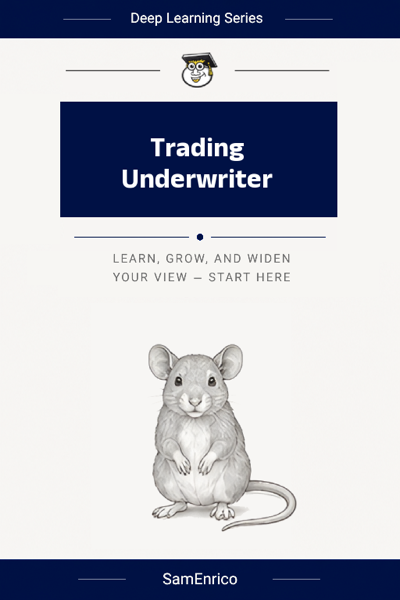
Trading Underwriter eBook
A Coursebook on Trading Underwriter
A Coursebook on Trading Underwriter
Formats
Free sample
Chapter 1: The Hybrid Necessity--The deal was priced at $42 per share. Within ninety minutes of the opening bell, it was trading at $38.50. The syndicate desk had done everything right—the book was covered two times, the institutional investors were all blue-chip names, and the company's story was compelling. Yet here I was, watching a quarter million shares of inventory bleed value by the second, with no natural buyers in sight and the stabilization agent frantically signaling that our Greenshoe was nearly exhausted.This is not a scene from a crisis movie. This is Tuesday at any major investment bank that still believes underwriting ends when the pricing is announced.The traditional model of originate-to-distribute worked beautifully for decades.
An investment banker would cultivate a relationship with a company, wait for the right moment to take it public, build a book of institutional demand, price the deal with a modest discount, allocate shares to loyal clients, and collect a fee. The trader's role was ancillary—execute the odd block, hedge a bit of residual risk, and move on to the next product. The underwriter and the trader occupied separate floors, spoke different jargon, and rarely needed to coordinate deeply.That world has ended.Not because bankers became incompetent or traders became greedy, but because the market structure changed beneath everyone's feet. Electronic trading compressed spreads to the point where the old underwriting fee model alone no longer guarantees profitability. High-frequency firms now provide liquidity faster and cheaper than any human syndicate desk could hope to match.
And the investor base has shifted dramatically—hedge funds and quantitative funds now account for a significant portion of IPO demand, and they have no loyalty. They flip. They short. They trade around the offering. They treat your carefully priced deal as just another arbitrage opportunity.In this new environment, the underwriter who cannot trade is a liability.
The trader who does not understand underwriting is a spectator. The only professionals who thrive are those who have become what this book calls the Trading Underwriter—a hybrid role that sits at the intersection of syndicate relationships and real-time risk management, capable of pricing a deal with one eye on the discounted cash flow model and the other on the order book's gamma exposure.This chapter explains why that hybrid role is no longer optional, how the traditional model fractured, and what the successful trading underwriter must become. By the end, you will understand why the remaining chapters of this book are essential to your survival and success in modern capital markets.The Anatomy of a Broken Model To understand where we are going, we must first understand how we arrived here. The originate-to-distribute model was not merely a business practice; it was an integrated system of relationships, incentives, and market structure that reinforced itself for nearly half a century.In the classic model, an investment bank's underwriting division would identify a company ready to go public. The syndicate desk would build a book of indications of interest from institutional investors—pension funds, mutual funds, insurance companies, endowments.
These investors were long-term holders by mandate and by culture. They bought shares to own them, not to flip them. They trusted the underwriter's certification role: if a reputable bank brought a deal to market, the company had passed a rigorous due diligence screen.The pricing process was artful but predictable. The underwriter would calculate a fundamental value using discounted cash flow analysis, comparable company multiples, and precedent transactions. Then they would apply a discount—typically 10 to 15 percent—to ensure that the first-day pop rewarded their best clients.
The offering would price on Thursday night, trade on Friday morning, close the following Wednesday. The underwriter's inventory was minimal because the deal was pre-sold. The trading desk's job was simple: handle the odd buy order, provide a little liquidity, and collect a small piece of the spread.Fees were substantial. A typical initial public offering underwriting fee ranged from 5 to 7 percent of the proceeds. For a $500 million deal, that meant $25 to $35 million in fee income, shared among the syndicate members.
The lead underwriter might take half of that. The bank's trading desk might see a small fraction, but the overall profitability of the underwriting division was robust.This model worked because the environment supported it. Markets were slower. Information was less instantaneous. The bid-ask spreads on exchange-listed stocks were wide enough to provide natural cushion.
High-frequency trading did not exist. Hedge funds were a fraction of the market. The rules of the game were stable and predictable.Then everything changed.The Three Cracks in the Foundation Three structural shifts, each powerful enough to reshape a market on its own, converged in the 2010s to shatter the originate-to-distribute model. Understanding these shifts is not optional background reading—it is the prerequisite for understanding every tactic and strategy in the chapters that follow.Crack One: The Collapse of Trading Costs The decimalization of stock prices in 2001—moving from fractions to pennies—was the first major blow. Overnight, the minimum tick size fell from one-sixteenth of a dollar, or $0.0625, to one cent.
Bid-ask spreads collapsed. A stock that might have traded with a five-cent spread now traded with a one-cent spread. For a retail investor, this was a gift. For an underwriter trying to earn a spread by providing liquidity, it was a disaster.The collapse in spreads rippled through the underwriting ecosystem. If the aftermarket bid-ask spread was one cent, there was no room for a traditional market maker to earn a meaningful profit from simply posting quotes.
The only way to make money was to trade in size and to move quickly—neither of which aligned with the slow, relationship-based underwriting model.Simultaneously, electronic trading platforms like Instinet, Island, and eventually the major exchanges' own electronic books displaced human specialists and floor traders. Speed became the primary competitive advantage. The bank that could route an order to the exchange in milliseconds won; the bank that relied on human judgment lost. Underwriting desks, which measured decision times in hours, found themselves increasingly disconnected from the market they were supposed to navigate.Crack Two: The Rise of High-Frequency Liquidity As spreads collapsed and electronic trading accelerated, a new class of market participant emerged: the high-frequency trading firm. Firms like Citadel Securities, Virtu Financial, and Two Sigma did not care about fundamental value, long-term holding periods, or relationships with issuers.
They cared about latency, order flow, and statistical arbitrage.These firms became the primary liquidity providers in most exchange-listed stocks. They posted bids and offers at a frequency measured in microseconds, captured the spread millions of times per day, and carried virtually no overnight inventory. When an initial public offering stock began trading, the high-frequency trading firms were there instantly, not because they believed in the company but because they could earn a fraction of a cent on each share traded.For the traditional underwriter, this was profoundly disorienting. The syndicate desk had always assumed that liquidity was scarce and valuable—that investors needed the underwriter to provide a market. Now, liquidity was abundant and cheap.
The high-frequency trading firms could provide tighter spreads and deeper quotes than any human desk. The underwriter's role as a…
This is the end of the free sample. Get the eBook to keep going. Buy now
About this book
Details
- Author
- Pimentel Gwenn
- Publisher
- SamEnrico
- Language
- English
- Genre
- trading, Informative, Educational
- Released
- 2026-06-03
- Pages (approx.)
- 148
- Available as
- eBook, Audiobook

Read better in the ZLOADR app
Your eBooks on your phone or tablet. Sign in with your SamEnrico account and start reading.
More by Pimentel Gwenn
 Blue Zone Water WisdomPimentel Gwenn$11.99
 Environmental Charity Fraud CoursePimentel Gwenn$11.99
 Food Addiction YouTube ChannelsPimentel Gwenn$11.99
 The Relapse Prevention Weight GuidePimentel Gwenn$11.99
 Business Networking Conversation GuidePimentel Gwenn$11.99
 The Stone Sentinels: Gothic Architects and the Skyward DreamPimentel Gwenn$11.99
 How to Start a Barley Meal Production Business (Beginners Guide)Pimentel Gwenn$11.99
 Ghana Ecommerce GuidePimentel Gwenn$12.99
 Founder Burnout to BreakthroughPimentel Gwenn$12.99
 Understanding Whitaker SyndromePimentel Gwenn$17.99
You may also like
 Shift Work Shift Trading GuideDuff Cathrine$11.99
 Insider Trading SentimentWurtz Shawnda$11.99
 Gambler's Fallacy TradingGaydos Shu$11.99
 Cryptocurrency Trading AddictionGeorge Kathleen$11.99
 Brokerage Account Margin TradingSegura Hermila$11.99
 Gambling Addiction and Day TradingClanton Hyacinth$11.99
 Beginner Mindfulness for Stock TradersFultz Mary$11.99
 Dividend Capture Strategy GuideWallace Antoinette$11.99
 Unauthorized Trading CasesQuintanilla Ima$11.99
 Insider Trading Heist TheoryTripp Luvenia$11.99
 Trader Distraction Control GuideSummers Gina$11.99
 Loss Aversion Trading GuideBoucher Ellamae$11.99