
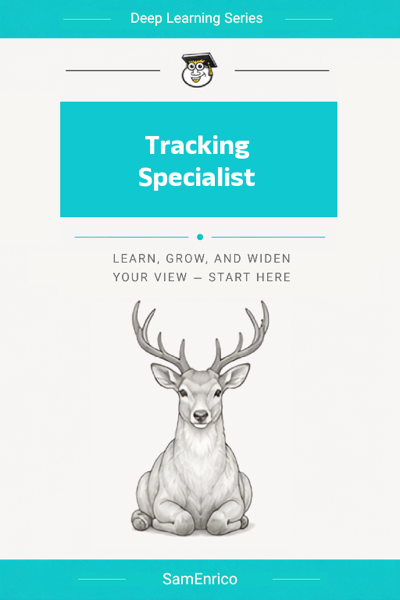
Non-FictionInformativeEducational
Tracking Specialist eBook
A Coursebook on Tracking Specialist
A Coursebook on Tracking Specialist
Formats
Free sample
Chapter 1: The Silent Language...--The first time I walked past a murder, I didn’t even know it. I was twenty-two years old, fresh out of a wildlife tracking course in the Montana wilderness, convinced I had mastered the art of reading the ground. I could tell a deer from an elk at fifty paces. I could distinguish a coyote’s direct-register walk from a domestic dog’s sloppy over-step. I carried a tracking stick whittled from a juniper branch and a notebook filled with detailed sketches of pressure releases and stride patterns.
I was, in my own mind, a tracker.Then I met Tom Brown Jr. at a gathering of outdoor educators in the Pine Barrens of New Jersey. He looked at my notebook, flipped through the pages without expression, and handed it back. “You’ve learned the alphabet,” he said. “You haven’t learned to read the language.” He pointed to a patch of sandy ground near the parking lot.
“Tell me what happened here in the last hour.”I knelt down. There were dozens of prints—boots, sneakers, dog paws, bicycle tires. I identified them all correctly. Brown nodded slowly. “Now tell me which person was angry.” I stared at the ground.
“And which one was carrying something heavy on their right shoulder. And which one stopped to look at something in the trees before changing direction.” I had no answers. I had been seeing but not observing. I had been identifying but not interpreting. I had been collecting data but reading no story.That was the day I learned that tracking is not a technical skill.
It is a language. And like any language, it has grammar, syntax, idiom, and poetry. The ground speaks constantly, but most people hear only noise. The tracker learns to hear sentences.What This Chapter Is Not Before we go any further, let me be clear about what this chapter—and this entire book—is not. This is not a field guide to animal footprints.
There are excellent books for that, including the Peterson Field Guides and the work of Mark Elbroch. This is not a survival manual, though the skills here will keep you alive. This is not a police procedural, though law enforcement trackers have used these methods to catch fugitives. This is not a nature-writing meditation, though you will never walk through the woods the same way again.This book is a coursebook on becoming a tracking specialist—someone who does not merely identify tracks but reads them as fluently as another person might read a newspaper. The difference is the difference between knowing the alphabet and reading Shakespeare.
Both are valuable. Only one changes how you see the world.By the end of this chapter, you will understand why tracking is not a skill you learn but a mindset you inhabit. You will know where tracking came from, where it is going, and why it matters more now than it has in a century. And you will begin the process of unlearning the habits that have kept you from truly seeing the ground beneath your feet.The Deep History: Tracking as the First Science Before agriculture, before writing, before mathematics or astronomy or medicine, there was tracking. The ability to read the ground was the original human superpower.
A hunter who could follow a wounded antelope for three days across hardpan desert fed their village. A scout who could distinguish a war party’s tracks from a hunting party’s saved lives. A mother who could read the sign of a saber-toothed cat near the waterhole kept her children away from the kill zone.Tracking is arguably the oldest science. It required systematic observation, hypothesis formation, testing, and revision—the same scientific method we use today, but written in dirt and blood and bent grass. The San Bushmen of the Kalahari Desert, who have been tracking for at least 20,000 years, can look at a single set of footprints and tell you the animal’s species, sex, approximate age, speed of travel, time of passage, whether it was injured, whether it was pregnant, and even which direction it was looking when it paused to drink.
They accomplish this without microscopes, without databases, without any tool other than their own trained perception.Native American trackers of the Apache and Comanche nations developed equally sophisticated systems. Apache scouts for the U.S. Cavalry could follow a horse thief across bare rock where no visible print existed, reading instead the displaced grains of sand, the orientation of pebbles knocked from their resting places, the subtle changes in lichen coloration where a hoof had scraped. These trackers were so legendary that the U.S. Army created a formal Scout program, employing Apache trackers well into the twentieth century.In Australia, Aboriginal trackers used what anthropologists have called “kinesthetic empathy”—the ability to inhabit the movement of the animal or person they were following.
They did not merely look for tracks; they felt their way into the quarry’s body, anticipating turns and pauses based on an intuitive understanding of how a tired kangaroo or a fleeing fugitive would move. This is not mysticism. It is pattern recognition so deep and fast that it operates below the level of conscious thought.Then, tracking nearly died. The industrial revolution, urbanization, and the rise of firearms made traditional tracking skills obsolete for most of humanity. Why learn to read the ground when you can shoot an animal from two hundred meters?
Why follow a trail when you can call emergency services? By the mid-twentieth century, tracking had become a niche hobby, a curiosity, a relic.But something unexpected happened. Tracking began to return—not as a necessity but as a choice. Wildlife biologists discovered that radio collars and GPS tags could tell them where animals went, but only trackers could tell them why. Search and rescue teams learned that dogs and helicopters were powerful tools, but only trackers could read the story of a lost person’s last hours.
Law enforcement realized that forensic evidence could put a suspect at a crime scene, but only trackers could follow that suspect away from the scene into the wilderness where they had hidden. Military units in Afghanistan and Iraq found that drones and satellites could see the forest, but only trackers could see the single bent blade of grass that revealed an IED emplacer’s path.Today, tracking is experiencing a renaissance. Professional tracking certifications, like the Cyber Tracker system developed in Southern Africa, now operate on six continents. Search and rescue teams include tracking specialists as standard members. Anti-poaching units in Africa rely on trackers as their primary detection tool.
Even urban police departments, from London to Los Angeles, have begun training officers in forensic tracking—reading the dust patterns on pavement, the scuff marks on walls, the geometry of security camera blind spots.We have not invented anything new. We are rediscovering what our ancestors knew: the ground speaks a language that is available to anyone willing to learn it.The Tracker’s Mindset: Seeing Versus Observing If tracking has a single secret, it is not a technique or a tool or a piece of knowledge. It is a…
This is the end of the free sample. Get the eBook to keep going. Buy now
About this book
Details
- Author
- Jefferies Angelia
- Publisher
- SamEnrico
- Language
- English
- Genre
- Non-Fiction, Informative, Educational
- Released
- 2026-05-11
- Pages (approx.)
- 154
- Available as
- eBook, Audiobook

Read better in the ZLOADR app
Your eBooks on your phone or tablet. Sign in with your SamEnrico account and start reading.
More by Jefferies Angelia
 PCOS AMH Level GuideJefferies Angelia$11.99
 Road Rage Therapy OptionsJefferies Angelia$11.99
 Moon Visualization Night Calm GuideJefferies Angelia$11.99
 Work Stress Acceptance CommitmentJefferies Angelia$11.99
 The Donna Strickland Laser ChirpingJefferies Angelia$11.99
 The Visionary Streets of L’Enfant: Designing a Capital for the AgesJefferies Angelia$11.99
 Understanding Osteopetrosis Autosomal Dominant Type 1Jefferies Angelia$17.99
 Tutoring Setup on a Budget GuideJefferies Angelia$12.99
 Terms of Service Dispute ResolutionJefferies Angelia$12.99
 How to Become a Sewing SupervisorJefferies Angelia$11.99
You may also like
 Hong Kong Handover 1997Dunn Johnnie$11.99
 Zumba For Postnatal Recovery CourseNeal Christian$11.99
 Zumba for BeginnersLadner Nikia$11.99
 YouTube Comment Mining GuideHumes Pandora$12.99
 Worry Box MeditationCarlin Rudy$11.99
 Workplace Stress MeditationNguyen Lynn$11.99
 Workplace Stress and Sleep RepairHawley Ivory$11.99
 Workplace Perfectionism CureDelaney Jeffry$11.99
 Workplace Injustice Anger GuideWallen Isabelle$11.99
 Work Addiction and Burnout LinkGreenwood Ester$11.99
 Women in Yoga and WellnessBeattie Galina$11.99
 Women in Stand Up ComedyChun Evangeline$11.99