
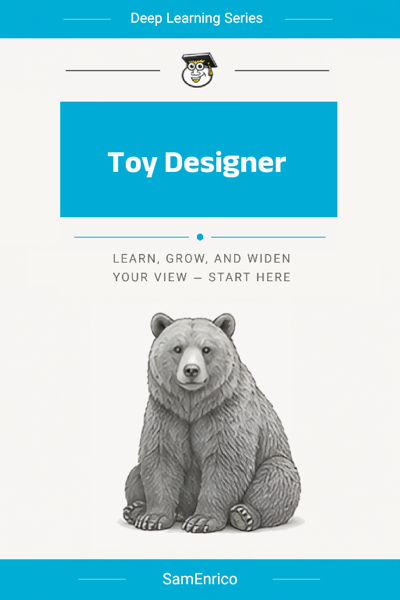
Non-FictionInformativeEducational
Toy Designer eBook
A Coursebook on Toy Designer
A Coursebook on Toy Designer
Formats
Free sample
Chapter 1: The Hidden Blueprint...--Every toy you have ever loved began as a lie.Not a malicious lie, but a useful fiction. The plush bear in your childhood bedroom was never “just a stuffed animal.” The LEGO castle was never “just bricks.” The action figure posed on a collector’s shelf was never “just plastic.” Behind each of these objects stands a hidden blueprint — a set of invisible rules, trade-offs, and hard-earned failures that transformed a scribble on a napkin into something a child dragged through mud, slept with for three years, or insisted on bringing to a dentist appointment.If you are reading this book, you already suspect that toy design is more than drawing cute characters. You are right. It is also more than engineering, more than child psychology, and more than manufacturing logistics. Toy design is the art of encoding a promise into a physical object — the promise of joy, discovery, comfort, or mastery.
And like all promises, it must be kept within brutal constraints: budgets measured in pennies, safety standards written in the blood of past failures, and the unpredictable verdict of a four-year-old who would rather play with the cardboard box than the $50 toy inside it.This chapter is not a history lesson, though history will appear. It is not a call to nostalgia, though nostalgia will surface. This chapter is an autopsy of the toy industry’s hidden architecture — the forces that determine which ideas survive and which vanish into the landfill of forgotten concepts. By the time you finish these pages, you will never look at a toy aisle the same way again. You will see the battlefields.The $100 Billion Question Let us begin with a number that sounds abstract but becomes painfully real the moment you try to manufacture your first product: the global toy industry generates approximately 100billionto100 billion to 100billionto120 billion in annual retail sales, depending on the year and which consulting firm you trust.
That number places toys ahead of the global film industry (roughly 80billionpre−pandemic)andcomfortablybehindvideogames(nearly80 billion pre-pandemic) and comfortably behind video games (nearly 80billionpre−pandemic)andcomfortablybehindvideogames(nearly200 billion). But unlike films, which monetize through tickets, streaming, merchandise, and sequels, most toys have one chance: the moment a child opens the box. If that moment fails, the toy dies.Here is what that number actually means for a designer. Out of every 1,000 toy concepts that enter formal development at a mid-sized company, approximately 10 will reach the pilot run stage. Of those 10, roughly 3 will earn back their tooling costs.
And perhaps 1 will become a sustained seller — the kind that lives on shelves for more than 18 months. These are not speculation. These are internal figures from a 2019 industry survey conducted by the Toy Association, corroborated by interviews with former Hasbro and Mattel product managers.The implication is brutal but liberating: most of your ideas will fail. Not because they are bad ideas, but because the gap between “cute concept” and “shippable product” is a chasm filled with mold costs, safety retests, retail chargebacks, and the mysterious preferences of a demographic that cannot articulate what it wants. This chapter exists to help you see that chasm before you fall into it.The Four Hidden Forces That Shape Every Toy Before we examine specific products or case studies, we must establish the four forces that govern toy design.
Every successful toy — from the Rubik’s Cube to the latest Tik Tok-viral fidget — has navigated these forces. Every failed toy has ignored at least one of them.Force One: The Attention Window A child’s attention is not a resource. It is a thief. For children aged 3 to 7, the average sustained play session on a new toy lasts between 4 and 7 minutes before they either seek parental interaction, switch activities, or — the worst outcome — walk away entirely. For children aged 8 to 12, that window extends to 12 to 18 minutes, but the competition sharpens: they are now comparing your toy to You Tube, Roblox, and group video calls.This forces a brutal design constraint.
Your toy must communicate its core play pattern within the first 30 seconds of unboxing. If a child cannot figure out what to do — if they look at the product and then look at you with confusion — you have lost. The most expensive packaging, the most beautiful sculpt, the most sophisticated mechanism means nothing if the first interaction is a question mark.Consider the enduring success of the simple pull-back car. The play pattern is visible in zero seconds: you pull it back, you let go, it moves forward. No instructions.
No batteries. No adult assembly. Compare that to a moderately complex building set with 47 pieces and a two-page fold-out guide. The building set may offer deeper play over time, but it must survive the first 30 seconds — and that means the box itself must show the finished model so clearly that a child can internalize the goal before tearing the tape.Force Two: The Parental Gatekeeper You are not designing only for children. You are designing for exhausted, skeptical, budget-conscious adults who have been disappointed by hundreds of toys before yours.
The parent (or grandparent, aunt, or family friend) makes the purchase decision based on a mental checklist that operates in under 10 seconds:Is this safe? (No sharp edges, small parts for under-3s, recognizable safety marks.)Is this age-appropriate? (Will my child be frustrated or bored?)Is this worth the price? (Compare to alternatives in the same aisle.)Will this create more mess or conflict? (The silent killer of many toy categories.)If your packaging screams “assembly required” or “batteries not included,” you have already lost a percentage of parents who will place the box back on the shelf and walk toward the plush aisle.
If your toy requires constant supervision (“adult guidance recommended”), you have lost another segment. The ideal toy, from the parent’s perspective, is one that the child can operate independently, clean up easily, and play with for longer than the time it took to pay for it.This does not mean every toy must be simple. Complex building sets and strategy board games serve older children and dedicated hobbyists. But you must know which gatekeeper you are addressing. A 70LEGOTechnicsetissoldnottothechildbuttotheparentwhoremembersloving LEGOasachild—thenostalgiapurchase.A70 LEGO Technic set is sold not to the child but to the parent who remembers loving LEGO as a child — the nostalgia purchase.
A 70LEGOTechnicsetissoldnottothechildbuttotheparentwhoremembersloving LEGOasachild—thenostalgiapurchase.A10 fidget spinner is sold to the parent looking for a quiet car ride. These are different emotional transactions.Force Three: The Retail Death Spiral Toys reach customers through a distribution system that actively destroys weak products. Here is how it works.A large retailer like Target or Walmart does not buy your toy upfront. They agree to stock it on consignment or with heavy return privileges. If the toy sells through at 80% or higher within a given window (typically 4 to 8 weeks), you may receive a reorder.
If it sells below 50%, the retailer will discount it to clear shelf space — and will remember your poor performance the next time you pitch a product. This is called the sell-through rate, and it is the single most important metric in mass-market toys.But there is a deeper…
This is the end of the free sample. Get the eBook to keep going. Buy now
About this book
Details
- Author
- Chu Hildegard
- Publisher
- SamEnrico
- Language
- English
- Genre
- Non-Fiction, Informative, Educational
- Released
- 2026-05-11
- Pages (approx.)
- 147
- Available as
- eBook, Audiobook

Read better in the ZLOADR app
Your eBooks on your phone or tablet. Sign in with your SamEnrico account and start reading.
More by Chu Hildegard
 Anger And Child's Friendship DramaChu Hildegard$11.99
 Anger Trigger Sensory SensitivitiesChu Hildegard$11.99
 Pain Neuroscience Support GroupChu Hildegard$11.99
 The Silent Revolution: How a Single Call Sparked a Global UprisingChu Hildegard$11.99
 Meal Prep Time Block MethodChu Hildegard$11.99
 Whispers from the Bone OrchardChu Hildegard$11.99
 How to Become a Chemical-equipment Sales EngineerChu Hildegard$11.99
 Income Streams Portfolio WorkbookChu Hildegard$12.99
 Cross Border Stablecoin GuideChu Hildegard$12.99
 Understanding Hyperostosis Corticalis GeneralisataChu Hildegard$17.99
You may also like
 Hong Kong Handover 1997Dunn Johnnie$11.99
 Zumba For Postnatal Recovery CourseNeal Christian$11.99
 Zumba for BeginnersLadner Nikia$11.99
 YouTube Comment Mining GuideHumes Pandora$12.99
 Worry Box MeditationCarlin Rudy$11.99
 Workplace Stress MeditationNguyen Lynn$11.99
 Workplace Stress and Sleep RepairHawley Ivory$11.99
 Workplace Perfectionism CureDelaney Jeffry$11.99
 Workplace Injustice Anger GuideWallen Isabelle$11.99
 Work Addiction and Burnout LinkGreenwood Ester$11.99
 Women in Yoga and WellnessBeattie Galina$11.99
 Women in Stand Up ComedyChun Evangeline$11.99