
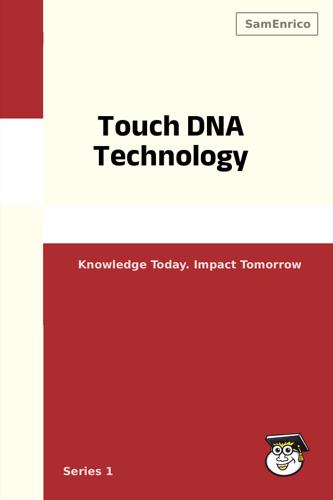
Non-FictionTrue CrimeTouch DNA
Touch DNA Technology eBook
How new testing revealed genetic material on cloth
by Miles Kim
How new testing revealed genetic material on clothing.
Formats
Free sample
Chapter 1: The Ghost in the Fabric...--The first time Detective Robert Galloway understood that he had been looking at evidence all wrong, he was standing in a fluorescent-lit evidence locker in downtown Baltimore, holding a pair of blue jeans that had been folded inside a paper bag for nineteen years. The jeans belonged to a murder victim, a twenty-three-year-old graduate student named Teresa, who had been found strangled in her apartment in 1996. The case had gone cold before Galloway had even joined the force. The original investigators had done everything right by the standards of their time. They had sealed the scene.
They had photographed every room. They had collected the jeans because there was a faint brownish stain on the left thigh that looked like dried coffee. They had tested the stain. It was coffee. So they had folded the jeans, bagged them, logged them, and shelved them.
For nineteen years, those jeans sat in the dark, waiting for a technology that did not yet exist to ask a question no one knew to ask.Galloway was not a forensic scientist. He was a cold case detective, the kind of man who spent his days reading autopsy reports from the Clinton administration and interviewing witnesses who had long since moved away and forgotten names. But in 2015, he had attended a two-day training seminar on something called "touch DNA." The instructor, a fast-talking forensic biologist from Virginia, had projected a photograph of a glass doorknob onto a screen and asked the room of seasoned detectives a simple question: "If a person touches this doorknob for three seconds, how many skin cells do they leave behind?" Galloway had guessed a hundred. Another detective guessed a thousand. The instructor smiled and clicked to the next slide.
The answer was six. Six microscopic skin cells, invisible to the naked eye, smaller than a grain of pollen. And those six cells, the instructor said, contained enough DNA to generate a full genetic profile. Galloway had felt the floor shift beneath his feet. For two decades, he had been looking for blood, for semen, for saliva—for the visible mess of violence.
He had been ignoring the invisible dust of everyday contact.That dust, he would learn, was everywhere. And it was about to crack the oldest case in his file.The Silent Crime Scene Before we can understand the revolution of touch DNA, we must first understand what came before. And what came before, by any honest measure, was a forensic dark age. For most of criminal justice history, investigators treated clothing as a surface for visible stains. A shirt was interesting only if it bore blood.
A pair of pants was evidence only if it showed semen. A jacket was worth bagging only if it had a bullet hole or a tear consistent with a struggle. The fabric itself—the woven landscape of cotton, wool, polyester, and denim—was considered inert. It was a canvas, not a reservoir.This blindness was not born of laziness. It was born of technological limitation.
Before the 1990s, the most advanced forensic tool for analyzing biological evidence was serology—the study of bodily fluids. If a stain looked like blood, a technician could perform a presumptive test (chemicals that turned pink in the presence of hemoglobin) and then, if they were lucky, an ABO blood typing test. That test could tell you whether the blood came from a person with Type A, Type B, Type AB, or Type O. It could not tell you which person. Approximately forty-five percent of the population shares Type O blood.
A blood match, in other words, was barely better than a coin flip.Then there was hair microscopy. For decades, forensic analysts compared hairs found at crime scenes to hairs plucked from suspects, examining them under microscopes for matching characteristics: the thickness of the shaft, the pattern of the cuticle, the presence of pigment granules. Juries found this testimony deeply persuasive. Experts would use phrases like "microscopically indistinguishable" and "consistent with having originated from," which sounded like certainty. But in 2009, the National Academy of Sciences released a landmark report that eviscerated hair microscopy.
A subsequent FBI review found that in at least ninety-five percent of cases in which examiners had testified to microscopic hair matches, their testimony had been scientifically flawed. Dozens of wrongful convictions were overturned. Men had gone to prison for decades because a hair "looked like" theirs under a microscope.The most haunting example is the case of Kirk Odom, a young Black man in Washington, D.C., who was convicted of sexual assault in 1981 based largely on hair comparison testimony. An FBI analyst testified that a hair found on the victim's nightgown was "microscopically similar" to Odom's. Odom spent twenty-two years in prison.
In 2012, DNA testing—touch DNA testing, specifically—was performed on the nightgown. The hair did not belong to Odom. It belonged to the actual perpetrator, a serial offender who had never been a suspect. Odom was exonerated. The hair that sent him to prison had been sitting in an evidence locker for three decades, silently screaming the truth that no one had the tools to hear.This is the tragedy of the pre-DNA era.
It is not that investigators were corrupt or lazy. It is that they were blind. They could only see what their tools allowed them to see. And their tools showed them only the visible.The Locard Exchange Principle, Waiting for Its Tool In 1910, a French forensic scientist named Edmond Locard proposed what would become the foundational axiom of forensic science: "Every contact leaves a trace." Locard argued that when two objects touch, they exchange microscopic material. A criminal may wipe down a weapon, but they cannot eliminate every particle of dust, every fragment of fiber, every invisible cell.
The crime scene is a web of exchanges, and the investigator's job is to read it.Locard was a visionary. He was also, by the standards of his time, largely impractical. He had no way to identify the traces he theorized. He could see fibers under a microscope. He could catalog pollen grains.
But he could not distinguish one person's skin cells from another's. The principle was beautiful. The tool did not exist.For most of the twentieth century, forensic science limped along in this gap between theory and practice. The tools improved incrementally. Gas chromatography could separate chemical compounds.
Electrophoresis could sort proteins by size. But the fundamental problem remained: human identification required a unique biological signature, and the only unique signatures known were fingerprints and, in theory, DNA. Fingerprints had to be visible or dusted into visibility. DNA required a visible stain.Clothing, as a result, was systematically underutilized. If a garment had no visible stain, it was often not collected at all.
If it was collected, it was stored without urgency. And if it was tested, it was tested only for blood type or, in rare cases, for enzyme markers that were even less discriminating than blood. The fabric itself—the woven matrix of fibers that touches every part of the body—was treated as irrelevant.Think about that for a moment. Every piece of clothing you wear comes into direct contact…
This is the end of the free sample. Get the eBook to keep going. Buy now
About this book
Details
- Author
- Miles Kim
- Publisher
- SamEnrico
- Language
- English
- Genre
- Non-Fiction, True Crime, Touch DNA
- Released
- 2026-06-07
- Pages (approx.)
- 139
- Available as
- eBook, Audiobook

Read better in the ZLOADR app
Your eBooks on your phone or tablet. Sign in with your SamEnrico account and start reading.
More by Miles Kim
 Self Hypnosis for Fear of SuffocationMiles Kim$11.99
 Post Divorce Identity GuideMiles Kim$11.99
 Foreign Correspondent PTSDMiles Kim$11.99
 YouTube Hypnosis ChannelMiles Kim$11.99
 The Teen DBT Regulation GuideMiles Kim$11.99
 MMR Vaccine Safety HandbookMiles Kim$11.99
 Presbycusis Hearing GuideMiles Kim$11.99
 The Poisoned Fields of Carthage: Hannibal's Deadly Gambit in the Second Punic WarMiles Kim$11.99
 Neon Genesis: The Birth of a Digital GodMiles Kim$11.99
 How to Produce SeitanMiles Kim$11.99
 How to Produce FluxMiles Kim$11.99
 A Collector's Handbook to the Bentley Continental S2Miles Kim$11.99
You may also like
 Hong Kong Handover 1997Dunn Johnnie$11.99
 Zumba For Postnatal Recovery CourseNeal Christian$11.99
 Zumba for BeginnersLadner Nikia$11.99
 YouTube Comment Mining GuideHumes Pandora$12.99
 Worry Box MeditationCarlin Rudy$11.99
 Workplace Stress MeditationNguyen Lynn$11.99
 Workplace Stress and Sleep RepairHawley Ivory$11.99
 Workplace Perfectionism CureDelaney Jeffry$11.99
 Workplace Injustice Anger GuideWallen Isabelle$11.99
 Work Addiction and Burnout LinkGreenwood Ester$11.99
 Women in Yoga and WellnessBeattie Galina$11.99
 Women in Stand Up ComedyChun Evangeline$11.99