
Non-FictionInformativeEducational
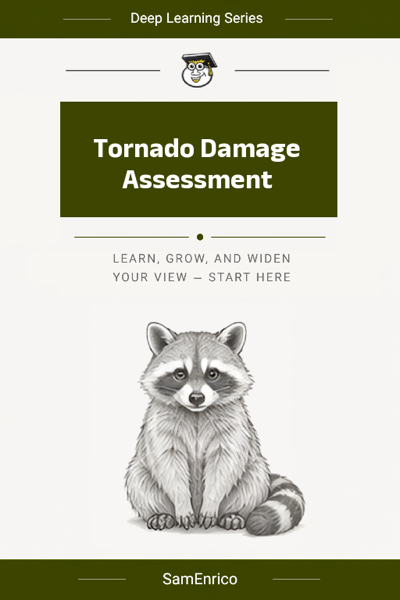
Tornado Damage Assessment eBook
A Coursebook on Tornado Damage Assessment
by Yu Britney
A Coursebook on Tornado Damage Assessment
Formats
Free sample
Chapter 1: The Invisible Crusher...–- On a clear April afternoon in 2011, a two-story brick home in Tuscaloosa, Alabama, stood with its family sheltering in an interior hallway. Forty-five seconds later, that same home existed as a debris field scattered across three counties. The family survived. The house did not. When the damage assessment team arrived twenty-three hours later, they found something puzzling: the reinforced concrete foundation slab had been swept completely clean, yet a single unbroken wine glass sat on what remained of the fireplace hearth.
That wine glass—delicate, fragile, untouched—became a forensic clue. It told the surveyors that the house had not been crushed by weight or shattered by impact. Instead, it had been unzipped by pressure differentials so violent that the structure essentially exploded outward, leaving behind only items too light or too low to catch the horizontal wind. The wine glass was not luck. It was physics.
And understanding that physics is the first step toward becoming a competent tornado damage assessor.This chapter is not an introduction in the conventional sense. It will not summarize the chapters to follow or provide a polite academic preamble. Instead, this chapter will do three things that every working damage assessor must master before stepping into the field. First, it will rewire how you think about wind itself—not as a uniform force but as a chaotic, rotating, translating vortex that loads structures in ways that straight-line wind engineering cannot predict. Second, it will explain why the original Fujita Scale failed and how the Enhanced Fujita Scale corrected those failures, a history that every surveyor must know to defend ratings in court, in scientific literature, and before grieving families.
Third, it will introduce the fundamental concept of the Damage Indicator—the architectural and biological “witnesses” that tell the story of wind speed—while establishing the dual identity of the damage assessor as both structural engineer and forensic meteorologist. By the end of this chapter, you will never look at a damaged building the same way again. You will see load paths, pressure gradients, and failure sequences where others see only rubble.The Critical Difference Between Synoptic and Non-Synoptic Wind Before any discussion of damage assessment can proceed, a fundamental distinction must be drawn—one that separates this field from conventional wind engineering. Most building codes, including the widely adopted ASCE 7 standard, are calibrated for synoptic wind events: hurricanes, extratropical cyclones, and large-scale thunderstorms that produce straight-line winds. Synoptic winds are relatively predictable in their behavior.
They blow from a consistent direction over an extended period, their gust profiles follow established probability distributions, and their loads on structures can be modeled with reasonable accuracy in wind tunnels.Tornadoes are not synoptic winds. They are non-synoptic vortices. This distinction matters not as academic jargon but as a practical reality that determines whether a building survives or fails. A tornado’s wind field rotates around a central axis while simultaneously translating across the landscape. This dual motion creates three simultaneous loading conditions that no straight-line wind produces.
First, there is tangential velocity—the rotating component that can exceed 300 miles per hour in extreme events. Second, there is translational velocity—the forward movement of the entire vortex, typically 30 to 60 miles per hour. Third, and most destructively, there is the radial pressure gradient: a dramatic drop in atmospheric pressure at the vortex center that can reach 100 millibars or more below ambient.To understand why this pressure drop matters, consider a sealed building. When the tornado vortex passes directly overhead, the external atmospheric pressure plunges. If the building envelope remains intact—windows closed, doors shut, garage door secure—the internal pressure remains at pre-storm ambient levels.
The resulting pressure differential, with higher internal pressure pushing outward against lower external pressure, creates an explosive uplift force on the roof. This is not wind pushing down or against the structure. It is the building trying to blow itself apart from the inside. Structural engineers sometimes call this the “pressure pot” effect. Survivors describe it as the moment the house “breathed out” before disintegrating.Conversely, if the building envelope is breached early—a window breaks, a garage door fails, a gable end collapses—the internal pressure rapidly equalizes with the external vortex pressure.
But now a different mechanism takes over. Wind rushes into the building through the breach, pressurizes the interior, and then seeks an exit path, often lifting the roof off from below. This is internal pressurization, a term that will appear repeatedly throughout this coursebook. The timing of the breach determines the failure mode. A breach that occurs before the vortex center arrives allows pressure equalization and reduces explosive loads but creates wind-driven internal flow.
A breach that occurs after the pressure drop has peaked can trigger the explosive failure.No straight-line wind event produces these dynamics. Hurricane winds, however powerful, do not create a 100-millibar pressure drop over a building in three seconds. Derechos do not generate suction vortices that dance around a main vortex. Downbursts, though capable of producing straight-line winds exceeding 100 miles per hour, lack the rotational component that creates torsional loading on rectangular structures. The damage assessor who applies synoptic wind logic to a tornado will make catastrophic errors in EF rating.
That is why this chapter begins with fluid dynamics rather than field protocols. You cannot assess what you do not understand.The Evolution of Damage Scales: From Fujita to Enhanced Fujita Every damage assessor must know the history of their primary tool—the wind damage scale—because that history explains why the current scale works the way it does and, more importantly, why the original scale produced systematic errors that sent communities into rebuilding cycles based on flawed intensity estimates.Dr. T. Theodore Fujita, a Japanese-American meteorologist at the University of Chicago, introduced the original Fujita Scale in 1971. Fujita was a genius of forensic meteorology.
He mapped tornado damage paths by walking entire tracks, photographing every damaged structure, and drawing hand-annotated maps that remain masterpieces of scientific observation. His scale ranged from F0 (light damage, 40-72 mph) to F5 (incredible damage, 261-318 mph). For nearly three decades, the F-scale served as the global standard for tornado intensity classification.The scale had one fatal flaw. Fujita derived his wind speed estimates from engineering calculations based on an implicit assumption: that all structures were built to approximately the same standards. That assumption was reasonable for Japan in 1971.
It was catastrophically wrong for the United States, where construction quality varies dramatically by region, by building code adoption, by income level, and by historical era. An F4 rating in rural Mississippi might correspond to the same observed damage as an F2 rating in suburban Dallas simply because the Mississippi home lacked roof anchoring that was standard in Texas. The scale was rating construction quality, not wind speed.The problem became undeniable after the 1997 Jarrell, Texas tornado. Jarrell produced damage that every surveyor agreed was F5 by any reasonable application of the original scale. Homes were swept from their foundations with such violence that concrete slabs were scoured clean and pavement was marred by debris impacts.
Yet when engineers analyzed the construction of the destroyed homes, they found minimal anchoring and substandard nailing patterns. The same…
This is the end of the free sample. Get the eBook to keep going. Buy now
About this book
Details
- Author
- Yu Britney
- Publisher
- SamEnrico
- Language
- English
- Genre
- Non-Fiction, Informative, Educational
- Released
- 2026-05-09
- Pages (approx.)
- 153
- Available as
- eBook, Audiobook

Read better in the ZLOADR app
Your eBooks on your phone or tablet. Sign in with your SamEnrico account and start reading.
More by Yu Britney
 Flow for WritersYu Britney$11.99
 Don Messick Boo Boo VoiceYu Britney$11.99
 Friendship Under Stress GuideYu Britney$11.99
 Lapse vs Collapse Binge GuideYu Britney$11.99
 The Cognitive Restructuring Weight GuideYu Britney$11.99
 Whispers of the Celestial Weaver: The Lost Art of the Silk Road StorytellersYu Britney$11.99
 Understanding Westphall DiseaseYu Britney$17.99
 How to Start a Bleaching and Dyeing of Yarns Business (Beginners Guide)Yu Britney$11.99
 Running a Startup on Hard ModeYu Britney$12.99
 Ghana Customer AcquisitionYu Britney$12.99
You may also like
 Hong Kong Handover 1997Dunn Johnnie$11.99
 Zumba For Postnatal Recovery CourseNeal Christian$11.99
 Zumba for BeginnersLadner Nikia$11.99
 YouTube Comment Mining GuideHumes Pandora$12.99
 Worry Box MeditationCarlin Rudy$11.99
 Workplace Stress MeditationNguyen Lynn$11.99
 Workplace Stress and Sleep RepairHawley Ivory$11.99
 Workplace Perfectionism CureDelaney Jeffry$11.99
 Workplace Injustice Anger GuideWallen Isabelle$11.99
 Work Addiction and Burnout LinkGreenwood Ester$11.99
 Women in Yoga and WellnessBeattie Galina$11.99
 Women in Stand Up ComedyChun Evangeline$11.99