
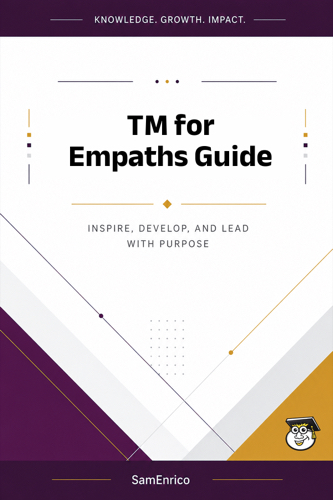
TM for Empaths Guide eBook
Protects against absorbing others' emotions.
Protects against absorbing others' emotions.
Formats
Free sample
Chapter 1: The Emotional Sponge...--–- By the time you finish reading this chapter, you will have absorbed at least one emotion that doesn't belong to you. The person in the room with you—or the memory of someone you spoke to hours ago—is leaking emotional data into your nervous system right now. You think you're just tired, or anxious, or inexplicably sad. But what if you're not actually feeling your own feelings? What if you've been walking through life as an emotional sponge, unknowingly soaking up the stress, grief, and chaos of everyone around you?This is not a metaphor.
This is neuroscience.You are about to discover why you feel exhausted after parties, why you can't watch the news without feeling physically ill, why certain people leave you drained after five minutes, and why you've been told your entire life that you're "too sensitive" as if that were a flaw. By the end of this chapter, you will have a name for what you've been experiencing, a framework for understanding it, and the first concrete step toward turning your sensitivity from a source of suffering into a superpower.Welcome to the first chapter of TM for Empaths Guide: Protect Against Absorbing Others' Emotions. This is not a book about becoming numb. This is a book about becoming sovereign over your own emotional territory.The Coffee Shop Revelation Let me paint a scene that will feel familiar to you.It's Saturday morning. You wake up feeling fine—not great, not terrible, just neutral.
You decide to treat yourself to a coffee from that little shop downtown. You walk in. The line is manageable. The barista smiles. You order your usual.But something shifts.Within thirty seconds of standing in line, you feel a tightness in your chest.
Your shoulders creep up toward your ears. Your jaw clenches. You scan the room for a threat and find none. No one is yelling. No one is crying.
There's just a woman on her phone near the window, a man tapping his foot impatiently behind you, and a teenager staring at a laptop with a furrowed brow.By the time you get your coffee, you're fully anxious. You take it to go, walk back to your car, and sit in the driver's seat wondering what the hell just happened. You were fine twenty minutes ago. Now you feel like you're waiting for bad news that never arrives.You just experienced energetic absorption.The woman on the phone was having a quiet argument with her partner. The man behind you was late for a meeting and radiating urgency.
The teenager was failing a class and carrying a low-grade terror that he'd learned to hide. None of them said a word to you. None of them looked at you. And yet, you carried their emotions out of that coffee shop as if they were your own.This is not imagination. This is not weakness.
This is a specific, measurable phenomenon that happens when your nervous system is wired differently than most people's.Clinical Empathy vs. Energetic Absorption: The Crucial Distinction Before we go any further, we need to draw a line between two things that most people confuse.Clinical empathy is the cognitive ability to understand another person's perspective and feelings. It is what allows you to say, "I see that you're sad, and I can imagine what that might feel like for you." Clinical empathy does not require you to feel the other person's sadness. It requires you to recognize it. This is a skill.
It can be learned. It is generally a good thing.Energetic absorption is something else entirely. It is the somatic, involuntary taking-on of another person's emotional state as if it were happening to your own body. You don't just understand that someone is anxious. You become anxious.
Your heart races. Your stomach knots. Your thoughts race. You are not imagining their feeling—you are hosting it.Here is the distinction in practice:Clinical Empathy Energetic Absorption"I see you're hurting.""I am now hurting too."You feel compassion You feel identical symptoms You remain in your body You leave your body and enter theirs You can choose to engage or not It happens whether you want it or not Leaves you connected Leaves you exhausted Most people have both capacities to some degree. Empaths have a dramatically heightened capacity for energetic absorption—often at the expense of their own emotional stability.If you have ever said any of the following, you are likely an absorber, not just an empath:"I can't be in crowds.
I get overwhelmed for no reason.""I know when someone is lying before they open their mouth.""Walking into a room, I can tell if there's been an argument recently.""I feel physically ill after watching the news.""People always tell me their problems, even strangers.""I need hours alone after socializing to feel normal again.""I've been told I'm 'too sensitive' more times than I can count."None of these are character flaws. They are symptoms of a nervous system that does not reliably distinguish between self and other.The Neuroscience of the Emotional Sponge Let's talk about mirror neurons.Discovered in the 1990s by neuroscientist Giacomo Rizzolatti and his team at the University of Parma, mirror neurons are brain cells that fire both when you perform an action and when you observe someone else performing that same action. If you reach for a cup, certain neurons fire. If you watch someone else reach for a cup, many of the same neurons fire. Your brain simulates the action internally without you actually moving.This is why you flinch when you see someone get hit in a movie.
This is why yawning is contagious. This is why you feel your favorite athlete's pain when they twist an ankle on live television.For most people, mirror neurons create a simulation of another person's experience—a rough draft, a sketch, a suggestion. For empaths, research suggests that the mirror neuron system is hyperactive. The simulation doesn't stay a simulation. It becomes the real thing.When you see someone anxious, your brain doesn't just understand anxiety.
It produces anxiety. Your amygdala activates. Your cortisol rises. Your heart rate adjusts to match theirs. Your nervous system has essentially decided that their threat is your threat.Your body does not know the difference between your pain and your partner's pain.Let that land.If your partner comes home stressed from work, your body may begin producing the same stress hormones as if you had just lived their terrible day.
If your child is anxious about a test, your body may begin producing the same cortisol as if you were the one about to be tested. If a stranger on the bus is quietly grieving, your body may begin producing the same inflammatory markers as if you had just experienced a loss.You are not imagining this. You are not being dramatic. You are not weak. You are experiencing a genuine neurological phenomenon that has been documented in peer-reviewed research.The problem is not your sensitivity.
The problem is that no one ever gave you the instruction manual for how to manage it.The Container Metaphor: Why…
This is the end of the free sample. Get the eBook to keep going. Buy now
About this book
Details
- Author
- Sampson Marvella
- Publisher
- SamEnrico
- Language
- English
- Genre
- Non-Fiction, Self-Help
- Released
- 2026-06-06
- Pages (approx.)
- 154
- Available as
- eBook, Audiobook

Read better in the ZLOADR app
Your eBooks on your phone or tablet. Sign in with your SamEnrico account and start reading.
More by Sampson Marvella
 Jealousy in Later LifeSampson Marvella$11.99
 Common Listening Barriers GuideSampson Marvella$11.99
 The Romantic Jealousy GuideSampson Marvella$11.99
 Affirmations for Healthy EatingSampson Marvella$11.99
 The Silk and Steel Affair: How a Spy Seduced the Cold WarSampson Marvella$11.99
 Studio PhotographerSampson Marvella$11.99
 Distressed Invoice FactoringSampson Marvella$12.99
 ClickUp Free Replaces Jira GuideSampson Marvella$12.99
 Understanding Toriello–carey SyndromeSampson Marvella$17.99
 How to Start a Candles and Tapers (wholesale) Business (Beginners Guide)Sampson Marvella$11.99
You may also like
 Hong Kong Handover 1997Dunn Johnnie$11.99
 Zumba For Postnatal Recovery CourseNeal Christian$11.99
 Zumba for BeginnersLadner Nikia$11.99
 YouTube Comment Mining GuideHumes Pandora$12.99
 Worry Box MeditationCarlin Rudy$11.99
 Workplace Stress MeditationNguyen Lynn$11.99
 Workplace Stress and Sleep RepairHawley Ivory$11.99
 Workplace Perfectionism CureDelaney Jeffry$11.99
 Workplace Injustice Anger GuideWallen Isabelle$11.99
 Work Addiction and Burnout LinkGreenwood Ester$11.99
 Women in Yoga and WellnessBeattie Galina$11.99
 Women in Stand Up ComedyChun Evangeline$11.99