
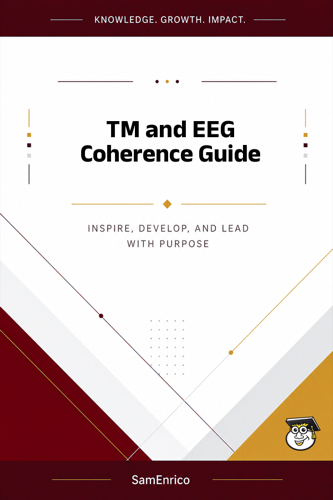
TM and EEG Coherence Guide
Measure brain wave synchronization during transcen
by Good Collene
Measure brain wave synchronization during transcendental meditation.
Formats
About this book
Free sample
Chapter 1: The Measurement Paradox--–- In the spring of 1967, a young researcher named R. Keith Wallace wheeled an electroencephalograph into a converted fraternity house at the University of California, Los Angeles. The machine was bulky, finicky, and prone to picking up radio signals from passing taxis. Wallace was attempting something that most neuroscientists considered either impossible or pointless: measuring what happens inside the brain of a person who claims to have transcended thought itself.The prevailing assumption at the time was simple. Meditation, if it did anything at all, merely relaxed the body.
Relaxation meant alpha waves. Alpha waves meant a calm, idling brain. Case closed. Why would anyone need to look further?Wallace's experiment changed everything. He attached electrodes to the scalps of a small group of practitioners of Transcendental Meditation, asked them to close their eyes, and recorded their brain activity for twenty minutes.
Then he asked them to continue sitting with eyes closed but to stop meditating. The difference between those two conditions—meditation versus simple rest—was subtle but unmistakable. During meditation, alpha waves did not merely increase. They organized themselves into patterns of remarkable synchrony across the frontal lobes.That synchrony, which Wallace could see but could not yet name with precision, would eventually become known as EEG coherence. And it would overturn the lazy assumption that meditation is just deep rest by another name.The Alpha Trap For decades, the public conversation about meditation and the brain has been dominated by a single, seductively simple idea: meditation increases alpha waves.
You have heard this claim in magazine articles, wellness podcasts, and even some scientific papers. Alpha waves, those leisurely oscillations between 8 and 12 cycles per second, are associated with wakeful relaxation. They rise when you close your eyes. They fall when you open them or concentrate on a difficult task. So when researchers saw alpha waves increasing during meditation, the conclusion seemed obvious: meditation relaxes you, and relaxation is the whole story.There is just one problem with this conclusion.
It is wrong.Not entirely wrong, but wrong enough to be misleading. Alpha waves do increase during Transcendental Meditation, especially in…
This is the end of the free sample. Get the eBook to keep going. Buy now
Contents
- Chapter 1
- Chapter 2
- Chapter 3
- Chapter 4
- Chapter 5
- Chapter 6
- Chapter 7
- Chapter 8
- Chapter 9
- Chapter 10
- Chapter 11
- Chapter 12
Details
- Author
- Good Collene
- Publisher
- SamEnrico
- Language
- English
- Genre
- Non-Fiction, Self-Help, EEG, Brain
- Released
- 2026-06-09
- Pages (approx.)
- 138
- Available as
- eBook, Audiobook

Read better in the ZLOADR app
Your eBooks on your phone or tablet. Sign in with your SamEnrico account and start reading.
More by Good Collene
 Creative Deprivation MethodGood Collene$11.99
 The Postpartum Bleeding GuideGood Collene$11.99
 The Assertiveness for Nurses GuideGood Collene$11.99
 Manager Anger Control GuideGood Collene$11.99
 The Iron Navigators: How Portugal Unlocked the WorldGood Collene$11.99
 Understanding Phacomatosis PigmentovascularisGood Collene$17.99
 How to Become a Commutator AssemblerGood Collene$11.99
 CRM Software Battle MapGood Collene$12.99
 One Page Plan for ConsultantsGood Collene$12.99
 Taylor Swift: The Eras Tour Record BreakerGood Collene$11.99
You may also like
 Hong Kong Handover 1997Dunn Johnnie$11.99
 Zumba For Postnatal Recovery CourseNeal Christian$11.99
 Zumba for BeginnersLadner Nikia$11.99
 YouTube Comment Mining GuideHumes Pandora$12.99
 Worry Box MeditationCarlin Rudy$11.99
 Workplace Stress MeditationNguyen Lynn$11.99
 Workplace Stress and Sleep RepairHawley Ivory$11.99
 Workplace Perfectionism CureDelaney Jeffry$11.99
 Workplace Injustice Anger GuideWallen Isabelle$11.99
 Work Addiction and Burnout LinkGreenwood Ester$11.99
 Women in Yoga and WellnessBeattie Galina$11.99
 Women in Stand Up ComedyChun Evangeline$11.99