
TM and Creativity eBook
Unlock creative potential by accessing deeper stat
by Carson Saul
Unlock creative potential by accessing deeper states of consciousness through TM.
Formats
Free sample
Chapter 1: The Effort Trap--–- The painter stared at the blank canvas for the seventh hour. Her hand ached. Her coffee had gone cold three cups ago. She had erased more than she had drawn, and the white rectangle in front of her had become an accusation rather than an invitation. She was trying.
She was trying so hard. And the harder she tried, the emptier the canvas became.This is the most destructive myth in creative work. It whispers to us in the quiet hours of the studio, the writer's room, the recording booth, the coding terminal. The myth says: You are not working hard enough. If you are stuck, you simply need to apply more effort.
Push through. Grind. Suffer for your art.The myth is wrong.What feels like a creative block is almost never a lack of effort. It is a surplus of neurological noise. And the solution is not to try harder.
The solution is to stop trying altogether—not by giving up, but by accessing a deeper state of consciousness where ideas arise effortlessly, like fish surfacing in still water after a storm has passed.This book is about that state. It is about Transcendental Meditation, a specific, scientifically validated technique for settling the mind into its quietest, most creative ground. But before we explore the mechanics of TM, before we look at brain scans and case studies and the testimony of some of the most creative people on the planet, we have to first dismantle the assumption that has been sabotaging you from the beginning.The assumption that effort equals results.Let me tell you a story.The Drowning Swimmer Imagine two people fall off a boat into rough water.The first swimmer thrashes. She kicks wildly, swings her arms, gasps for air. Every muscle is clenched.
Her heart pounds. She is trying to survive with every fiber of her being. And because she is trying so hard, because her body is rigid with effort, she exhausts herself in ninety seconds. Her oxygen burns up. Her muscles lock.
She sinks.The second swimmer, who has been trained in a different approach, does the opposite. She stops thrashing. She spreads her arms and legs, tilts her head back, and floats. Her breathing slows. Her muscles relax.
She expends almost no energy. She can float for hours. And when a rescue boat arrives, she has the strength to reach out and grab the line.This is not a metaphor about swimming. This is a metaphor about the creative mind.When you are stuck—when the deadline is looming, when the blank page is staring back, when the melody won't come, when the code won't compile, when the design feels dead—your instinct is to thrash. You work longer hours.
You drink more coffee. You stare harder at the problem. You run the same mental loops over and over, hoping that raw willpower will somehow crack the code.But raw willpower is the enemy of creative insight.Every time you "try harder," you activate what neuroscientists call the Executive Function Override. This is a stress response mediated by the prefrontal cortex—the part of your brain responsible for logical planning, impulse control, and focused attention. When you perceive a problem (a blank page, a missing chord, a plot hole), your prefrontal cortex clamps down.
It says: We need to solve this. Focus. Concentrate. Don't get distracted.And in doing so, it literally shuts down the very neural networks you need for creativity.The Neuroscience of "Trying"Let me explain what happens inside your skull when you "try harder."Your brain operates through a constant negotiation between different networks. The most important for our purposes are two: the Executive Control Network (ECN) and the Default Mode Network (DMN).The ECN is your task manager.
It activates when you need to focus on a specific goal—balancing your checkbook, following a recipe, solving a math problem. It is linear, logical, and effortful. It is essential for editing, pruning, and executing plans. But it is terrible at generating new ideas.The DMN, by contrast, is your imagination engine. It activates when you are daydreaming, reminiscing, or letting your mind wander.
It is associative, holistic, and effortless. It is the network that makes connections between seemingly unrelated memories, concepts, and sensations. It is the birthplace of the "Aha!" moment.Here is the problem. When you are under stress—when a deadline is approaching, when you have failed before, when the stakes feel high—your ECN goes into overdrive. It perceives the creative problem as a threat.
And like a security guard who has been told there is an intruder, it locks down the building.Specifically, the ECN inhibits the DMN. It says: No wandering. No daydreaming. We need to stay on task.This is the Executive Function Override. And it is catastrophic for creativity.Studies using functional magnetic resonance imaging (f MRI) have shown that when people are asked to solve a creative problem under time pressure, their DMN activity decreases significantly compared to when they are relaxed.
The harder they try, the less access they have to the very neural machinery that generates insight.This is why you have had the experience of struggling with a problem for hours, giving up in frustration, and then—while taking a shower, or walking the dog, or lying in bed half-asleep—the solution appears fully formed in your mind.You didn't think your way to the solution. You relaxed your way there.The Paradox of the Creative Block Let me say this as clearly as I can: Creative blocks are not a lack of ideas. They are a surplus of neurological noise.Think of your mind as a radio. When you are relaxed, the radio picks up a clear signal. The music—the ideas—come through effortlessly.
But when you are stressed, when you are "trying hard," the radio produces static. That static is the sound of your ECN overriding your DMN. It is the sound of rumination, anxiety, self-criticism, and the endless loop of "What if I fail?"Most people, when they hear static, turn up the volume. They try harder. They work longer.
They increase the pressure.This is exactly the wrong response.Turning up the volume does not reduce static. It amplifies it. The only way to hear the signal is to reduce the noise. And the only way to reduce the noise is to stop trying.This is the paradox at the heart of all genuine creativity. The effort that feels necessary—the grinding, the struggling, the forcing—is actually the barrier.
And the effortlessness that feels like giving up is actually the gateway.David Lynch, the filmmaker who has been practicing Transcendental Meditation for more than forty years, puts it this way in his book Catching the Big Fish:"Ideas are like fish. If you want to catch little fish, you can stay in the shallow water. But if you want to catch the big fish, you've got to go deeper. Down deep, the fish are more powerful and more pure. They're huge and abstract.
And they're very beautiful. You can catch them if you just go deep enough. But if you thrash around on…
This is the end of the free sample. Get the eBook to keep going. Buy now
About this book
Details
- Author
- Carson Saul
- Publisher
- SamEnrico
- Language
- English
- Genre
- Non-Fiction, Self-Help, Creativity
- Released
- 2026-06-10
- Pages (approx.)
- 147
- Available as
- eBook, Audiobook

Read better in the ZLOADR app
Your eBooks on your phone or tablet. Sign in with your SamEnrico account and start reading.
More by Carson Saul
 Inactivity Muscle Loss ReversalCarson Saul$11.99
 The MBSR Graduate GuideCarson Saul$11.99
 Indoor Air Quality Improvement GuideCarson Saul$11.99
 Breath for Natural DisastersCarson Saul$11.99
 All Three Food Intolerances GuideCarson Saul$11.99
 Ford Quotes GuideCarson Saul$11.99
 Arthritis Assistive Devices GuideCarson Saul$11.99
 Anger Stage of LossCarson Saul$11.99
 The Jade Serpent's Oath: A Dragon's Vow in the Celestial CourtCarson Saul$11.99
 The Secret Codebreakers: How a Teenage Girl Outsmarted the NazisCarson Saul$11.99
 The Last Diplomat: Siege of the U.S. Embassy in TehranCarson Saul$11.99
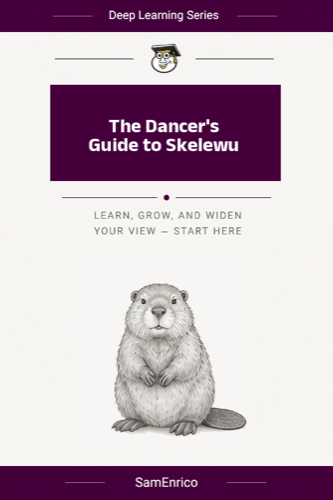 The Dancer's Guide to SkelewuCarson Saul$11.99
You may also like
 Trance for Creativity BoostEngel Colene$11.99
 Self Hypnosis for Creativity HabitsGerman Bernetta$11.99
 Mindfulness Meditation for Creativity BlockPage Duane$11.99
 Joyful Creativity Through GratitudeJacob Antoine$11.99
 Ideation Techniques For SolutionsKim Vincent$11.99
 Fear Of Failure In CreativityCrean Fairy$11.99
 EQ For Creative Professionals GuideGilley Elanor$11.99
 Creative Legacy GuideHooker Georgiana$11.99
 Alcoholism Recovery for Creative Souls WorkbookCompton Leota$11.99
 Creativity Trance MethodLy Morgan$11.99
 Creative Morning Routine GuideBetancourt Jacquelynn$11.99
 Walking Meditation For Creative BlockStevens Irvin$11.99