
Non-FictionSelf-HelpTime Management
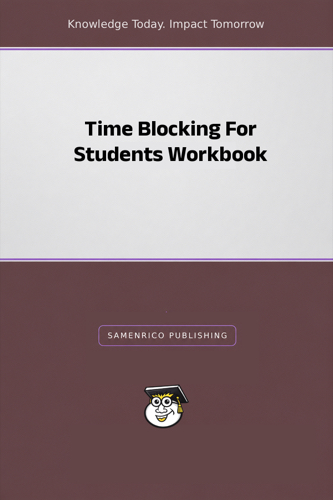
Time Blocking For Students Workbook eBook
Teaches scheduling study sessions, breaks, and rec
Teaches scheduling study sessions, breaks, and recreation to prevent overwhelm.
Formats
Free sample
Chapter 1: The Buried Hours--If you picked up this workbook, there is a very good chance that you feel busy all the time but somehow never get enough done. You wake up tired, rush from class to class, sit down to study for what feels like hours, and then look at the clock only to discover that the afternoon has vanished and you cannot remember a single thing you actually completed. You tell yourself that you just need to try harder, or that you are naturally disorganized, or that some people are born with time management skills and you are not one of them.That is all wrong.You are not lazy. You are not broken. You do not lack willpower.
What you lack is a clear picture of where your hours are actually going. And you cannot fix what you cannot see.This chapter is called The Buried Hours because most students are walking around with twenty to thirty hours per week that they cannot account for—hours that feel like work but produce nothing, hours that disappear into the cracks between classes, hours stolen by the tiny decision to check your phone for just five minutes. By the time you finish this chapter, you will have a precise, unarguable map of your own 168-hour week. You will know exactly where your time leaks are. And you will finally understand why you feel overwhelmed.Let us be clear about what this chapter is not.
It is not a lecture about how you should stop wasting time. It is not a guilt trip. It is a diagnostic tool, like an X-ray for your schedule. You would not expect a doctor to treat a broken bone without first seeing the image. You should not expect to fix your schedule without first seeing the data.
So put aside your shame about how you have been spending your time. That shame is not useful here. What is useful is curiosity.The 168-Hour Reality There are exactly 168 hours in a week. That is not a metaphor or an approximation. It is a mathematical fact.
Seven days times twenty-four hours. No matter how overwhelmed you feel, you have the same number of hours as every other student on your campus.Here is how those hours typically break down for a full-time college student. Sleep takes fifty-six hours if you get eight hours per night—and most students get less, which we will discuss later. Class time takes roughly fifteen hours for a full-time course load, though this varies by major and university. Personal care—showering, eating, dressing, bathroom—takes about ten hours per week.
That leaves eighty-seven hours. Eighty-seven hours for studying, socializing, exercising, working a part-time job, scrolling on your phone, staring at the ceiling wondering what is wrong with you, and everything else.The problem is not that you do not have enough hours. The problem is that you do not know where they go.Think about this for a moment. If someone asked you right now how many hours you studied last week, could you give an answer within two hours of the truth? Could you tell me exactly how much time you spent on your phone?
Could you account for the fifteen-minute gaps between classes, or the thirty minutes between when you finished dinner and when you started your homework? Most students cannot. They experience their time as a blur of busyness punctuated by panic. That blur is what we are going to clarify.The Psychology of Time Blindness There is a term in cognitive science for what you are experiencing. It is called time blindness.
It is the inability to accurately perceive how long tasks take and how much time has passed. Every human has some degree of time blindness, but students are particularly vulnerable because your days are fragmented into small chunks—fifty-minute classes, thirty-minute study sessions, ten-minute walks across campus. Each chunk feels insignificant on its own. But they add up.Here is what time blindness does to you. You sit down to write a paper.
You tell yourself it will take two hours. Six hours later, you are still on the first paragraph, and you have no idea where the afternoon went. You check your phone for five minutes, and when you look up, forty-five minutes have passed. You tell yourself you will study for three hours tomorrow, but when tomorrow comes, you only manage forty-five minutes of actual focus, and you genuinely believe you studied for three hours because you were sitting at your desk the whole time. You are not lying.
You are time blind.The antidote to time blindness is not willpower. You cannot will yourself to perceive time more accurately any more than you can will yourself to see in the dark. The antidote is measurement. You need an external tool that records time objectively, because your brain cannot do it.That tool is called a time log.The 168-Hour Audit: Your First Real Data Turn to the back of this workbook where you will find the 168-Hour Audit. It is a massive grid.
Seven days across the top. Twenty-four hours down the side. Each cell represents one hour of your life. Your job for the next seven days is to carry this grid with you everywhere and, at the end of every hour, write down exactly what you did.Not what you intended to do. Not what you wish you had done.
What you actually did.Here is the critical instruction. You must fill this out in real time. Do not wait until the end of the day. Do not rely on memory. Memory is exactly what we are trying to bypass.
Set an alarm on your phone for every hour if you have to. When the alarm goes off, take thirty seconds to jot down the dominant activity of the past hour. That is it. Thirty seconds. You can do that even in the middle of a lecture.At the end of the week, you will categorize each hour into one of four colors.Fixed Commitments are the things you cannot move.
Class time. Work shifts. Sleep. Scheduled appointments. These are your non-negotiables.
Color them blue.Study Time is any hour where you were actively engaged in academic work. Reading, writing, problem sets, reviewing notes, preparing for exams. Note the word actively. Sitting at your desk while scrolling your phone is not study time. Color these hours green.Transition and Chores include commuting, eating meals, showering, doing laundry, grocery shopping, cleaning your room, waiting in line.
These are the background activities that keep you alive and functional. Color them yellow.Distraction and Leisure is the catch-all for everything else. Social media, streaming video, video games, hanging out with friends without a specific goal, staring at your ceiling, stress-scrolling, group chats, You Tube spirals. Color these red.At the end of the week, you will count the hours in each color. That counting is where the truth lives.What the Audit Reveals I have watched hundreds of students complete this audit.
I can tell you with confidence what you are likely to find.First, you will almost certainly discover that you have far fewer…
This is the end of the free sample. Get the eBook to keep going. Buy now
About this book
Details
- Author
- Whatley Nancie
- Publisher
- SamEnrico
- Language
- English
- Genre
- Non-Fiction, Self-Help, Time Management
- Released
- 2026-06-11
- Pages (approx.)
- 130
- Available as
- eBook, Audiobook

Read better in the ZLOADR app
Your eBooks on your phone or tablet. Sign in with your SamEnrico account and start reading.
More by Whatley Nancie
 Gifted Child Burnout Recovery PlanWhatley Nancie$11.99
 Loving Kindness for Religious TraumaWhatley Nancie$11.99
 Writing Comparison on Social MediaWhatley Nancie$11.99
 Stretching for Dancers GuideWhatley Nancie$11.99
 The Iron Horse of Arabia: The Unbreakable Record of the 1932 Cairo MarathonWhatley Nancie$11.99
 Citation Rules for Philosophy PapersWhatley Nancie$12.99
 Project Management Impact MetricsWhatley Nancie$12.99
 Understanding Nanism Due to Growth Hormone ResistanceWhatley Nancie$17.99
 Dungeon MasterWhatley Nancie$11.99
 How to Start a Chintz Glazing Business (Beginners Guide)Whatley Nancie$11.99
You may also like
 Hong Kong Handover 1997Dunn Johnnie$11.99
 Zumba For Postnatal Recovery CourseNeal Christian$11.99
 Zumba for BeginnersLadner Nikia$11.99
 YouTube Comment Mining GuideHumes Pandora$12.99
 Worry Box MeditationCarlin Rudy$11.99
 Workplace Stress MeditationNguyen Lynn$11.99
 Workplace Stress and Sleep RepairHawley Ivory$11.99
 Workplace Perfectionism CureDelaney Jeffry$11.99
 Workplace Injustice Anger GuideWallen Isabelle$11.99
 Work Addiction and Burnout LinkGreenwood Ester$11.99
 Women in Yoga and WellnessBeattie Galina$11.99
 Women in Stand Up ComedyChun Evangeline$11.99