
Non-FictionSelf-HelpRetirement
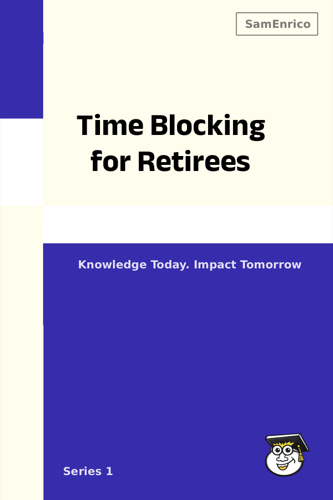
Time Blocking for Retirees eBook
Structure volunteer work hobbies and social time i
Structure volunteer work hobbies and social time in retirement.
Formats
Free sample
Chapter 1: The Work Hangover--–- The day you retire, everyone brings you cake and tells you how lucky you are. No one warns you about Tuesday afternoon of week three, when the laundry is done, the newspaper is read, and the clock on the microwave reads 2:47 PM. That is when the silence arrives. Not the peaceful kind of silence—the kind that feels like a stopped heart. You have spent forty-three years rushing toward deadlines, and now there is not a single deadline in sight.
You should feel free. Instead, you feel like a ghost wandering through your own living room.This is the Work Hangover. It is the most common, most unspoken, and most dangerous condition of early retirement. It is not depression in the clinical sense, though it can look like it. It is the psychological whiplash of losing the container that held your days together.
For decades, work provided structure without you having to think about it. Meetings, commutes, lunch hours, project deadlines, performance reviews, coffee breaks—these were the scaffolding of your waking life. You may have complained about the scaffolding. You may have dreamed of the day it would be removed. But scaffolding serves a purpose: it keeps the building from collapsing.
When it disappears overnight, the building does not dance with joy. The building sways.This chapter is about understanding that sway before it knocks you over. The goal is not to convince you that you made a mistake by retiring. The goal is to show you that what you are feeling—the aimlessness, the low-grade boredom, the strange sense of uselessness—is not a personal failing. It is a predictable, normal, even inevitable response to losing forty to fifty hours of forced structure every week.
And it has a cure. The cure is not to go back to work. The cure is to become the Chief Design Officer of your own life, building a new container that fits the person you are now, not the person your employer needed you to be.The Myth of Endless Leisure There is a fantasy that sells millions of retirement planning books every year. The fantasy goes like this: retirement is a permanent vacation. You will wake up late, drink coffee on the patio, read the entire stack of novels you have been saving, take up oil painting, travel to Tuscany, and never look at a spreadsheet again.
It sounds wonderful because it is a fantasy. And like most fantasies, it falls apart about three weeks into the reality.The problem with endless leisure is that leisure only feels good in contrast to labor. A day off is delicious because you earned it. A vacation is rejuvenating because you have somewhere to return from. When every day is a day off, no day is a day off.
The pleasure of sleeping in fades when sleeping in becomes the default. The joy of an afternoon nap disappears when you have nothing to be tired from. This is not a moral failing. It is neurological. The human brain is wired for cycles of effort and recovery, tension and release, goal and achievement.
When you remove the effort, the tension, and the goals, the brain does not feel peaceful. It feels lost.This is why so many retirees report feeling more tired in their first year of retirement than they ever felt while working. They are not tired from doing too much. They are tired from doing too little. The absence of meaningful structure creates a low-level anxiety that drains energy.
You spend your mornings wondering what to do. You spend your afternoons feeling guilty for not doing it. You spend your evenings scrolling through streaming services looking for something—anything—that feels worth watching. And then you go to bed wondering where the day went.This is the Work Hangover. And it has nothing to do with whether you loved your job or hated it.
People who loved their careers experience it because they miss the sense of purpose. People who hated their careers experience it because they never learned how to structure time without someone else telling them what to do. Either way, the result is the same: a calendar that is empty on paper and exhausting in practice.The Container Theory of Time To understand why retirement feels so disorienting, you need to understand what work actually gave you. Yes, it gave you money. Yes, it gave you identity and social status.
But beneath those obvious gifts, work gave you something more fundamental: a container.A container is any external structure that organizes your time without you having to make constant decisions. Before retirement, your container looked something like this:6:30 AM: Alarm. You do not decide to get up. The alarm decides for you.7:15 AM: Commute. You do not decide to leave the house.
The train schedule or traffic pattern decides for you.9:00 AM: First meeting. You do not decide to work. The calendar decides for you.12:00 PM: Lunch. You do not decide to eat. The lunch hour decides for you.5:00 PM: End of day.
You do not decide to stop. The workday decides for you.10:30 PM: Bedtime. You do not decide to sleep. The knowledge that you have to wake up at 6:30 AM decides for you.Notice what is happening here. Almost none of these decisions required active thought.
The container did the work of organizing your hours. This is not a bad thing. In fact, it is a very efficient thing. The human brain has limited decision-making capacity. When you offload hundreds of small decisions (when to wake, when to eat, when to work, when to rest) onto an external container, you free up mental energy for other things.
The problem is not that you had a container. The problem is that you did not build it yourself. Your employer built it for you. And when you retired, the container did not gently transform into something new. It vanished.Now you wake up and the alarm is silent.
Now you look at the clock and the commute is gone. Now you finish breakfast and there is no meeting waiting. Now you finish lunch and there is no afternoon deadline. The decision-making load that used to be handled by your employer is now entirely on your shoulders. Every hour of every day requires a choice.
And choices are exhausting.This is why so many retirees end up watching television for six hours a day. It is not because television is that good. It is because television is the default. When you cannot decide what to do, the path of least resistance—the activity that requires no decision at all—is to sit down and turn on the screen. Television becomes the accidental container.
And like most accidental containers, it is a terrible fit. It fills the hours without filling the soul.Why Structure Is Not the Enemy If you are like most retirees, the word "structure" makes you wince. You spent forty years inside someone else's structure. You lived by the bell. You answered to the calendar.
You scheduled your life around meetings that could have been emails. The idea of adding structure to retirement sounds like…
This is the end of the free sample. Get the eBook to keep going. Buy now
About this book
Details
- Author
- Elizondo Keira
- Publisher
- SamEnrico
- Language
- English
- Genre
- Non-Fiction, Self-Help, Retirement
- Released
- 2026-06-06
- Pages (approx.)
- 154
- Available as
- eBook, Audiobook

Read better in the ZLOADR app
Your eBooks on your phone or tablet. Sign in with your SamEnrico account and start reading.
More by Elizondo Keira
 Self Disclosure PersuasionElizondo Keira$11.99
 Instagram Engagement EnvyElizondo Keira$11.99
 US Executive Order on AI GuideElizondo Keira$11.99
 Perimenopause and Bipolar Disorder ManagementElizondo Keira$11.99
 The Unseen Victory: How a 19th-Century Nurse Outsmarted the British EmpireElizondo Keira$11.99
 Quality EngineerElizondo Keira$11.99
 Understanding Kaplan–plauchu–fitch SyndromeElizondo Keira$17.99
 How to Start a Burning Oil Business (Beginners Guide)Elizondo Keira$11.99
 European Talent Mobility GuideElizondo Keira$12.99
 Financial Scarcity Rewrite ManualElizondo Keira$12.99
You may also like
 Hong Kong Handover 1997Dunn Johnnie$11.99
 Zumba For Postnatal Recovery CourseNeal Christian$11.99
 Zumba for BeginnersLadner Nikia$11.99
 YouTube Comment Mining GuideHumes Pandora$12.99
 Worry Box MeditationCarlin Rudy$11.99
 Workplace Stress MeditationNguyen Lynn$11.99
 Workplace Stress and Sleep RepairHawley Ivory$11.99
 Workplace Perfectionism CureDelaney Jeffry$11.99
 Workplace Injustice Anger GuideWallen Isabelle$11.99
 Work Addiction and Burnout LinkGreenwood Ester$11.99
 Women in Yoga and WellnessBeattie Galina$11.99
 Women in Stand Up ComedyChun Evangeline$11.99