
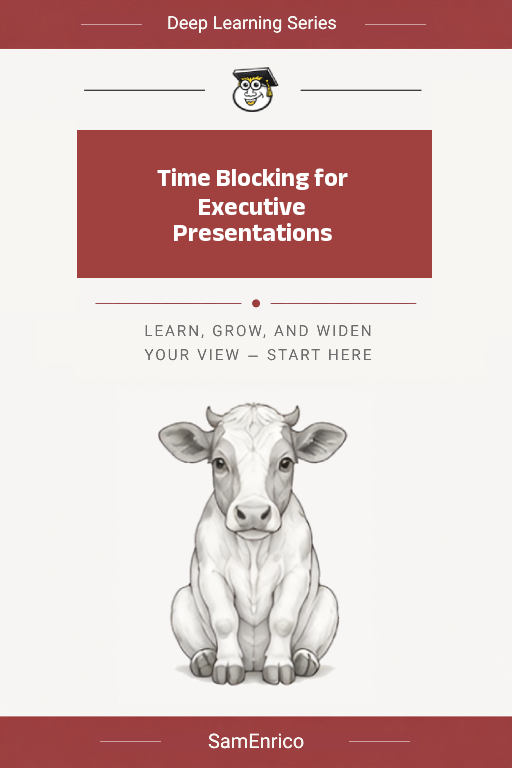
Non-FictionProfessional's Cheat SheetPresentation Prep
Time Blocking for Executive Presentations eBook
Reserves blocks for storyboarding, slide creation,
by Dugas Johnna
Reserves blocks for storyboarding, slide creation, and rehearsal, ensuring high-stakes presentations are thoroughly prepared.
Formats
Free sample
Chapter 1: The 25-Minute Betrayal--–- The first time it happened, I was thirty-two years old, sitting in a windowless conference room on the forty-seventh floor of a Manhattan skyscraper, watching a senior vice president named Carol destroy a career in real time.Carol had spent three weeks preparing her presentation. I knew this because I had seen the late-night emails, the Sunday afternoon Slack messages, the frantic text to an analyst at 11:47 PM asking for "just one more sensitivity analysis." She had done everything right by conventional standards. She had built forty-seven slides. She had rehearsed the transitions. She had memorized the first three minutes word for word.
She had even color-coded her speaker notes to match the company's branding guide.None of it mattered.The CEO walked in ninety seconds late, scrolled through her first slide without looking up, and asked: "What are you actually asking me to decide?"Carol froze. She looked at her notes. She looked at the slide. She looked at the CEO. She said, "Well, we've been analyzing the Q3 trends, and there are several factors to consider, and I think what we're seeing is—"He cut her off.
"I don't have time for several factors. I have seven minutes before my next call. Give me the decision."She couldn't. Not because she wasn't smart. Not because she hadn't done the work.
She couldn't because she had spent three weeks building slides and zero days figuring out how to say what she actually wanted in one clear sentence.The meeting ended seven minutes later. Carol's recommendation was never formally considered. Six months after that, she was gone. Not because of a single bad meeting—but because that meeting became the data point everyone remembered. "Carol can't present to the board." "Carol doesn't know what she wants." "Carol is not executive material."I sat in that room and thought: That could have been me.
That will be me, if I don't figure out what she did wrong.What Carol did wrong—and what nearly every executive does wrong, including me for the first decade of my career—was open Power Point before she had done the strategic thinking. She confused activity with progress. She believed that more slides meant more preparation. She thought that memorizing words was the same as owning the argument.She was wrong. And so are you, if you're reading this chapter and you have ever, even once, opened Power Point on a Sunday night to "get started" on a Monday morning presentation.This chapter is going to fix that.
Not with abstract advice. Not with motivational platitudes. With a specific, repeatable, 25-minute protocol that will force you to do the one thing that separates executives who get promoted from executives who get sidelined: state your recommendation in one sentence before you do anything else.The Anatomy of a High-Stakes Failure Let me tell you what actually happens when an executive opens Power Point first.It starts innocently enough. You have a presentation to deliver in two weeks. The topic is complex—maybe a new market entry, maybe a budget reallocation, maybe a strategic pivot.
You have data, you have opinions, you have a team that has done analysis. And you think: I should just get something on the page. I'll start with a title slide and an agenda, and the rest will come together.This is the single most dangerous thought in executive communication.Here is what actually happens after you open Power Point first. You spend twenty minutes choosing a template. You spend another thirty minutes writing an agenda that no one will read because agendas are for the presenter's comfort, not the audience's clarity.
You write a slide called "Background" and fill it with five bullet points of context that the CEO already knows. You write a slide called "Market Analysis" and paste in a chart that your analyst sent you, without really understanding whether that chart proves anything. You write a slide called "Recommendation" but you're not actually sure what the recommendation is yet, so you write something vague like "We recommend exploring strategic options."Then you run out of time. The meeting is tomorrow. You panic.
You add three more slides to cover the gaps you just noticed. You stay up until midnight tweaking fonts and aligning boxes. You wake up tired, caffeinate aggressively, and walk into the room hoping that your slides will do the talking for you.They won't. Slides don't talk. Slides don't persuade.
Slides don't answer questions. You do. Or you don't.This pattern—open Power Point, fill slides, notice gaps, add more slides, tweak formatting, sleep poorly, perform badly—is so common that it has a name in the research literature. I call it Presentational Procrastination. It is the act of doing low-cognitive-load work (arranging boxes, choosing fonts, pasting charts) to avoid high-cognitive-load work (figuring out what you actually want, why it matters, and what you need from the audience).Presentational Procrastination feels like progress.
It is not progress. It is the enemy of progress.The One-Sentence Rule The solution is absurdly simple, which is why almost no one does it.Before you open any presentation software, write your entire recommendation in one sentence.That's it. One sentence. Not a paragraph. Not a bulleted list.
Not a "well, it depends on several factors" qualification. One sentence that an eighth grader could read aloud and understand.Here is what that sentence must contain, using the RAPID Protocol that will structure every chapter of this book:R - Recommendation: What exactly are you asking the audience to do or decide? Be specific. "Improve our supply chain" is not a recommendation. "Approve $2.3 million to renegotiate our three largest freight contracts" is a recommendation.A - Audience: Who needs to act on this recommendation?
Name them. "The executive committee" is too vague. "The CFO and the head of operations" is specific.P - Position: Why are you the right person to make this recommendation? What authority or expertise do you bring? "As head of logistics for eighteen months, I've analyzed every contract" establishes credibility.I - Impact: What happens if the audience approves your recommendation?
Be specific about the outcome. "This will reduce Q4 freight costs by 12 percent, saving $1.2 million."D - Decision: What exactly do you need from the audience? A vote? A signature? A verbal commitment?
"I need the CFO to sign the contract release by Friday."Put together, a RAPID one-sentence recommendation looks like this:"I recommend that the CFO and head of operations approve 2.3milliontorenegotiateourthreelargestfreightcontracts,whichwillreduce Q4freightcostsby12percentandsave2.3 million to renegotiate our three largest freight contracts, which will reduce Q4 freight costs by 12 percent and save 2.3milliontorenegotiateourthreelargestfreightcontracts,whichwillreduce Q4freightcostsby12percentandsave1.2 million, based on my analysis of eighteen months of logistics data, and I need the CFO's signature by Friday."That sentence is twenty-eight words. It took me forty-five seconds to write. It contains everything the audience needs to know to make a decision. Everything else—the charts, the context, the analysis—is supporting evidence for that sentence.If you cannot write that sentence, you are not ready to open Power Point. And you will not be ready tomorrow, or the day after, until you do the hard work of figuring out what…
This is the end of the free sample. Get the eBook to keep going. Buy now
About this book
Details
- Author
- Dugas Johnna
- Publisher
- SamEnrico
- Language
- English
- Genre
- Non-Fiction, Professional's Cheat Sheet, Presentation Prep
- Released
- 2026-05-29
- Pages (approx.)
- 158
- Available as
- eBook, Audiobook

Read better in the ZLOADR app
Your eBooks on your phone or tablet. Sign in with your SamEnrico account and start reading.
More by Dugas Johnna
 AI Attendance Tracker GuideDugas Johnna$11.99
 Heat Exposure and HGHDugas Johnna$11.99
 Italian Immigrant Food DynastyDugas Johnna$11.99
 Parental Anger Self Care GuideDugas Johnna$11.99
 The Eisenhower Matrix for Social Media ManagersDugas Johnna$11.99
 The Siege of Khiva: The Last Stand of the Silk RoadDugas Johnna$11.99
 Understanding Medrano Roldan SyndromeDugas Johnna$17.99
 How to Become a Net MakerDugas Johnna$11.99
 USA Raise Tax ImplicationsDugas Johnna$12.99
 Product Marketing ManagerDugas Johnna$11.99
You may also like
 Hong Kong Handover 1997Dunn Johnnie$11.99
 Zumba For Postnatal Recovery CourseNeal Christian$11.99
 Zumba for BeginnersLadner Nikia$11.99
 YouTube Comment Mining GuideHumes Pandora$12.99
 Worry Box MeditationCarlin Rudy$11.99
 Workplace Stress MeditationNguyen Lynn$11.99
 Workplace Stress and Sleep RepairHawley Ivory$11.99
 Workplace Perfectionism CureDelaney Jeffry$11.99
 Workplace Injustice Anger GuideWallen Isabelle$11.99
 Work Addiction and Burnout LinkGreenwood Ester$11.99
 Women in Yoga and WellnessBeattie Galina$11.99
 Women in Stand Up ComedyChun Evangeline$11.99