
Non-FictionProfessional's Cheat Sheet
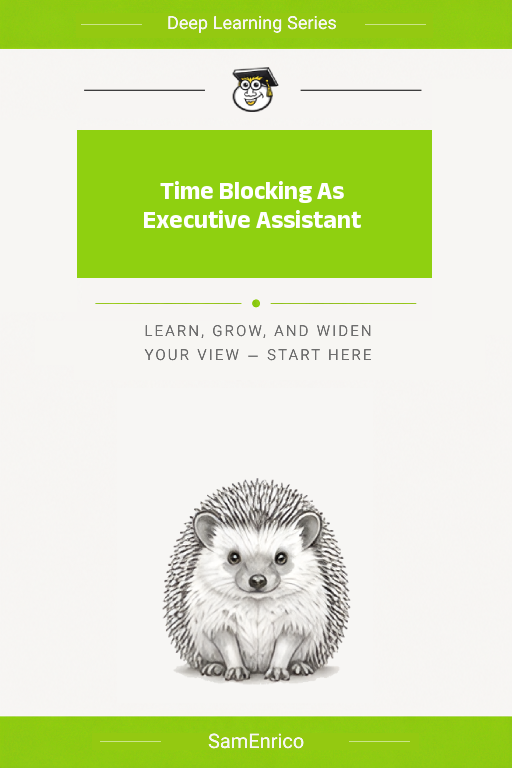
Time Blocking As Executive Assistant eBook
Delegate calendar blocking to your EA using these
Delegate calendar blocking to your EA using these instruction templates.
Formats
Free sample
Chapter 1: The Interruption Lie--–- By the time you finish reading this sentence, the average executive has already been interrupted at least once today. By the time you finish this paragraph, they will have lost approximately four minutes of focus that they will never get back. And by the time you finish this chapter, they will have forgotten what they were working on entirely.This is not hyperbole. This is mathematics.The average executive experiences between 50 and 80 interruptions per day. Some arrive as email pings.
Some as Slack messages. Some as a colleague tapping on the office door frame with the four most dangerous words in the English language: "Got a quick second?"Each interruption costs not just the thirty seconds or two minutes of the interruption itself. The real cost is the recovery time. Neuroscientists have known this for decades, though most executives have conveniently ignored it. When your brain is pulled away from a task, it does not simply resume where it left off.
It must reorient. It must remember what it was doing. It must suppress the intrusive thought that just arrived. This process takes, on average, twenty-three minutes.Twenty-three minutes.Do the math. Five interruptions per day – a conservative estimate for most executives – costs nearly two hours of lost cognitive processing.
Ten interruptions – closer to reality for a CEO or senior leader – costs nearly four hours. That is not time spent in meetings. That is not time spent on email. That is time that simply evaporates, like steam from a kettle, leaving behind only the vague sense of exhaustion that every executive knows but few can explain.Here is the lie that most time management books tell you: you can fix this yourself. They will give you systems.
They will give you templates. They will tell you to turn off notifications, batch your email, and learn to say no. All of this is true. All of this is useless. Because you are an executive, and you do not control your own calendar.
Your stakeholders do. Your team does. The client who "just needs five minutes" does. Your brain may belong to you, but your schedule belongs to everyone else.This chapter is about admitting that truth. And then doing something about it.The Invention of the "Quick Second"Let us examine the anatomy of a typical interruption, because understanding its structure is the first step to dismantling it.The interruption begins with a request.
That request almost always contains an implicit assumption of urgency. "Got a quick second?" is not a question. It is a demand dressed in casual clothing. The correct answer – "No, I do not have a quick second, and even if I did, that second would cost me twenty-three minutes of cognitive recovery" – is socially impossible to say. So you say yes.
You smile. You invite the interruption in.The interruption then expands to fill the time available. Parkinson's Law applies to interruptions as ruthlessly as it applies to meetings. A "quick second" becomes five minutes. Five minutes becomes fifteen.
Fifteen becomes a derailed afternoon. And the person who interrupted you walks away feeling productive, having "gotten an answer," while you are left staring at your screen, unable to remember what you were doing before they arrived.This pattern repeats eight to twelve times per day for the average executive. That is not a guess. That is the data from decades of workplace observation studies. Researchers have followed executives around with stopwatches.
They have tracked every knock, every ping, every "quick question." What they found is almost comical in its consistency: executives spend an average of just eleven minutes on any single task before being interrupted. Eleven minutes. Then the phone buzzes. Then the door opens. Then the Slack notification appears.After the interruption, it takes an average of twenty-three minutes to return to the same level of cognitive focus.
But here is the cruel twist: by the time those twenty-three minutes have passed, another interruption has usually arrived. The executive never fully returns. They bounce from one shallow engagement to the next, producing the appearance of activity without the reality of progress.This is the interrupted life. And it is the default state of most executives in the modern workplace.The Permission Paradox Why do executives tolerate this? The answer is uncomfortable but necessary to confront.
Executives tolerate interruptions because they have been trained to believe that availability equals effectiveness.The executive who always answers email within five minutes is praised as responsive. The executive who always says yes to meeting requests is praised as collaborative. The executive whose door is always open is praised as accessible. These are not neutral descriptions. They are performance metrics, explicitly or implicitly enforced by organizational culture.
The executive who does not respond quickly is labeled difficult. The executive who declines meetings is labeled political. The executive who closes their door is labeled inaccessible.The interruption is not an accident. It is a feature of a system that rewards reactivity over strategy.This creates the permission paradox. You, the executive, have the formal authority to say no.
No one can force you to accept a meeting. No one can force you to answer a Slack message at 9:47 AM. You have the power. But you do not have the permission. The culture has not granted you the social license to protect your time.
And so you continue to say yes, not because you want to, but because the cost of saying no – in social capital, in perceived responsiveness, in organizational politics – feels higher than the cost of the interruption itself.This is where the Executive Assistant enters the story. Not as a scheduler. Not as an administrator. But as the one person in the organization who can say no on your behalf without paying the social penalty.The EA does not need to be liked by your colleagues. The EA does not need to be perceived as responsive.
The EA's job is not to be popular. The EA's job is to protect your time. When the EA says, "My executive is in a focus block until 11 AM and cannot be interrupted," the social cost falls on the EA, not on you. You remain the responsive, collaborative, accessible leader. The EA becomes the necessary bad cop.This is not delegation of tasks.
This is delegation of permission. And it is the single most underutilized tool in executive productivity.The Arithmetic of Waste Let us make this concrete, because abstractions are comforting and numbers are not.Take your calendar from the past two weeks. Count the number of meetings you attended. Now count how many of those meetings had a clear agenda distributed in advance, a designated decision-maker, and a written outcome. Be honest.
The average executive finds that fewer than forty percent of their meetings meet these three criteria.Now calculate the time spent in meetings without agendas. The average executive spends approximately twelve hours per week in meetings that lack a clear purpose. That is twelve hours. Every week. Five hundred hours per year.
That is the equivalent of twelve and a half full workweeks. Three months of your working life, every year, sitting in meetings that…
This is the end of the free sample. Get the eBook to keep going. Buy now
About this book
Details
- Author
- Fitzsimmons Refugia
- Publisher
- SamEnrico
- Language
- English
- Genre
- Non-Fiction, Professional's Cheat Sheet
- Released
- 2026-05-30
- Pages (approx.)
- 137
- Available as
- eBook, Audiobook

Read better in the ZLOADR app
Your eBooks on your phone or tablet. Sign in with your SamEnrico account and start reading.
More by Fitzsimmons Refugia
 TM for Postpartum DepressionFitzsimmons Refugia$11.99
 IoT Device Data Breach ScriptsFitzsimmons Refugia$11.99
 The Nun Who Became AbbessFitzsimmons Refugia$11.99
 Strength Training For RunnersFitzsimmons Refugia$11.99
 Crohn's Microbiome SupportFitzsimmons Refugia$11.99
 Growing Up Without ElectricityFitzsimmons Refugia$11.99
 Executive Team Burnout RiskFitzsimmons Refugia$11.99
 Teen Step Meeting GuideFitzsimmons Refugia$11.99
 Antony BlinkenFitzsimmons Refugia$11.99
 Tides of the Forgotten: The Ghost Fleet of the SargassoFitzsimmons Refugia$11.99
 The Feast of the Oxford Scholars: A Banquet of EnlightenmentFitzsimmons Refugia$11.99
 Frozen Echoes: The Mystery of the Vanishing Arctic ResearchersFitzsimmons Refugia$11.99
You may also like
 Hong Kong Handover 1997Dunn Johnnie$11.99
 Zumba For Postnatal Recovery CourseNeal Christian$11.99
 Zumba for BeginnersLadner Nikia$11.99
 YouTube Comment Mining GuideHumes Pandora$12.99
 Worry Box MeditationCarlin Rudy$11.99
 Workplace Stress MeditationNguyen Lynn$11.99
 Workplace Stress and Sleep RepairHawley Ivory$11.99
 Workplace Perfectionism CureDelaney Jeffry$11.99
 Workplace Injustice Anger GuideWallen Isabelle$11.99
 Work Addiction and Burnout LinkGreenwood Ester$11.99
 Women in Yoga and WellnessBeattie Galina$11.99
 Women in Stand Up ComedyChun Evangeline$11.99