
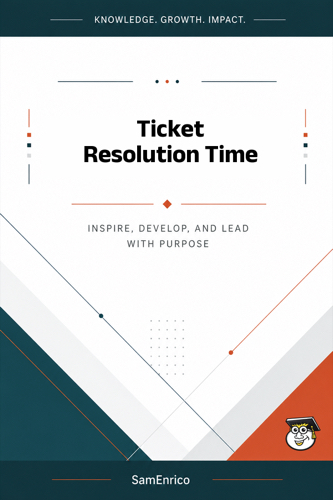
Non-FictionBusiness BriefSupport Metrics
Ticket Resolution Time eBook
Measure support and ops productivity remotely.
Measure support and ops productivity remotely.
Formats
Free sample
Chapter 1: The 8-Hour Fallacy--–- The first lie we tell ourselves is that time equals output. The second lie is that watching someone work makes them work better. Together, these two lies have cost remote support organizations billions of dollars in lost productivity, burned-out agents, and churned customers. This chapter dismantles both lies and introduces a new way of measuring what actually matters.On a Tuesday morning in March 2020, almost every support operations manager in the world woke up to the same nightmare. The bullpen was empty.
The visible reassurance of twenty heads bent over dual monitors, the ambient noise of typing and muffled phone conversations, the ability to tap a shoulder and say "got a sec?"—all of it vanished overnight. In its place came a grid of faces on a Zoom call, green status dots in Slack, and a gnawing, existential question: Is anyone actually working?What happened next reveals everything that is wrong with how we measure productivity. Managers who had spent years preaching about "outcome-based management" quietly installed time-tracking software. They asked agents to log their hours in fifteen-minute increments. They ran reports on "active time" in the helpdesk.
They measured keystrokes and mouse movements. And then they watched, bewildered, as ticket resolution times climbed, customer satisfaction scores dropped, and their best agents submitted resignations.The problem was not the agents. The problem was not remote work. The problem was that the old metrics—the ones that felt reassuringly concrete in an office—became not just useless but actively destructive the moment the team went home.This chapter dismantles the traditional "butts in seats" approach to productivity measurement and introduces a new framework built for the remote-first era. We will explore why the eight-hour workday is a fiction, how legacy metrics like Average Handle Time become toxic under surveillance, and why outcome-based measurement is the only path forward.
By the end of this chapter, you will understand why your current dashboards are lying to you—and what to do about it.The Great Unspoken Truth of Remote Work Let us begin with a radical proposition: most knowledge workers have never been productive for eight hours in a single day. Not in the office. Not anywhere. The difference is that in the office, the theater of productivity—the appearance of busyness—was convincing enough to fool managers. At home, the theater collapsed.The 8-Hour Fallacy is the assumption that an employee who is scheduled to work eight hours actually delivers eight hours of value.
This assumption has never survived contact with reality. Research on knowledge work consistently shows that the human brain is capable of approximately three to four hours of truly focused, high-cognitive-load work per day. The remaining hours are filled with administrative tasks, meetings that could have been emails, social interaction, coffee breaks, and the low-grade ambient distraction that comes from being in a shared space.In the office, these non-productive periods are invisible because they are normalized. A ten-minute chat at someone's desk is "collaboration." A thirty-minute lunch is "team building." The fifteen minutes spent walking to the conference room and setting up the projector is just "how meetings work." But when an agent is at home and takes fifteen minutes to do laundry between tickets, that same interval becomes suspicious. Why?
Because the manager cannot see the laundry. They can only see the gap.This asymmetry—the visibility of idle time at home versus the invisibility of idle time in the office—is the source of nearly all remote productivity paranoia. And it leads managers to make catastrophic errors.The Surveillance Trap When managers feel blind, their first instinct is to install cameras. Not literal cameras (usually), but digital equivalents: time-tracking software, activity monitors, keystroke loggers, screenshot capturers, and "productivity score" algorithms that claim to measure focus. These tools sell themselves on a simple promise: Now you can see what your employees are really doing.What they actually deliver is a disaster.Consider a typical agent named Priya.
Before the pandemic, Priya worked in a bullpen. She arrived at 9:00 AM, spent the first fifteen minutes making tea and chatting with her neighbor, started tickets at 9:15, took a proper lunch break at noon, spent thirty minutes in the afternoon helping a junior agent, and left at 5:30 PM. Over the course of a full day, she resolved thirty-two tickets. Her manager was happy.Now Priya works from home. She arrives at her desk at 8:45 AM, logs into the helpdesk immediately, and starts working.
She skips lunch to handle an urgent escalation. She stays online until 6:00 PM to cover a colleague in a different time zone. Her manager installs activity monitoring software and discovers that Priya has "idle time" totaling two hours across the day—bathroom breaks, a quick call with her child's school, fifteen minutes to eat dinner. The software reports that Priya is only 75% "productive." Her manager schedules a performance review.Priya resolved forty-one tickets that day—nine more than her office average. But the monitoring software does not see tickets.
It sees gaps. And it punishes her for being human.This is the Surveillance Trap: the more you monitor activity, the less you measure actual productivity. Agents who know they are being watched optimize for the metrics being watched. If the software tracks keystrokes, they type more. If it tracks mouse movements, they wiggle the mouse.
If it tracks "active time," they never mark themselves away. They become actors in a play about productivity, and the real work—solving customer problems—becomes secondary.The damage goes beyond wasted time. Surveillance destroys trust. And trust, as we will see throughout this book, is the currency of remote operations. When agents feel watched, they become risk-averse, less collaborative, and more likely to hide problems.
They stop asking for help because asking for help looks like idle time. They stop experimenting with better solutions because failure looks like inefficiency. They stop caring about customers because the only thing being measured is their own compliance.Why Average Handle Time Becomes Toxic at Home No metric has caused more damage to remote support organizations than Average Handle Time (AHT) . For those unfamiliar: AHT is the average duration from the moment an agent accepts a ticket (or answers a call) to the moment they close it. In call centers, AHT was a useful operational metric because calls were discrete, sequential, and highly structured.
In modern support—especially remote support—AHT is a weapon of self-destruction.Here is why.When agents work from home, they lose the ambient coaching of the office. In a bullpen, if an agent is stuck on a ticket for forty-five minutes, a senior agent or manager might notice and offer help. The clock is visible to everyone. This social pressure is uncomfortable but often productive. At home, that pressure vanishes.
The only remaining pressure comes from the metrics themselves.When an agent sees their AHT climbing, they face a choice. The right choice is to ask for help, research the problem thoroughly, or escalate to a specialist. The fast choice is to close the ticket with a partial solution, a template response, or a deflection. Under surveillance, the fast choice becomes irresistible.We see this pattern repeatedly…
This is the end of the free sample. Get the eBook to keep going. Buy now
About this book
Details
- Author
- Starkey Jacqui
- Publisher
- SamEnrico
- Language
- English
- Genre
- Non-Fiction, Business Brief, Support Metrics
- Released
- 2026-06-10
- Pages (approx.)
- 145
- Available as
- eBook, Audiobook

Read better in the ZLOADR app
Your eBooks on your phone or tablet. Sign in with your SamEnrico account and start reading.
More by Starkey Jacqui
 The Money Secret Telling GuideStarkey Jacqui$11.99
 Governor's Presidential RunStarkey Jacqui$11.99
 Parent Self Care Emergency KitStarkey Jacqui$11.99
 Thyroid and SkinStarkey Jacqui$11.99
 Microbiome After ColonoscopyStarkey Jacqui$11.99
 Sleep And PTSD MemoryStarkey Jacqui$11.99
 Crisis Leadership for HospitalsStarkey Jacqui$11.99
 Boundary Reinforcement GuideStarkey Jacqui$11.99
 Blood and Steel: The Mamluks' Last Stand at Marj DabiqStarkey Jacqui$11.99
 The Opium War: Britain's Gunboat Diplomacy and the Fall of the QingStarkey Jacqui$11.99
 Frozen Shadows: The Mystery of the 1937 Arctic AirshipStarkey Jacqui$11.99
 The Mineral Guide to Hanksite, From Searles Lake.Starkey Jacqui$11.99
You may also like
 Hong Kong Handover 1997Dunn Johnnie$11.99
 Zumba For Postnatal Recovery CourseNeal Christian$11.99
 Zumba for BeginnersLadner Nikia$11.99
 YouTube Comment Mining GuideHumes Pandora$12.99
 Worry Box MeditationCarlin Rudy$11.99
 Workplace Stress MeditationNguyen Lynn$11.99
 Workplace Stress and Sleep RepairHawley Ivory$11.99
 Workplace Perfectionism CureDelaney Jeffry$11.99
 Workplace Injustice Anger GuideWallen Isabelle$11.99
 Work Addiction and Burnout LinkGreenwood Ester$11.99
 Women in Yoga and WellnessBeattie Galina$11.99
 Women in Stand Up ComedyChun Evangeline$11.99