
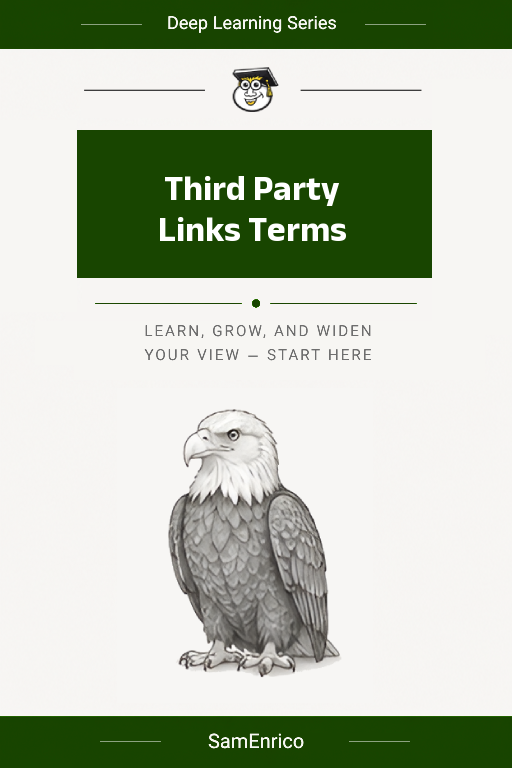
Third Party Links Terms eBook
Write disclaimer clauses for third-party links in
Write disclaimer clauses for third-party links in your terms of service with no endorsement statements and external site policies.
Formats
Free sample
Chapter 1: The Broken Link Audit--–- The email arrived at 2:47 PM on a Tuesday. Sarah Chen, founder of a mid-sized parenting blog called "Gentle Days," had built her business over seven years. She employed twelve writers, served two million monthly visitors, and had never once thought about the 14,000 outbound links scattered across her domain. The email's subject line read: "Summons to Appear – Superior Court of California." A reader had clicked her link to a "safe sleep product," the product had malfunctioned, and the jury was asking a devastating question: Why did YOU send them there?Sarah's story is not unique. It is the quiet nightmare of the modern web.
Every website owner believes their liability ends at their own domain border. You create content, you publish it, you are responsible for it. That much is intuitive. But the hyperlink—that humble blue underline—creates a legal wormhole. When you link to another site, courts increasingly ask whether you have vouched for what lies on the other side.
And the answer, as Sarah discovered, is often yes.This chapter is not about drafting clauses. It is not about legal language or FTC compliance. Those come later. This chapter is about something more fundamental: knowing what you actually own. Before you can protect yourself, you must know what links exist on your site, where they lead, and how they got there.
Most website owners cannot answer these questions. The ones who can are the ones who survive the lawsuit.The Custodian of the Gate Theory Why would a plaintiff sue the linker instead of the linked? The answer is simple economics. The site that posted the link usually has visible assets, an insurance policy, and a registered business address. The site being linked to might be anonymous, offshore, or judgment-proof.
Lawyers call this the "Custodian of the Gate" theory: you placed the gateway on your property, so you are responsible for who walks through it.Consider the anatomy of a typical link lawsuit. A user clicks an outbound link from your site. They encounter harmful content, a defective product, malware, or defamatory statements. Their attorney files suit. They name two defendants: the site that created the harmful content (hard to find, often overseas) and your site (easy to find, has insurance, employs people).
Your attorney files a motion to dismiss, arguing that you merely provided a link. The judge looks at the jury instructions. The jury looks at your terms of service. And then they ask one question: Did the user have any reason to believe you had vetted this destination?The most dangerous moment in any link lawsuit is the discovery phase. This is when the plaintiff's attorney requests all internal documents, communications, and policies related to your linking practices.
Sarah Chen's attorney made that request. What they found was devastating: no link policy, no audit logs, no disclaimer clause, and a Word Press plugin that had been automatically creating affiliate links for three years without anyone's knowledge.The "Custodian of the Gate" theory turns on a single word: control. If you control the gate, you control who enters. And if you control who enters, you are responsible for what they find. But what does "control" mean in the context of a hyperlink?
The answer is emerging from courtrooms across the country, and it is not favorable to website owners.The 500,000 Dollar Link Let us examine Sarah Chen's case in detail, because it contains every mistake a website owner can make. Gentle Days was a parenting blog focused on infant safety. Sarah's most popular post was "The Ultimate Safe Sleep Guide," which reviewed five bassinets, three breathing monitors, and two wearable blankets. Each product recommendation included an outbound link to the manufacturer's website. This was standard practice in the parenting blogger community.The problem arose with the wearable blanket.
Sarah had linked to a small manufacturer called "Cozy Sleep." The link was a standard hyperlink: "Click here to buy the Cozy Sleep Wearable Blanket." At the time Sarah posted the link, Cozy Sleep was a legitimate business with positive reviews. Six months later, Cozy Sleep was purchased by a private equity firm that cut costs by using substandard materials. The wearable blanket began to overheat. A one-year-old child suffered second-degree burns. The parents sued everyone in the distribution chain, including Gentle Days.Sarah's attorney filed a motion to dismiss, arguing that she was not the manufacturer, distributor, or retailer.
She was just a blogger who wrote a review. The judge denied the motion. The reasoning: Sarah's review included statements like "the safest blanket we have found" and "we recommend this product to our readers." The link was presented not as a neutral reference but as an endorsement. The jury would have to decide whether Sarah had "actively linked" or "passively linked."The case settled for 500,000.Sarah′sinsurancecovered500,000. Sarah's insurance covered 500,000.Sarah′sinsurancecovered300,000.
She paid the remaining $200,000 from her savings. Gentle Days closed six months later. The blog's final post was a single sentence: "We are no longer publishing new content."The lesson is not that you should never link to products. The lesson is that you cannot afford to be ignorant of your links. Sarah did not know about the private equity acquisition.
She did not know the product had changed. She did not have a policy for re-auditing old links. She did not have a disclaimer clause that might have shifted liability. She was flying blind, and it cost her everything.The Difference Between Hyperlinks, Deep Links, and Embedded Links Before you can audit your links, you must understand what you are looking for. Not all links are created equal in the eyes of the law.
The technical implementation of a link can determine your liability exposure. This section breaks down the three primary types of links you will encounter.Standard Hyperlinks A standard hyperlink is the familiar blue underlined text that takes the user from one webpage to another. Legally, standard hyperlinks are the lowest risk because they are the most clearly understood as navigation. When a user sees a standard hyperlink, they generally understand that they are leaving your site and entering another. However, the context of the hyperlink matters enormously.
A hyperlink embedded in a sentence like "I love this product" is more dangerous than a hyperlink in a resource list labeled "External Links."Deep Links A deep link bypasses a website's homepage and takes the user directly to an internal page. For example, linking directly to a product page on Amazon instead of Amazon.com. Deep links are moderately more risky than standard hyperlinks because they can circumvent terms of service, paywalls, or age gates. Some websites explicitly prohibit deep linking in their terms. If you deep link to a page that requires a user to agree to terms, and your link bypasses that agreement, you may be liable for tortious interference with contract.
A real case from 2018 involved a ticketing reseller that deep-linked to venue seating charts, bypassing the venue's terms of service. The venue sued and won $350,000.Embedded Links (Inline Links)An embedded link pulls content from a third party and displays it as if it were part of your own page. The most…
This is the end of the free sample. Get the eBook to keep going. Buy now
About this book
Details
- Author
- Samples Carie
- Publisher
- SamEnrico
- Language
- English
- Genre
- Non-Fiction, First 30 Days
- Released
- 2026-06-01
- Pages (approx.)
- 147
- Available as
- eBook, Audiobook

Read better in the ZLOADR app
Your eBooks on your phone or tablet. Sign in with your SamEnrico account and start reading.
More by Samples Carie
 Elastic Cloud Outage GuideSamples Carie$11.99
 Effortless Transcending TechniqueSamples Carie$11.99
 The Anki Flashcard Memory GuideSamples Carie$11.99
 Selling Inherited Property in RetirementSamples Carie$11.99
 Work Stress Spillover PreventionSamples Carie$11.99
 Starlight Odyssey: The Lost Mission of Pioneer 10Samples Carie$11.99Starlight Odyssey: The Lost Mission of Pioneer 10Samples Carie$11.99
 Queue ManagementSamples Carie$11.99
 Understanding W SyndromeSamples Carie$17.99
 Startup Visa Community GuideSamples Carie$12.99
 How to Start a Basins Made of Fibre-cement Business (Beginners Guide)Samples Carie$11.99
You may also like
 Hong Kong Handover 1997Dunn Johnnie$11.99
 Zumba For Postnatal Recovery CourseNeal Christian$11.99
 Zumba for BeginnersLadner Nikia$11.99
 YouTube Comment Mining GuideHumes Pandora$12.99
 Worry Box MeditationCarlin Rudy$11.99
 Workplace Stress MeditationNguyen Lynn$11.99
 Workplace Stress and Sleep RepairHawley Ivory$11.99
 Workplace Perfectionism CureDelaney Jeffry$11.99
 Workplace Injustice Anger GuideWallen Isabelle$11.99
 Work Addiction and Burnout LinkGreenwood Ester$11.99
 Women in Yoga and WellnessBeattie Galina$11.99
 Women in Stand Up ComedyChun Evangeline$11.99