
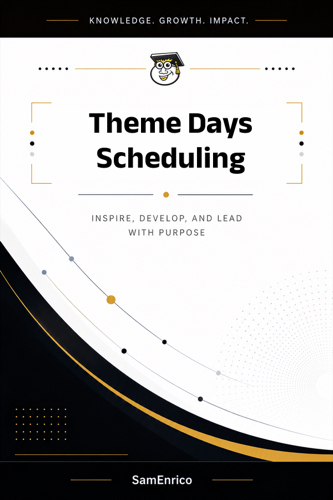
Non-FictionSelf-HelpTheme Days
Theme Days Scheduling eBook
Assign each weekday a focus area to batch work and
by Durr Glynda
Assign each weekday a focus area to batch work and reduce decision fatigue.
Formats
Free sample
Chapter 1: The Monday Morning Lie...--It is 8:47 AM on a Monday. You have been “working” for forty-seven minutes. In that time, you have opened your email three times, replied to two messages, glanced at a report your boss sent on Friday, remembered you need to schedule a dentist appointment, texted your partner about dinner, switched to a spreadsheet, realized you forgot what you were looking for, switched back to email, found a Slack message from a colleague asking for “five minutes of your time,” spent twenty minutes on a video call that could have been an email, hung up, and now—staring at your screen—you cannot remember what you were doing before the call.You are exhausted. It is not yet 9:00 AM.If this feels familiar, you are not lazy, undisciplined, or bad at your job. You are suffering from something far more insidious: the belief that a “generalist day”—a day where you jump between different types of tasks, contexts, and cognitive demands—is normal, efficient, and even virtuous.
This is the Monday Morning Lie, and it is costing you hours of productivity, elevating your stress levels, and making you feel perpetually behind even when you are working constantly.This book exists to replace that lie with a simpler, more humane, and radically more effective truth: one theme per day. No more. No less.But before we get to the solution—before we talk about batching, flow states, and the perfect Tuesday—we must first understand the enemy. And the enemy is not your inbox, your colleagues, or your demanding schedule. The enemy is context switching.The Anatomy of a Switch Let us define our terms with precision.
Context switching is the act of shifting your attention from one type of task to another. This is different from multitasking (which is the attempt to do two things simultaneously). Context switching is sequential: you stop Task A, you move to Task B, and then—often—you return to Task A.Seems harmless, does it not? After all, how hard can it be to stop writing an email and start reviewing a spreadsheet?The answer, revealed by decades of cognitive psychology research, is: very hard. When you switch contexts, your brain does not simply “pause” one task and “resume” another.
Instead, it must perform a sequence of invisible, expensive operations:Goal shifting: “I am going to stop working on the report and instead answer this message.”Rule activation: “I am now pulling up the rules and knowledge for answering messages, not for writing reports.”Attention residue: A portion of your focus remains stuck on the previous task, like a drop of water clinging to a surface after you think you have emptied the cup.It is this third element—attention residue—that does the most damage. In a landmark study published in Organizational Behavior and Human Decision Processes, researcher Sophie Leroy found that when people switch away from an incomplete task, their subsequent performance on the new task suffers significantly. Why? Because their attention is divided. Part of their brain is still thinking about the first task: what was left undone, what they need to remember, what they will do when they return to it.Leroy’s study quantified the cost.
Participants who switched tasks before completing the first one performed substantially worse on the second task than those who completed the first task before switching. And the effect persisted even after the switch.In other words, you do not recover from a context switch the moment you start the new task. The residue lingers. And if you switch again—and again—the residue accumulates, like layers of dust on a window, until you can barely see through to the work in front of you.The 23-Minute Truth How long does it take to fully recover from a context switch? The most frequently cited figure in productivity literature—often attributed to a study at the University of California, Irvine—is approximately 23 minutes.Let me repeat that: twenty-three minutes.After a single interruption or switch, it takes an average of twenty-three minutes to return to the same depth of focus you had before the switch.
This is not the time to “get back to work.” This is the time for your brain to fully disengage the residue of the previous task and re-engage the cognitive architecture required for the current one.Now do the math.Suppose you switch contexts fifteen times in a day. That is a conservative estimate for many knowledge workers, who switch tasks as often as every three to five minutes by some measures. Fifteen switches multiplied by twenty-three minutes of recovery time equals 345 minutes—nearly six hours of lost focus per day.Six hours.You are not working an eight-hour day. You are spending six hours recovering from switches and two hours actually working, but the recovery feels like work, so you go home exhausted, convinced you were busy all day, with nothing substantial to show for it.This is not a productivity problem. This is a structural problem with how you are scheduling your time.The Myth of the Generalist Day Why do we tolerate this?
Why do we arrange our days as chaotic jumbles of unrelated tasks—email, then creative work, then a meeting, then administration, then a call, then strategy—as if variety were a virtue?The answer lies in a deep-seated cultural belief that I call the Myth of the Generalist Day. This myth holds three things to be true:Variety is stimulating. Switching between different types of work keeps you fresh and engaged.Responsiveness is productivity. Answering every email, Slack message, and request as they arrive is a sign of diligence.The “busy” feeling is accurate. If you feel busy, you must be productive.All three are false.First, variety is not stimulating; it is exhausting.
The brain craves coherence—the ability to stay within a single cognitive domain long enough to achieve flow. Switching for the sake of variety is like changing the channel every thirty seconds and claiming you are watching television.Second, responsiveness is not productivity. Responding to an email the moment it arrives may make you feel responsive, but it fragments your attention and prevents you from doing the deep work that actually moves the needle. The most productive people in almost every field are not the most responsive; they are the most protective of their focus.Third, the “busy” feeling is a liar. Your brain produces a sense of busyness when you switch tasks rapidly because each switch triggers a small burst of adrenaline—a mini-crisis response.
You feel alert, engaged, even urgent. But that feeling is not a signal of productivity. It is a signal of fragmentation. A marathon runner does not feel “busy” every thirty seconds. A runner feels focused, steady, and in rhythm.
So, too, should your workday feel.The generalist day is a cultural inheritance from a time before knowledge work existed. Factory workers could switch between tasks because the tasks were physical and low-cognition. A line worker who stops screwing bolts to answer a question about inventory loses only the seconds of the interruption. There is no “attention residue” when the task requires…
This is the end of the free sample. Get the eBook to keep going. Buy now
About this book
Details
- Author
- Durr Glynda
- Publisher
- SamEnrico
- Language
- English
- Genre
- Non-Fiction, Self-Help, Theme Days
- Released
- 2026-06-06
- Pages (approx.)
- 140
- Available as
- eBook, Audiobook

Read better in the ZLOADR app
Your eBooks on your phone or tablet. Sign in with your SamEnrico account and start reading.
More by Durr Glynda
 Senior Housing Tax DeductionsDurr Glynda$11.99
 Parenting Trigger ManagementDurr Glynda$11.99
 Sam Sheppard Death And MysteryDurr Glynda$11.99
 Hookah and Shisha Toxin GuideDurr Glynda$11.99
 Neurotech Investment MapDurr Glynda$11.99
 The Elevator Pitch BlueprintDurr Glynda$11.99
 Tinnitus Hypnosis ScriptsDurr Glynda$11.99
 Customer Service AngerDurr Glynda$11.99
 Gold, Guns, and Ghosts: The Cursed 1968 Mexico City OlympicsDurr Glynda$11.99
 Steel and Secrets: The Golden Spike ConspiracyDurr Glynda$11.99
 Quetzalcoatl's Feathers: The Serpent's Divine FlightDurr Glynda$11.99
 PayPal Business and Mass PayoutsDurr Glynda$11.99
You may also like
 Hong Kong Handover 1997Dunn Johnnie$11.99
 Zumba For Postnatal Recovery CourseNeal Christian$11.99
 Zumba for BeginnersLadner Nikia$11.99
 YouTube Comment Mining GuideHumes Pandora$12.99
 Worry Box MeditationCarlin Rudy$11.99
 Workplace Stress MeditationNguyen Lynn$11.99
 Workplace Stress and Sleep RepairHawley Ivory$11.99
 Workplace Perfectionism CureDelaney Jeffry$11.99
 Workplace Injustice Anger GuideWallen Isabelle$11.99
 Work Addiction and Burnout LinkGreenwood Ester$11.99
 Women in Yoga and WellnessBeattie Galina$11.99
 Women in Stand Up ComedyChun Evangeline$11.99