
Non-FictionNon-Obvious CareerEthics
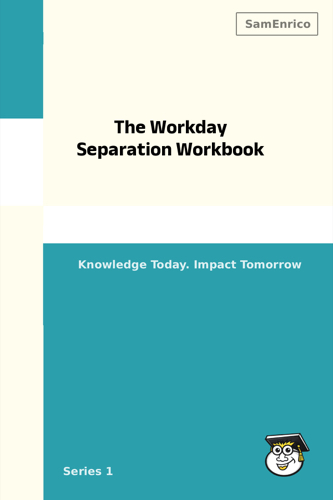
The Workday Separation Workbook eBook
Keep freelance work completely separate from emplo
Keep freelance work completely separate from employer time, devices, and intellectual property.
Formats
Free sample
Chapter 1: The Loyalty Lie...--–- Every morning, millions of professionals clock in and sell their time. Every evening, millions more clock out and sell their skills again—to different clients, on different projects, under different names. Between these two worlds lies a fault line that most workers never see until the ground opens beneath them.The fault line is invisible because it runs through something we rarely examine: the employment contract. We sign it on our first day, sometimes without reading it, always without negotiating it. We file it away and forget it exists.
Years later, when our side business has grown into something real—something with paying clients, recurring revenue, and actual value—that forgotten document reaches up from the filing cabinet and swallows everything we built.This chapter is about what that document actually says. Not what we hope it says. Not what feels fair. What it says.The Case of the Disappearing App Let me tell you about someone I'll call Priya. Priya was a senior product manager at a midsize software company in Austin, Texas.
She had worked there for six years. Her performance reviews were excellent. Her manager trusted her with high-visibility projects. She was on track for a promotion to director.Outside work, Priya was building a meal-planning app for families with food allergies. Her daughter had been diagnosed with a severe peanut allergy the previous year, and Priya had struggled to find reliable tools for managing safe meals.
So she built her own. She coded on weekends. She designed the interface on weekday evenings after her daughter went to sleep. She paid for a freelance developer on Upwork to help with the database architecture. She spent about fifteen thousand dollars of her savings on the project.Priya was careful.
She never used her work laptop for the app. She never wrote a line of code during work hours. She never discussed the app with colleagues. She kept everything on her personal Mac Book, her personal Git Hub account, her personal cloud storage. She was the model of what a responsible side hustler should be.One Tuesday, Priya's manager asked her to join a call with someone from the legal department.
Priya assumed it was about the upcoming product launch. It was not.The legal department had discovered that Priya's meal-planning app used a database structure similar to something her employer had patented three years earlier. The similarity was not exact—Priya had never seen the patent, and her implementation was independently developed—but it was close enough to trigger an intellectual property review. The company's invention assignment clause, which Priya had signed without reading on her first day, granted her employer ownership of any intellectual property "related to the Company's current or anticipated business."The meal-planning app had nothing to do with her employer's enterprise software. But the legal department argued that "anticipated business" could include consumer applications—the company had considered building a consumer product years ago, though they never did.
Based on that tenuous connection, the company claimed ownership of Priya's app.Priya fought back. She hired a lawyer. The lawyer cost her twelve thousand dollars—nearly all of her savings beyond what she had already invested in the app. After six months of legal back-and-forth, Priya settled. She kept the app but gave her employer a perpetual, royalty-free license to use any of its intellectual property.
The app launched, but investors balked when they learned that another company had a license to Priya's code. The funding fell through. The app died.Priya still works at the same company. She was passed over for the promotion. Her manager, who had supported her before the dispute, now treats her with cautious distance.
She does not freelance anymore.Priya's story is not unusual. It is not even extreme. It is the standard outcome when a dual professional runs into an invention assignment clause without a separation strategy. The employer has the money, the lawyers, and the signed agreement. The employee has a dream and a sense of unfairness.
Unfairness does not win legal disputes.The Anatomy of an Invention Assignment Clause Invention assignment clauses appear in nearly every employment agreement for professional, technical, and creative roles. They are standard. They are also, for freelancers, the most dangerous paragraph in the document.A typical invention assignment clause reads something like this:"Employee agrees that any and all inventions, discoveries, developments, improvements, works of authorship, trade secrets, know-how, and intellectual property (collectively, 'Inventions') conceived, reduced to practice, created, developed, or made by Employee during the term of Employee's employment with the Company, whether or not during working hours or using Company equipment, facilities, or resources, shall be the sole and exclusive property of the Company. Employee hereby assigns to the Company all right, title, and interest in and to such Inventions. Employee agrees to execute any documents necessary to perfect the Company's ownership rights."Let me translate that from legalese into English: Anything you think of or make while you work for us—no matter when you think of it, no matter what you make it on, no matter how unrelated it is to your job—belongs to us.
We own it. Sign here.The key phrase is "whether or not during working hours or using Company equipment." This is the clause that destroys freelance careers. It means that the novel you write on weekends belongs to your employer. The software you develop at 2 AM on your personal laptop belongs to your employer. The paintings you create in your home studio belong to your employer.
The consulting advice you give to a completely unrelated industry belongs to your employer.Courts enforce these clauses. They enforce them even when the employee worked entirely on personal time and personal equipment. They enforce them even when the employer never paid for the employee's creative work. They enforce them even when the employer never knew the employee was freelancing. The signature on the employment agreement is, in most cases, the end of the argument.The Narrow Exceptions That Might Save You There are exceptions to the enforceability of invention assignment clauses.
They are narrow. They vary by state. And they are not the safety net most freelancers imagine.The "Own Time and Equipment" Exception California Labor Code Section 2870 is the strongest employee protection in the country. It provides that an invention assignment clause cannot apply to an invention that meets all three of these conditions:The invention was developed entirely on the employee's own time The invention was developed without using the employer's equipment, supplies, facilities, or trade secrets The invention does not relate directly to the employer's business or to the employer's actual or demonstrably anticipated research or development Three conditions. All must be met.
The third condition is the killer. "Relates directly to the employer's business" is interpreted broadly by courts. If your freelance work touches your employer's industry in any way—same customers, same technology, same problems—you may lose protection. And "demonstrably anticipated research or development" means your employer can claim ownership of freelance work in areas they have merely considered exploring, even if they never actually pursued them.California's protection is real, but it is not…
This is the end of the free sample. Get the eBook to keep going. Buy now
About this book
Details
- Author
- Ledford Tanja
- Publisher
- SamEnrico
- Language
- English
- Genre
- Non-Fiction, Non-Obvious Career, Ethics
- Released
- 2026-06-09
- Pages (approx.)
- 152
- Available as
- eBook, Audiobook

Read better in the ZLOADR app
Your eBooks on your phone or tablet. Sign in with your SamEnrico account and start reading.
More by Ledford Tanja
 The Eisenhower Block MatrixLedford Tanja$11.99
 Costa Rica Living AbroadLedford Tanja$11.99
 IBS Caffeine Management GuideLedford Tanja$11.99
 Failure Resilient Teen GuideLedford Tanja$11.99
 The Lowball Persuasion TechniqueLedford Tanja$11.99
 Office Interruption Buster WorkbookLedford Tanja$11.99
 Aquatic Therapy for Widespread PainLedford Tanja$11.99
 Large Truck Anxiety ReductionLedford Tanja$11.99
 The Unseen Hands: The Black Women Who Built the Civil Rights MovementLedford Tanja$11.99
 Blade of the Crimson Moon: The Ronin’s Last StandLedford Tanja$11.99
 The Beat That Broke the Rules: How a Teenager's Garage Band Changed Hip-Hop ForeverLedford Tanja$11.99
 The Complete Guide to the Master CleanserLedford Tanja$11.99
You may also like
 Hong Kong Handover 1997Dunn Johnnie$11.99
 Zumba For Postnatal Recovery CourseNeal Christian$11.99
 Zumba for BeginnersLadner Nikia$11.99
 YouTube Comment Mining GuideHumes Pandora$12.99
 Worry Box MeditationCarlin Rudy$11.99
 Workplace Stress MeditationNguyen Lynn$11.99
 Workplace Stress and Sleep RepairHawley Ivory$11.99
 Workplace Perfectionism CureDelaney Jeffry$11.99
 Workplace Injustice Anger GuideWallen Isabelle$11.99
 Work Addiction and Burnout LinkGreenwood Ester$11.99
 Women in Yoga and WellnessBeattie Galina$11.99
 Women in Stand Up ComedyChun Evangeline$11.99