
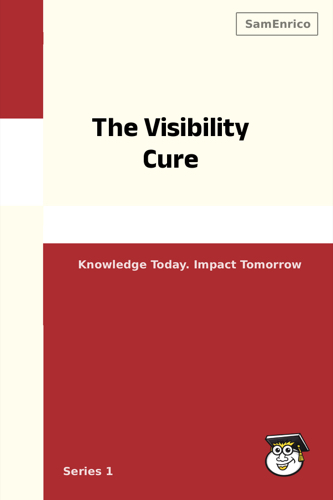
The Visibility Cure eBook
Stop hiding in meetings and start speaking up with
Stop hiding in meetings and start speaking up without fear of being exposed as clueless.
Formats
Free sample
Chapter 1: The Regret Loop--–- The post-meeting walk to the coffee machine is a ritual of quiet devastation. You replay the moment—fourteen seconds, maybe twenty—when the conversation drifted past a topic you actually knew something about. You had the data point. You had the pattern. You had the question no one else was asking.
And you said nothing. Now the meeting is over, the decision is made, and someone else said your idea using different words. They got the nod. They got the credit. You got a lukewarm cup of coffee and a head full of sentences you should have spoken.This is not a small thing.
This is not "just being introverted" or "cautious by nature." This is a tax you are paying every single day, and it is costing you far more than you realize.Let me name it for you: the Regret Loop.The Regret Loop is the cycle of wanting to speak, deciding not to, and then replaying the moment afterward with a rising sense of frustration. It begins before the meeting even starts—a low-grade anxiety about whether you will find the right moment. It peaks during the meeting itself, when your heart rate increases and your mouth goes dry. And it crashes afterward, when you walk to the coffee machine or close your laptop and think, Why didn't I just say something?The Regret Loop is exhausting. Not because talking is hard, but because not talking is exhausting.
Silence is not restful. Silence is a performance. You are actively suppressing your own voice, and that suppression requires enormous energy. By the end of a day of meetings where you said nothing, you feel as drained as if you had led the entire conversation. That is not a coincidence.
That is the cost of invisibility.The Myth of the Quiet Genius Let me address the myth that keeps most people silent. It is a seductive myth, and it goes something like this: If I just do good work, someone will notice. I don't need to speak up. My results will speak for themselves.This is a lie. A beautiful, comforting, career-destroying lie.Here is the truth that no one tells you in graduate school or orientation or those polite performance reviews: Invisible work earns no promotions.
The person who closes the deal gets remembered. The person who crunches the numbers gets forgotten. The person who speaks in the meeting gets the project. The person who sends the follow-up email gets the coffee run.I am not saying this to be cynical. I am saying this because I have seen it happen hundreds of times.
I have coached professionals who were brilliant—genuinely brilliant—and who stayed silent for years, waiting to be discovered. They waited. And waited. And then they watched less competent, more visible colleagues get promoted above them. Not because those colleagues were smarter.
Because they were present.Presence is not intelligence. Presence is not expertise. Presence is the willingness to occupy space in a conversation. And that willingness is a skill—not a personality trait, not a gift from the gods, not something you either have or don't have. It is a skill, like budgeting or project management or public speaking.
And like any skill, it can be learned.The Hidden Tax of Silence Let me show you what the Regret Loop costs you. I want you to do a simple calculation. Think about your last five meetings. In each meeting, how many times did you want to speak? Not how many times you spoke.
How many times you wanted to. Now subtract how many times you actually spoke. That difference? That is your Regret Ratio.Most professionals have a Regret Ratio of 3:1 or higher. For every three times they want to speak, they speak once.
Some people have ratios of 5:1 or 10:1. I have worked with clients who wanted to speak in every single meeting and spoke in none.Now multiply that ratio by the number of meetings you attend each week. By the number of weeks in a year. By the number of years you have been in the workforce. That is not just a number.
That is a mountain of unspoken ideas, unheard questions, and invisible contributions.And here is what that mountain costs you:First, opportunity. Every time you stay silent, someone else speaks. Sometimes they say your exact idea. Sometimes they say something worse, and the team makes a worse decision. Either way, you lost the chance to shape the outcome.
That is not abstract. That is a real loss—a project that goes in the wrong direction, a problem that takes longer to solve, a decision that you will have to clean up later.Second, credibility. People notice who speaks and who does not. They may not consciously register it, but they notice. The person who speaks regularly is the person who seems confident, engaged, and knowledgeable.
The person who never speaks becomes background noise. You become the person whose presence is tolerated but whose absence would not be noticed. That is a brutal sentence, but it is true. Invisibility is not humility. Invisibility is erasure.Third, career trajectory.
Every promotion I have ever seen—every single one—went to someone who had been visible. Not necessarily the loudest person. Not necessarily the person with the highest title. But the person whose voice had been heard. Promotions are not awarded to the best work.
Promotions are awarded to the work that was seen. If your work is invisible, it does not exist.Productive Silence vs. Fear-Based Silence Before you panic, let me make an important distinction. Not all silence is bad. There is such a thing as productive silence—silence that serves a strategic purpose.
Productive silence is when you are listening for a pattern, waiting for the right moment, or allowing someone else to finish their thought. Productive silence is active, not passive. You are not hiding. You are preparing.Then there is fear-based silence. Fear-based silence is when you want to speak and do not.
When you have something to say and you swallow it. When you know you have a contribution and you tell yourself it is not good enough, not ready, not worth the risk. Fear-based silence is the engine of the Regret Loop. It is the silence that leaves you exhausted and frustrated after every meeting.How do you tell the difference? Ask yourself one question: Am I choosing this silence, or is the silence choosing me?If you are actively deciding that listening is more valuable than speaking in this specific moment, that is productive silence.
If you are telling yourself that you will speak later, or that your idea needs more work, or that someone else will say it better—that is fear-based silence. Fear-based silence always comes with a story. I'll speak next time. I need to be more prepared. I don't want to interrupt.
They probably already know this. Those stories are the walls of the prison you have built for yourself.The First Ten Minutes Here is the first tactical rule of this book, and I want you to take it seriously. It will seem small.…
This is the end of the free sample. Get the eBook to keep going. Buy now
About this book
Details
- Author
- Weston Shawanna
- Publisher
- SamEnrico
- Language
- English
- Genre
- Non-Fiction, Self-Help
- Released
- 2026-06-07
- Pages (approx.)
- 98
- Available as
- eBook, Audiobook

Read better in the ZLOADR app
Your eBooks on your phone or tablet. Sign in with your SamEnrico account and start reading.
More by Weston Shawanna
 Strength Training For ConfidenceWeston Shawanna$11.99
 Napping For Insomnia PatientsWeston Shawanna$11.99
 Fibromyalgia Diet HandbookWeston Shawanna$11.99
 South Park OriginsWeston Shawanna$11.99
 Micronutrients For Fertility GuideWeston Shawanna$11.99
 Fintech Deal TermsWeston Shawanna$11.99
 Property Tax ManagementWeston Shawanna$11.99
 Caregiver for Multiple SclerosisWeston Shawanna$11.99
 The Lost Symphony of Mozart: A World Without AmadeusWeston Shawanna$11.99
 The Last Transmission: The Titanic’s Final SOS and the World That Didn’t RespondWeston Shawanna$11.99
 The Jade Serpent's Curse: How the Dragon King Lost His ScalesWeston Shawanna$11.99
 Public Health ManagementWeston Shawanna$11.99
You may also like
 Hong Kong Handover 1997Dunn Johnnie$11.99
 Zumba For Postnatal Recovery CourseNeal Christian$11.99
 Zumba for BeginnersLadner Nikia$11.99
 YouTube Comment Mining GuideHumes Pandora$12.99
 Worry Box MeditationCarlin Rudy$11.99
 Workplace Stress MeditationNguyen Lynn$11.99
 Workplace Stress and Sleep RepairHawley Ivory$11.99
 Workplace Perfectionism CureDelaney Jeffry$11.99
 Workplace Injustice Anger GuideWallen Isabelle$11.99
 Work Addiction and Burnout LinkGreenwood Ester$11.99
 Women in Yoga and WellnessBeattie Galina$11.99
 Women in Stand Up ComedyChun Evangeline$11.99