
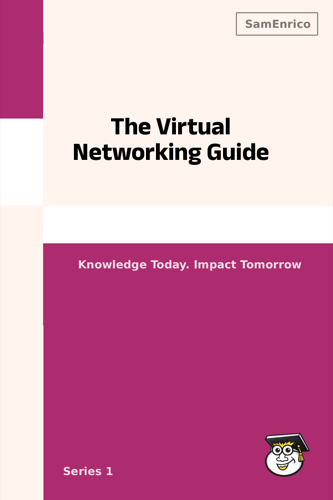
The Virtual Networking Guide eBook
Builds relationships through video calls and onlin
Builds relationships through video calls and online events.
Formats
Free sample
Chapter 1: The Ping Paradigm--–- The first time I watched a brilliant in-person networker fail miserably on Zoom, I thought it was a technical glitch. He was the kind of person who could work a physical room like a maestro—touching shoulders, laughing at precisely the right moments, remembering names after a single handshake. But on video, he appeared stiff, his jokes landed flat, and he spent the entire call staring at his own face in the corner of the screen. Afterward, he asked me, “What happened? I was being myself.” And that was precisely the problem.
He was being his in-person self in a space that follows completely different rules.This chapter dismantles the most dangerous assumption in modern professional life: that effective in-person networking skills transfer seamlessly to video calls. They do not. In fact, research suggests that people overestimate their virtual communication effectiveness by approximately 40 percent—a phenomenon Andrew Brodsky, a Harvard professor and author of Ping: The Secrets of Successful Virtual Communication, calls the “Zoom confidence gap” (Brodsky, 2023). We think we’re coming across as warm, engaged, and competent. What others see is often distracted, flat, and vaguely untrustworthy.The goal of this chapter is to reset your expectations entirely.
By the time you finish reading, you will understand why virtual networking is fundamentally different from physical networking, how to choose the right communication channel for every situation, and why your energy management is just as important as your social skills. You will also learn the contingency matrix—a decision tool that will guide you through the rest of this book whenever you face the question, “Should I use video, voice, email, or something else?”Let’s begin with the science of why your laptop camera is not a window—it is a filter.The Physical Illusion: Why Your Charisma Doesn't Travel In-person charisma relies on three things that disappear on video: proximity, peripheral vision, and shared physical space. When you stand next to someone at a conference, your brain processes dozens of subtle cues—the slight lean of their torso, the direction of their feet, the warmth of their handshake, the ambient energy of the crowd around you. These cues happen automatically, below the level of conscious thought, and they create a sense of connection that feels effortless.On a video call, every single one of those cues is stripped away. What remains is a two-dimensional rectangle of compressed pixels, transmitted with a slight delay that disrupts the natural rhythm of conversation.
Your peripheral vision disappears; you can only see the person you are looking at directly. Physical touch is gone. Shared space is reduced to a grid of identical boxes. And worst of all, you are watching yourself perform in real time—something that never happens in real life.This last factor, mirror anxiety, is unique to video communication. In a physical room, you have no live feedback loop showing you your own facial expressions.
On Zoom, your own face stares back at you, inviting constant self-evaluation. “Do I look engaged? Is my lighting okay? Why is my eyebrow doing that?” This self-monitoring consumes cognitive bandwidth that would otherwise go toward listening and connecting. The result is a paradox: you are more aware of yourself and less aware of others, even as you appear less engaged to them.Jeremy Bailenson, founding director of Stanford University’s Virtual Human Interaction Lab, has documented this phenomenon extensively.
In his 2021 study on Zoom fatigue, Bailenson identified four primary causes of virtual exhaustion: mirror anxiety, convergence strain (forcing your eyes to focus on a screen at a fixed distance), reduced mobility (being locked in a frame), and cognitive load (the brain working overtime to decode pixelated expressions). These factors do not exist in physical meetings, which is why an hour on Zoom can feel more draining than three hours in a conference room.But here is the crucial insight: the problem is not that video is bad. The problem is that video is different. And different requires a new skill set.Media Richness Theory: Why Richer Isn't Always Better In 1986, communication theorists Richard Daft and Robert Lengel introduced Media Richness Theory, a framework for understanding why some communication channels work better for certain tasks than others. The theory ranks channels along a spectrum of “richness,” defined by four criteria:Immediate feedback – Can the receiver respond in real time?Multiple cues – Does the channel convey body language, tone, and facial expression?Language variety – Can it handle natural language (not just numbers or yes/no)?Personal focus – Does it feel tailored to the individual?By these criteria, in-person communication is the richest channel.
It offers instant feedback, full body language, natural conversation, and personal connection. Video calls come next—they offer most of these cues, but with compression artifacts, lag, and reduced peripheral vision. Phone calls follow, stripping away visual cues but preserving tone and immediacy. Email is the leanest channel, offering delayed feedback, no nonverbal cues, and limited personalization.The intuitive conclusion—and the one most people make—is that richer is always better. If a conversation is important, you should use video.
If it is very important, you should meet in person. This intuition is wrong.Brodsky’s research demonstrates that video calls can actually harm certain types of conversations. When the topic is complex, sensitive, or requires careful thought, the cognitive load of processing video cues interferes with your ability to think clearly. Your brain is so busy trying to decode whether that flicker of facial expression was annoyance or a bad internet connection that it has no bandwidth left to understand the actual content of what is being said.Consider a scenario: you need to give a colleague constructive feedback on a difficult project. If you do this on a video call, you will spend half your energy monitoring your own face, worrying about how your feedback is landing, and trying to read their pixelated micro-expressions.
The result is that you deliver the feedback poorly, they receive it defensively, and the conversation goes badly. An asynchronous voice memo—recorded when you are calm, edited before sending, and listened to when they are ready to receive it—might yield a much better outcome.Conversely, consider a different scenario: you and a colleague have been trading increasingly tense emails about a misunderstanding. The tone has soured, but the actual content is simple. In this case, a five-minute video call can resolve the issue immediately, because seeing each other’s faces rebuilds empathy and strips away the imagined hostility that email creates.The difference between these two scenarios is the difference between complex cognitive disagreement and emotional misunderstanding. And this distinction is the heart of the contingency matrix that will guide you through this book.The Contingency Matrix: Choosing the Right Channel Throughout The Virtual Networking Guide, whenever you face the question “Should I use video, voice, or email?”, you will return to this matrix.
It resolves the apparent contradiction that video can be both harmful and helpful, depending on the situation.Type of Communication Best Channel Why Emotional misunderstanding (tone, hurt feelings, perceived disrespect)Synchronous video call Facial cues help repair rapport; you can see when someone softens; the immediacy…
This is the end of the free sample. Get the eBook to keep going. Buy now
About this book
Details
- Author
- Herrick Karissa
- Publisher
- SamEnrico
- Language
- English
- Genre
- Non-Fiction, Self-Help, Remote Work
- Released
- 2026-06-08
- Pages (approx.)
- 125
- Available as
- eBook, Audiobook

Read better in the ZLOADR app
Your eBooks on your phone or tablet. Sign in with your SamEnrico account and start reading.
More by Herrick Karissa
 Courageous Legacy CourseHerrick Karissa$11.99
 Asha Degree DNA EvidenceHerrick Karissa$11.99
 Body Scan for Flying FearHerrick Karissa$11.99
 Spin Virtual Class ProductionHerrick Karissa$11.99
 Operation Condor: The Cold War's Shadow Over Latin AmericaHerrick Karissa$11.99
 How to Start a Dentist Business (Beginners Guide)Herrick Karissa$11.99
 Music MemorabiliaHerrick Karissa$11.99
 Transportation Factoring GuideHerrick Karissa$12.99
 FlutterFlow Dashboard GuideHerrick Karissa$12.99
 Understanding Verloes–gillerot–fryns SyndromeHerrick Karissa$17.99
You may also like
 Remote Work Anger ManagementClay Marlo$11.99
 Weekly Review for Remote WorkersReid Dustin$11.99
 Virtual Networking Success GuideWilloughby Eun$11.99
 Virtual Body Language GuideGilman Marx$11.99
 Virtual Assistant Deployment GuideGossett Kevin$11.99
 Remote Work Self Esteem HandbookTucker Lillie$11.99
 Remote Work Loneliness GuideDennison Karon$11.99
 Remote Work Isolation GuideDurant Shea$11.99
 Remote Work Anger Management GuideCampos Ivey$11.99
 Remote Communication Skills GuideLoomis Billie$11.99
 Breath Awareness For Zoom FatigueParkinson Cassey$11.99
 Virtual Meeting Body Language GuideFeldman Lenna$11.99