
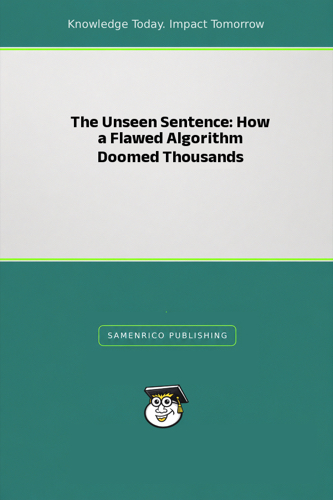
Non-FictionIncarceration Nation
The Unseen Sentence: How a Flawed Algorithm Doomed Thousands
Uncover the chilling story of how a biased risk-as
Uncover the chilling story of how a biased risk-assessment tool, COMPAS, reshaped sentencing in America, trapping thousands in cycles of incarceration.
Formats
About this book
Free sample
Chapter 1: The Digital Gavel...--–- In May 2014, two people were arrested in Florida for stealing things that did not belong to them. One was an eighteen-year-old Black woman who took a bicycle and a scooter from an unlocked porch. The other was a forty-one-year-old white man who stole a lawnmower and several power tools from a hardware store. These were not remarkable crimes. They were the kind of petty offenses that cycle through America’s misdemeanor courts by the thousands every week—small, sad, forgettable.
But these two arrests would become famous. They would be cited in congressional testimony, debated in law reviews, and held up as proof that the American justice system had quietly outsourced its conscience to a machine. The reason their names are remembered—Brisha Borden and Vernon Prater—is not because of what they did, but because of what an algorithm predicted they would do next.The algorithm was called COMPAS, an acronym for the Correctional Offender Management Profiling for Alternative Sanctions. It was a piece of software designed by a small company named Northpointe, later rebranded as Equivant, and it had spread through courtrooms across Florida, Wisconsin, New York, and California like a digital epidemic. The pitch was simple and seductive: judges were drowning in paperwork, defendants were backed up in holding cells for months, and the system was broken.
COMPAS promised to fix it. A defendant would answer 137 questions—about their childhood, their friends, their temper, their neighborhood—and the algorithm would produce a single number from one to ten. That number was the risk score. It claimed to predict the likelihood that the defendant would commit another crime if released. Low risk meant bail, probation, or a light sentence.
High risk meant detention, a longer prison term, or enhanced supervision. The judge did not have to understand how the number was calculated. The company did not have to explain it. The number simply appeared on a screen, and the gavel fell.Brisha Borden answered her 137 questions and received a score of eight for future violent crime. That put her in the highest…
This is the end of the free sample. Get the eBook to keep going. Buy now
Contents
- Chapter 1
- Chapter 2
- Chapter 3
- Chapter 4
- Chapter 5
- Chapter 6
- Chapter 7
- Chapter 8
- Chapter 9
- Chapter 10
- Chapter 11
- Chapter 12
Details
- Author
- Terrell Tandra
- Publisher
- SamEnrico
- Language
- English
- Genre
- Non-Fiction, Incarceration Nation
- Released
- 2026-06-04
- Pages (approx.)
- 141
- Available as
- eBook, Audiobook

Read better in the ZLOADR app
Your eBooks on your phone or tablet. Sign in with your SamEnrico account and start reading.
More by Terrell Tandra
 Remote Communication Complete GuideTerrell Tandra$11.99
 Refeed Day Calorie GuideTerrell Tandra$11.99
 Parental Anger Morning RoutineTerrell Tandra$11.99
 Franchising Your Local Brand Across Borders Forced Localization LawsTerrell Tandra$11.99
 Urge Surfing Technique GuideTerrell Tandra$11.99
 Swipe Right for History: How a Forgotten Photo Changed the WorldTerrell Tandra$11.99
 Understanding Deafness Conductive Ptosis Skeletal AnomaliesTerrell Tandra$17.99
 Community Engagement StrategyTerrell Tandra$12.99
 Nonprofit Penalty GuideTerrell Tandra$12.99
 Field RepresentativeTerrell Tandra$11.99
 How to Start a Hobby in Map MakingTerrell Tandra$11.99
You may also like
 Hong Kong Handover 1997Dunn Johnnie$11.99
 Zumba For Postnatal Recovery CourseNeal Christian$11.99
 Zumba for BeginnersLadner Nikia$11.99
 YouTube Comment Mining GuideHumes Pandora$12.99
 Worry Box MeditationCarlin Rudy$11.99
 Workplace Stress MeditationNguyen Lynn$11.99
 Workplace Stress and Sleep RepairHawley Ivory$11.99
 Workplace Perfectionism CureDelaney Jeffry$11.99
 Workplace Injustice Anger GuideWallen Isabelle$11.99
 Work Addiction and Burnout LinkGreenwood Ester$11.99
 Women in Yoga and WellnessBeattie Galina$11.99
 Women in Stand Up ComedyChun Evangeline$11.99