
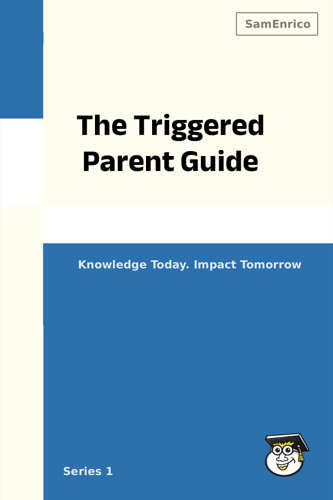
The Triggered Parent Guide eBook
Identify specific child behaviors that spark your
by Berlin Dino
Identify specific child behaviors that spark your anger and plan responses.
Formats
Free sample
Chapter 1: The Seven-Second Hijack--–- The morning had started beautifully. You woke up before the kids, made coffee, scrolled your phone in peace. You felt patient, loving, ready to be the parent you promised yourself you would be. Then your four-year-old refused to put on shoes. You asked nicely.
Nothing. You asked again, firmer. Still nothing. And then, somewhere between the third request and the fifth, something inside you snapped. Your voice rose.
Your jaw clenched. You said something you immediately regretted—a threat, a sarcastic remark, a yell that silenced the whole room. Your child cried. You felt ashamed. And you thought, Where did that come from?
I was just calm a minute ago.This chapter answers that question. It explains the neurobiology of the parental anger trigger: why it happens in roughly seven seconds, why counting to ten fails, and why your child’s behavior feels like a personal attack even when you know logically it isn’t. You will learn the four universal sparks that ignite parental anger, why your body reacts before your brain can stop it, and how to complete the first and most critical exercise of this book: the Last Five Blowups retrospective log. By the end of this chapter, you will understand that your anger is not a moral failure. It is a biological event.
And biology can be rewired.The Speed of a Trigger Let’s start with a simple fact that most parenting books overlook: from the moment a child whines, defies, or hits, the parent’s emotional spike reaches its peak in approximately seven seconds. That is not an opinion. It is derived from research on the amygdala’s response time to perceived threats. The amygdala, an almond-shaped cluster of nuclei deep in the brain’s temporal lobe, functions as an alarm system. It scans the environment for danger constantly, without your conscious awareness.
When it detects a threat—real or imagined—it sends an emergency signal throughout your nervous system. Your heart rate increases. Your breath shortens. Your muscles tense. Blood moves away from your digestive system and toward your large muscle groups, preparing you to fight, flee, or freeze.
All of this happens in less than one second.By the time you consciously register your child’s behavior—“She just hit her brother” or “He just said ‘no’ for the third time”—your body is already in a state of high alert. The remaining six seconds are when your prefrontal cortex, the reasoning center of your brain, tries to catch up. It attempts to override the alarm with logic: “She’s just tired,” “He doesn’t mean it,” “This isn’t an emergency.” But the amygdala has a faster neural pathway. It connects directly to your emotional centers. The prefrontal cortex’s calming signals travel along slower, more circuitous routes.
By the time your logic arrives, the emotional explosion has already been triggered. That is the seven-second spiral.This explains why counting to ten fails. Counting to ten takes roughly ten seconds. By the time you reach seven, your amygdala has already hijacked your response. You are not counting to ten to prevent an explosion.
You are counting to ten while already inside one. The counting becomes a performance, not a pause. The same is true for deep breathing, walking away, or repeating a mantra. These techniques work when practiced before a trigger. They fail during a trigger because the neural pathways for accessing them are shut down by the very hijack they are meant to stop.
This is not a failure of your willpower. It is a feature of your neurobiology.The Amygdala Hijack, Explained for Tired Parents The term “amygdala hijack” was popularized by the science journalist Daniel Goleman in his book Emotional Intelligence. In simple terms, it means that your emotional brain has taken control of your thinking brain. Imagine a fire alarm that not only rings but also locks the door to the fire extinguisher. That is the amygdala hijack.
The alarm is blaring (anger, fear, panic), and the tools you need to calm down (reason, empathy, perspective) are temporarily inaccessible.When your child triggers you, several physiological changes occur simultaneously. Your adrenal glands release epinephrine and norepinephrine, commonly known as adrenaline and noradrenaline. These hormones increase your heart rate, elevate your blood pressure, and boost your energy levels. Your pupils dilate to take in more visual information. Your hearing sharpens.
Your body is preparing for a physical confrontation, even if the threat is a four-year-old whining about a red cup. At the same time, your body releases cortisol, a stress hormone that begins to shut down non-essential systems. Digestion slows. Immune response decreases. Your prefrontal cortex, which depends on a steady supply of glucose and oxygen, receives less blood flow.
You literally cannot think as clearly as you could two minutes earlier.Meanwhile, your child’s brain is also dysregulated. Young children have not fully developed the neural pathways for impulse control, emotional regulation, or perspective-taking. The prefrontal cortex of a child under six is still under construction. When your child whines, hits, or screams, their own amygdala is also hijacked. This is the crucial insight that most triggered parents miss: you are not a calm adult responding to a misbehaving child.
You are two dysregulated nervous systems colliding. Neither of you has access to your reasoning brain. Neither of you is choosing to escalate. You are both reacting to a perceived threat. The only difference is that you, as the adult, are responsible for repairing the damage afterward.This is not about blame.
It is about biology. Once you understand that your anger is a physiological event—not a choice, not a character flaw, not evidence that you are a bad parent—you can begin to interrupt it at the physical level. You cannot argue your way out of an amygdala hijack. You cannot reason with it. But you can short-circuit it with a physical anchor, which you will learn in Chapter 4.
First, you need to know what sets it off.The Four Universal Anger Sparks After analyzing hundreds of parent-reported triggers across ten bestselling parenting books and clinical research, a clear pattern emerges. Parental anger is almost always ignited by one of four universal sparks. These are not causes; they are categories. They describe the type of threat your amygdala detects. Each spark activates a different survival response.
Learning to name your spark in the moment is the first step toward interrupting it.Spark One: Threat to Authority This spark activates when your child challenges your right to direct their behavior. Examples include direct defiance (“No, I won’t”), ignoring a clear instruction, or negotiating after a decision has been made. The amygdala interprets this challenge as a social threat. In evolutionary terms, a challenge to authority threatened your status in the group, which could affect your access to resources and safety. Modern parents feel this spark when their child says “You can’t make me” or walks away mid-instruction.
The physical sensation is often heat rising in the chest or face, a tightening of the jaw, and a sudden urge to assert control. The automatic thought is usually something like…
This is the end of the free sample. Get the eBook to keep going. Buy now
About this book
Details
- Author
- Berlin Dino
- Publisher
- SamEnrico
- Language
- English
- Genre
- Non-Fiction, Self-Help, Triggers
- Released
- 2026-06-07
- Pages (approx.)
- 148
- Available as
- eBook, Audiobook

Read better in the ZLOADR app
Your eBooks on your phone or tablet. Sign in with your SamEnrico account and start reading.
More by Berlin Dino
 The English Feudalism GuideBerlin Dino$11.99
 HIIT Brain Function GuideBerlin Dino$11.99
 Validation For BPD RelationshipsBerlin Dino$11.99
 Twelve Step Relapse PreventionBerlin Dino$11.99
 The Battle of the Hydaspes: Alexander's Last Stand in India (326 BC)Berlin Dino$11.99
 Switching Cost Analysis GuideBerlin Dino$12.99
 Free PR Tools for StartupsBerlin Dino$12.99
 How to Start a Bats Made of Ceramic Business (Beginners Guide)Berlin Dino$11.99
 The Breeder's Guide to Leghorn ChickensBerlin Dino$11.99
 Investment ConsultantBerlin Dino$11.99
You may also like
 Hong Kong Handover 1997Dunn Johnnie$11.99
 Zumba For Postnatal Recovery CourseNeal Christian$11.99
 Zumba for BeginnersLadner Nikia$11.99
 YouTube Comment Mining GuideHumes Pandora$12.99
 Worry Box MeditationCarlin Rudy$11.99
 Workplace Stress MeditationNguyen Lynn$11.99
 Workplace Stress and Sleep RepairHawley Ivory$11.99
 Workplace Perfectionism CureDelaney Jeffry$11.99
 Workplace Injustice Anger GuideWallen Isabelle$11.99
 Work Addiction and Burnout LinkGreenwood Ester$11.99
 Women in Yoga and WellnessBeattie Galina$11.99
 Women in Stand Up ComedyChun Evangeline$11.99