
Non-FictionSelf-HelpRelationships
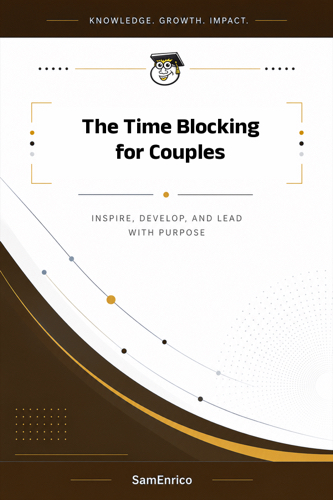
The Time Blocking for Couples eBook
Coordinate individual and shared time blocks for r
by Purvis Shu
Coordinate individual and shared time blocks for relationship harmony.
Formats
Free sample
Chapter 1: The Container Revolution--–- The fight started, as it always did, at 6:47 PM on a Tuesday.One partner had just walked through the door after a twelve-hour day, the other had been handling a screaming toddler and a boiling pot of pasta since 4:00 PM. Neither had eaten. The dishwasher needed emptying. There was a school form due tomorrow. And somewhere beneath all of that noise, both of them were quietly, desperately lonely for each other."I thought you said you'd be home by six," Partner A said, not as an accusation but as a plea."I got held up," Partner B replied, already defensive.
"You know how my boss is.""I'm not your boss. I'm your partner. I just wanted to see you before the kid passed out."And then, because no one had the energy for the real conversation, they both retreated to their separate corners—Partner A to the kitchen, Partner B to the bedroom to change—and the evening dissolved into the familiar rhythm of two people coexisting rather than connecting. The pasta got eaten in silence. The toddler went to bed without a goodnight kiss from Partner B, who was already answering work emails.
And at 10:15 PM, both partners collapsed into bed, too exhausted to even reach for each other's hand.They had shared a calendar. They had a shared grocery list app. They had a family group chat. And none of it had saved them from this.This is the hidden crisis of modern coupledom. It is not that we don't love each other.
It is not that we don't try. It is that our time has become a battlefield—fragmented, reactive, and fundamentally out of sync. We have more productivity tools than ever before, and less relationship presence than our grandparents had with a single wall calendar and a prayer.The problem is not your calendar. The problem is not your partner. The problem is that you have been treating time as something that happens to you rather than something you design together.This chapter introduces the foundational shift that makes everything else in this book possible: moving from the tyranny of the to-do list to the spaciousness of the container.
Welcome to the Container Revolution.The Myth of "We Don't Have Time"Before we build anything, we have to demolish a lie. The lie is this: We don't have enough time for our relationship.You have heard it from your own mouth. You have heard it from friends. You have heard it from every exhausted couple in every exhausted movie about exhausted people. And it is, quite simply, false.What you actually lack is not time but synchronized attention.
Let me prove it to you.Take out your phone right now—I'll wait—and open your screen time report. Look at the last seven days. How many hours did you spend scrolling social media? Watching television? Staring at your inbox after 9:00 PM?
For the average American adult, that number is between four and seven hours per day of passive, fragmented attention. Now add your partner's screen time. Now add the hours you spend doing chores while mentally somewhere else. Now add the hours you spend "relaxing" in the same room but not actually present.You have time. You have plenty of time.
What you don't have is defended, intentional, mutually agreed-upon containers for that time.The psychologist Mihaly Csikszentmihalyi, who spent decades studying human happiness, coined the term "psychic entropy"—the natural tendency of the mind to descend into chaos unless given structure. Your relationship experiences the same entropy. Without intentional containers, your shared attention will always fragment toward the path of least resistance: the phone, the chore, the work email, the exhaustion spiral.Here is the truth that will either liberate you or terrify you: You are already time blocking. Every time you say "I'll do that after dinner" or "Let's watch one more episode" or "I just need five more minutes of work," you are making a decision about how to contain your time. You are just making those decisions badly—reactively, individually, and without a shared language.The Container Revolution is the act of taking that power back.
It is the decision to stop letting time happen to you and start building the walls that turn chaos into spaciousness.The 21-Block Week: Your Canvas Here is the single most important image you will carry from this chapter. Draw it in your mind, then draw it on paper, then hang it on your refrigerator.A week has seven days. Each day has three natural phases: Morning (wake up until noon), Afternoon (noon until 5:00 PM or the end of work), and Evening (after work until sleep). That is twenty-one blocks of time.Seven days × three phases = twenty-one containers.That is it. That is your canvas.
Not a sprawling, infinite Google Calendar with thirty-minute increments that make you feel like a failure before you begin. Just twenty-one boxes, each one representing a significant chunk of your shared life.Now, here is the insight that changes everything: These twenty-one blocks are not all the same. You are not expected to be productive, present, romantic, industrious, or anything else in every block. The blocks are neutral. They are just boxes.
What you put inside them is where the art happens.In the introduction to this book, you were promised that every block would receive one of three labels. Those labels are coming in just a moment. But first, I need you to sit with the simplicity of the canvas itself.Most couples approach time management like they are trying to drink from a fire hose. They list everything they have to do—work deadlines, doctor's appointments, school pickups, date nights, exercise, meal prep, laundry, car maintenance, family birthdays, and on and on and on—and then they try to cram all of it into a calendar that already looks like a Jackson Pollock painting.The 21-Block Week does the opposite. It says: You only have twenty-one containers.
That is a feature, not a bug. Because limited containers force you to make choices. And choices force you to prioritize. And prioritization is the only path to peace.You cannot fit everything into twenty-one blocks. You were never going to fit everything into your life anyway.
The difference is that now you will stop pretending otherwise.The Three Labels: Duty, Us, Me Now we add the labels. Each of your twenty-one blocks will receive exactly one of three designations. There are no other options. This limitation is intentional and, I promise you, liberating.Duty Block (Red)The first label is Duty. These are the blocks where you show up for the world's expectations of you.
Paid work. Household chores. Errands. Administrative tasks. Caring for children (though note: caring for children is a Duty when you are in "manager mode"; when you are in "play mode," it may become a different label, which we will discuss in Chapter 4).
Phone calls you don't want to make. Emails you have to answer. The dentist appointment. The car oil change. The taxes.Duty Blocks are not bad.
They are not the enemy. They are simply the price of admission to adult life. The problem is not Duty…
This is the end of the free sample. Get the eBook to keep going. Buy now
About this book
Details
- Author
- Purvis Shu
- Publisher
- SamEnrico
- Language
- English
- Genre
- Non-Fiction, Self-Help, Relationships
- Released
- 2026-06-07
- Pages (approx.)
- 148
- Available as
- eBook, Audiobook

Read better in the ZLOADR app
Your eBooks on your phone or tablet. Sign in with your SamEnrico account and start reading.
More by Purvis Shu
 Upwork Proposal Writing WorkbookPurvis Shu$11.99
 Commercial Child Actor JourneyPurvis Shu$11.99
 The Rhetorical TrianglePurvis Shu$11.99
 Reference Management After Job LossPurvis Shu$11.99
 Teen Self Esteem Therapy OptionsPurvis Shu$11.99
 The Freelance Creative Outlet GuidePurvis Shu$11.99
 UK VAT Deregistration When to Apply ManualPurvis Shu$11.99
 Buffett Precision CastpartsPurvis Shu$11.99
 The Silk Road to the Red Planet: Medieval Astronomers and the Secret Maps of MarsPurvis Shu$11.99
 The Last Stand of the Whiskey Ring: How a Secret Society Brought Down a PresidentPurvis Shu$11.99
 The Fire and the Forge: Benin's Iron RevolutionPurvis Shu$11.99
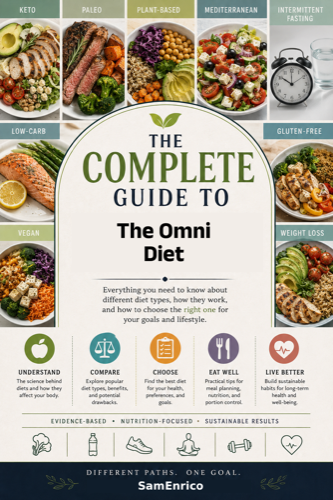 The Complete Guide to the Omni DietPurvis Shu$11.99
You may also like
 Hong Kong Handover 1997Dunn Johnnie$11.99
 Zumba For Postnatal Recovery CourseNeal Christian$11.99
 Zumba for BeginnersLadner Nikia$11.99
 YouTube Comment Mining GuideHumes Pandora$12.99
 Worry Box MeditationCarlin Rudy$11.99
 Workplace Stress MeditationNguyen Lynn$11.99
 Workplace Stress and Sleep RepairHawley Ivory$11.99
 Workplace Perfectionism CureDelaney Jeffry$11.99
 Workplace Injustice Anger GuideWallen Isabelle$11.99
 Work Addiction and Burnout LinkGreenwood Ester$11.99
 Women in Yoga and WellnessBeattie Galina$11.99
 Women in Stand Up ComedyChun Evangeline$11.99