
Non-FictionSelf-HelpImpulse Control
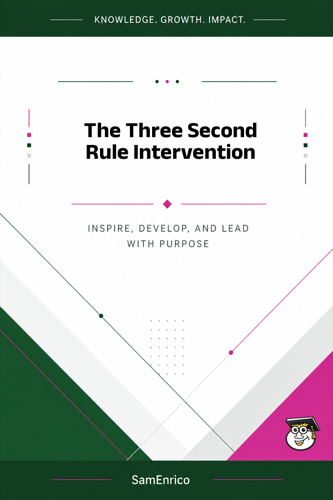
The Three Second Rule Intervention eBook
Pause for three seconds before any sexual decision
by Bowie Marget
Pause for three seconds before any sexual decision to interrupt compulsion.
Formats
Free sample
Chapter 1: The One-Second Thief--–- You are less than one second away from any decision you wish you hadn’t made.Not one minute. Not one hour. Not even the time it takes to say “I should know better.”One second. Maybe less.That’s how fast your brain can lock in a choice that will cost you hours of shame, days of regret, or years of your life. In the time it takes to blink, your autopilot can override your better judgment, silence your values, and leave you watching yourself do something you swore you wouldn’t do again.This book is about how to steal that second back.Not through willpower.
Not through shame. Not through trying harder. Through something so simple that most people dismiss it: a deliberate, conscious pause. Three seconds of nothing except attention. Three seconds that separate the life you keep falling into from the life you actually want.But before we get to the solution, we have to understand the thief.The thief lives in your skull.
It has no malicious intent. It’s not trying to ruin your life. It’s just doing what evolution designed it to do: save energy, automate repetition, and react faster than thought. Its name is the basal ganglia, and it is the reason you can drive a car without remembering how you got home, the reason you can type without looking at the keyboard, and the reason you can find yourself in the middle of a compulsive sexual act with no memory of deciding to start.The basal ganglia is your brain’s habit center. It learns through repetition.
Every time you do something—good or bad—the basal ganglia lays down a slightly stronger pathway. Do something enough times, and the pathway becomes a superhighway. Your conscious mind (the prefrontal cortex) gets downgraded to a passenger. The basal ganglia drives.Here’s what that means for you: the average compulsion loop—from trigger to action—takes less than one second.Less. Than.
One. Second.You feel a flicker of boredom, loneliness, stress, or arousal. Before you can form the thought “I shouldn’t do this,” your hand is already moving. The tab is already open. The app is already loading.
The person is already messaging. You are already gone.And then you come back, hours later, wondering what happened. Wondering why you keep doing this. Wondering if you’re broken.You are not broken. You are just fast.
Faster than your own better judgment. And speed is the enemy of choice.This chapter is going to show you why that one-second window exists, why willpower alone can’t close it, and how a single three-second pause can change everything. By the end of this chapter, you will understand the neuroscience of compulsion in plain language, you will know why “just say no” is a myth, and you will have taken the first step toward reclaiming the space between impulse and action.Let’s begin.The Myth of the Bad Decision Most people believe that bad decisions happen because of bad character. If you keep doing something you know is harming you, the logic goes, you must be weak, immoral, or simply unwilling to change.This belief is not only wrong—it is dangerous. It keeps people trapped in shame cycles for years, sometimes decades.
Because if you believe your problem is a character defect, the only solution is to try harder to be a better person. And when trying harder fails (as it always does), you conclude that you are unfixable. So you stop trying. Or you try harder next time, which fails again. The shame deepens.
The behavior escalates. The loop tightens.Here is the truth that will set you free: compulsive behavior is not a character problem. It is a brain problem. Specifically, it is a speed problem.Your brain has two competing systems. The first system is ancient, fast, and automatic.
It includes the basal ganglia (habit center) and the limbic system (emotion and reward center). This system operates without your permission. It doesn’t ask what you value. It doesn’t care about your long-term goals. It responds to cues in the environment with learned behavioral scripts.
Cue → urge → action. Less than one second.The second system is newer, slower, and deliberate. It lives primarily in the prefrontal cortex, just behind your forehead. This is the part of your brain that plans, considers consequences, inhibits impulses, and aligns behavior with values. It is what makes you human.
It is also slow—painfully slow compared to the basal ganglia. The prefrontal cortex takes about half a second just to notice that something is happening. It takes another second or two to evaluate options and make a conscious choice.In a race between the basal ganglia and the prefrontal cortex, the basal ganglia wins every time. It has already started the action before the prefrontal cortex even knows there was a choice to make.This is not a failure of character. This is physics.
The fast system is faster than the slow system. Period.The good news is that you can slow the fast system down. Not by fighting it—that’s like trying to stop a freight train with your bare hands. But by inserting a deliberate pause between the cue and the action. A pause long enough for the slow system to catch up.Three seconds is the magic number.
Neuroscience research has shown that three seconds is the minimum time needed for the prefrontal cortex to shift from passive observation to active intervention. Three seconds is the difference between reacting and responding. Three seconds is the window in which a compulsion dies or lives.The Compulsion Gap Let me introduce you to a concept that will appear throughout this book: the compulsion gap.The compulsion gap is the vanishingly small window between the emergence of an urge and the initiation of action. In a healthy brain, this gap is wide enough for conscious choice. You feel hungry, you pause, you decide what to eat.
You feel angry, you pause, you decide how to respond. You feel attracted, you pause, you decide how to act.In a compulsive brain, this gap has been compressed to nearly nothing. Years of repetition have worn the gap down like water wearing down rock. What was once a conscious choice has become an automatic reaction. You don’t decide to act.
You just act.The compulsion gap still exists—it has to, because all behavior requires neural transmission time. But it has become so narrow that your conscious mind cannot fit inside it. By the time you notice the urge, the action has already begun.The three-second rule is a tool for widening the compulsion gap. Not by magic. By structure.
When you deliberately pause for three seconds, you are not trying to suppress the urge. You are not fighting your brain. You are simply stretching the gap. You are giving the prefrontal cortex the one thing it needs most: time.Think of it like this. Imagine you are driving a car.
Your basal ganglia is the accelerator—fast, powerful, always ready to go. Your prefrontal cortex is the brake. In a compulsive…
This is the end of the free sample. Get the eBook to keep going. Buy now
About this book
Details
- Author
- Bowie Marget
- Publisher
- SamEnrico
- Language
- English
- Genre
- Non-Fiction, Self-Help, Impulse Control
- Released
- 2026-06-10
- Pages (approx.)
- 139
- Available as
- eBook, Audiobook

Read better in the ZLOADR app
Your eBooks on your phone or tablet. Sign in with your SamEnrico account and start reading.
More by Bowie Marget
 Parkinson Circadian GuideBowie Marget$11.99
 Key Employee Sudden Departure Simulation KitBowie Marget$11.99
 Spouse Death and SleepBowie Marget$11.99
 Uber Destination Filter StrategyBowie Marget$11.99
 Flare First Aid MeditationBowie Marget$11.99
 Cannabis Use Disorder Chronic PainBowie Marget$11.99
 Monopolization Fine DatabaseBowie Marget$11.99
 Hydration Anxiety FixBowie Marget$11.99
 The Torchbearer: How a Forgotten Hero Lit the 1948 London GamesBowie Marget$11.99
 Lysistrata’s Lament: The War That Women WonBowie Marget$11.99
 Growing ChamaeliriumBowie Marget$11.99
 How to Start a Compressor Engine Business (Beginners Guide)Bowie Marget$11.99
You may also like
 Hong Kong Handover 1997Dunn Johnnie$11.99
 Zumba For Postnatal Recovery CourseNeal Christian$11.99
 Zumba for BeginnersLadner Nikia$11.99
 YouTube Comment Mining GuideHumes Pandora$12.99
 Worry Box MeditationCarlin Rudy$11.99
 Workplace Stress MeditationNguyen Lynn$11.99
 Workplace Stress and Sleep RepairHawley Ivory$11.99
 Workplace Perfectionism CureDelaney Jeffry$11.99
 Workplace Injustice Anger GuideWallen Isabelle$11.99
 Work Addiction and Burnout LinkGreenwood Ester$11.99
 Women in Yoga and WellnessBeattie Galina$11.99
 Women in Stand Up ComedyChun Evangeline$11.99