
Non-FictionBiographyDigital Equity
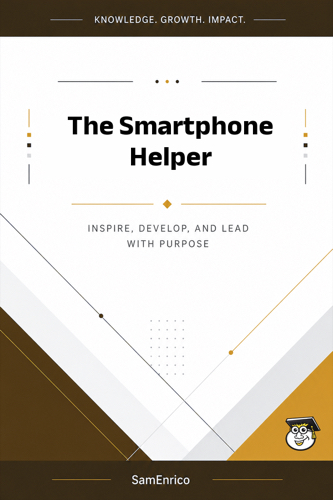
The Smartphone Helper eBook
Shares how a volunteer set up devices for low-inco
by Tuggle Dayle
Shares how a volunteer set up devices for low-income families.
Formats
Free sample
Chapter 1: The Woman at Window 4--The food bank opened at 4:00 PM, but the line started forming at 2:30. By the time I pulled into the church parking lot, fifty-seven people were already waiting. I know it was fifty-seven because I counted them twice, trying to delay the moment I would have to get out of my car and admit that I had no idea what I was doing.I had volunteered for the checkout line—Window 4, the last station before families walked away with their boxes of canned vegetables, powdered milk, and dented soup cans. My job was simple: smile, scan the barcode on their intake card, say "Have a good evening," and repeat. I could do that.
I had spent fifteen years in Silicon Valley optimizing ad delivery algorithms that required more cognitive complexity than this. I could smile and scan.The first three families came and went in a blur of faces I would not remember. Then Keisha arrived at Window 4.She was thirty-four years old, though she looked fifty. The lines around her eyes had the deep permanence of someone who had been exhausted for so long that exhaustion had become her resting state. She had two children with her—a girl around ten years old who carried a worn-out backpack and a boy around seven who was trying to climb the metal barrier separating the line from the parking lot.
She held a smartphone in her hand. Not an old one. Not a cracked one. A relatively new Samsung Galaxy, the kind that cost maybe two hundred dollars at a discount retailer. She was holding it out to me like it was a wounded animal she did not know how to help."I'm sorry," she said.
"I know this is for food. But do you have anybody here who knows about phones?"I looked at her. I looked at the phone. I looked at the line behind her, which had grown to at least sixty people now."What's wrong with it?" I asked."It won't stop screaming at me."I took the phone from her hand and looked at the screen. The notification bar was a disaster zone.
Thirty-seven unread text messages. Fourteen app update requests. A permanent weather alert that had been sitting there for three days. Three missed calls from a number she did not recognize. Facebook Messenger bubbling with notifications.
A system notification telling her that her storage was almost full. Two separate game requests from Candy Crush. A reminder that she had not backed up her photos in six months.Her phone was not broken. It was being attacked."Can you fix it?" she asked. "I can't think with all the buzzing."I spent the next fifteen minutes sitting on a plastic folding chair next to Window 4, silencing her notifications one by one.
I showed her how to turn off Facebook's push alerts. I showed her how to mute the weather app. I showed her how to clear the notification bar with a single swipe. I showed her how to find the setting that stopped Candy Crush from sending her "reminders" that she had not played in three days.When I handed the phone back to her, the notification bar was empty. The screen was calm.Keisha looked at the phone.
Then she looked at me. Then she started to cry.Not the quiet, polite tears of someone who is trying to hide their emotions. Full crying. The kind of crying that comes from a place so deep that the person doing it did not know it was there until it opened."You don't understand," she said, wiping her face with the back of her hand. "That phone has been screaming at me for six months.
Every time it buzzed, I thought it was something bad. The school calling about my daughter. My landlord saying we're late again. My mother in the hospital. And it was never any of those things.
It was just... games. Telling me to play games."She paused."I thought I was going crazy."I did not know what to say. I had spent ten years of my professional life working on systems designed to do exactly what Keisha's phone had been doing. I had written code that determined the optimal time of day to send a push notification to maximize the likelihood that a user would open an app.
I had attended meetings where we celebrated a 15 percent increase in "user engagement" measured in minutes spent staring at a screen. I had never once, in ten years, thought about what those notifications felt like on the other end. I had never imagined a woman at a food bank, holding a phone out like a wounded animal, convinced that she was losing her mind because of the work I had helped build."Thank you," Keisha said. She picked up her box of food. Her daughter took her hand.
"Thank you for making it quiet."She walked away. The next person in line stepped up to Window 4. I smiled, scanned their intake card, and said, "Have a good evening." But I was not there anymore. I was somewhere else entirely, standing at the edge of a realization I did not want to have.The Burned-Out Engineer Let me back up.Before I became the person who volunteers at food banks and sets up phones for strangers, I was a software engineer in San Francisco. I worked for a company you have heard of.
I do not need to name it, because the specifics do not matter. What matters is what I did there for ten years: I optimized attention.My job title changed over time—first Product Manager, then Senior Product Manager, then Lead of Engagement Optimization—but the work never changed. I was given a goal, usually phrased in the language of metrics: increase daily active users by 8 percent, extend average session duration by twelve seconds, reduce churn (the industry term for "people quitting") by 3 percent. And I did it. I was good at it.
I was promoted for it. I was praised for it.I wrote algorithms that decided when to send you a notification. I tested different message copy to see which phrasing made you more likely to click. (Did you know that "Your friend commented on a photo" gets a 12 percent higher click-through rate than "See what your friend is up to"? I learned that through an A/B test on three million users.
I felt very smart about it at the time.) I built systems that tracked your scrolling speed, your hesitation moments, your pause points, and used that data to predict exactly when you were about to close the app—so the app could show you something interesting just in time to keep you there for five more minutes.I was not a villain. I did not wake up in the morning thinking, How can I ruin lives today? I woke up thinking about the ticket in my project management queue, the deadline that was approaching, the meeting I had at 10:00 AM with the data science team. I was a professional solving professional problems. The fact that those problems were about manipulating human attention for…
This is the end of the free sample. Get the eBook to keep going. Buy now
About this book
Details
- Author
- Tuggle Dayle
- Publisher
- SamEnrico
- Language
- English
- Genre
- Non-Fiction, Biography, Digital Equity
- Released
- 2026-06-07
- Pages (approx.)
- 141
- Available as
- eBook, Audiobook

Read better in the ZLOADR app
Your eBooks on your phone or tablet. Sign in with your SamEnrico account and start reading.
More by Tuggle Dayle
 Relationship Burnout RecoveryTuggle Dayle$11.99
 Name Emotional TaggingTuggle Dayle$11.99
 Rightsizing Your Retirement Home GuideTuggle Dayle$11.99
 Early Payment DiscountTuggle Dayle$11.99
 Salary Negotiation GuideTuggle Dayle$11.99
 Compulsive Spending TriggersTuggle Dayle$11.99
 OKRs for Remote TeamsTuggle Dayle$11.99
 Theseus and the Minotaur: Labyrinth of ShadowsTuggle Dayle$11.99
 The Poisoned Prohibition: The Hacker Who Sold Death in a BottleTuggle Dayle$11.99
 How to Produce a KamadoTuggle Dayle$11.99
 Service Providers Guide to MattressesTuggle Dayle$11.99
 How to Become a PumperTuggle Dayle$11.99
You may also like
 Hong Kong Handover 1997Dunn Johnnie$11.99
 Zumba For Postnatal Recovery CourseNeal Christian$11.99
 Zumba for BeginnersLadner Nikia$11.99
 YouTube Comment Mining GuideHumes Pandora$12.99
 Worry Box MeditationCarlin Rudy$11.99
 Workplace Stress MeditationNguyen Lynn$11.99
 Workplace Stress and Sleep RepairHawley Ivory$11.99
 Workplace Perfectionism CureDelaney Jeffry$11.99
 Workplace Injustice Anger GuideWallen Isabelle$11.99
 Work Addiction and Burnout LinkGreenwood Ester$11.99
 Women in Yoga and WellnessBeattie Galina$11.99
 Women in Stand Up ComedyChun Evangeline$11.99