
Non-FictionSelf-HelpTech Communication
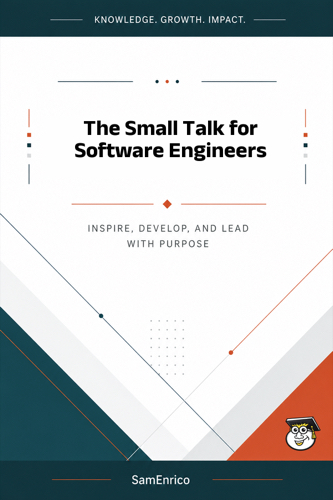
The Small Talk for Software Engineers eBook
Translates technical minds to casual human convers
Translates technical minds to casual human conversation at work and meetups.
Formats
Free sample
Chapter 1: The Compiler Error--–- Imagine you’re staring at a terminal. You’ve written what you believe is flawless code. The logic is sound. The syntax is pristine. You’ve accounted for edge cases, null pointers, and even that one weird dependency that broke the build last Tuesday.
You hit enter, expecting a clean compile. Instead, the compiler throws an error. Not a syntax error. Not a missing semicolon. Something deeper.
A type mismatch. A fundamental incompatibility between what you wrote and what the system expects.That feeling of frustration, confusion, and mild embarrassment? That’s exactly what happens when a software engineer tries to make small talk.You walk into a meetup. You see a colleague in the kitchen at work. You join a Zoom call two minutes early.
Your brain, trained for precision, clarity, and efficiency, tries to execute the social equivalent of a function call. You say something logical. The other person responds with something ambiguous. You try to solve a problem they didn’t ask to solve. The conversation crashes.
Not with a dramatic explosion, but with a quiet, awkward silence. You walk away thinking, “Why is that so hard? It shouldn’t be this hard.”Here’s the truth that no one in tech tells you: It’s not hard because you’re broken. It’s hard because you’re using the wrong programming language for the runtime environment.Your brain, beautifully optimized for systems, data structures, and deterministic outcomes, is trying to run social software on a machine that runs on emotion, ambiguity, and rapport. The compiler isn’t broken.
You’re just compiling for the wrong architecture.This chapter is the error log. It will walk you through exactly why small talk fails for technical minds, not as a judgment on your personality, but as a diagnostic tool. By the end, you’ll have a clear map of your specific conversational blind spots, a vocabulary for what goes wrong, and the beginning of a fix that doesn’t require you to become a different person.The Three Core Mismatches: Why Your Social Compiler Throws Errors Every software engineer knows that a successful program requires alignment between the code, the compiler, and the target environment. Small talk fails for engineers because of three foundational mismatches between how engineers think and how casual conversation works. These aren’t flaws.
They are features of your technical mind that become bugs in a social context.Mismatch #1: Precision vs. Ambiguity You write code that demands exactitude. A variable is typed. A function returns a specific data structure. A conditional branch executes only when a condition is precisely met.
Ambiguity in code is not a quirk; it’s a bug waiting to happen. You’ve been trained, possibly for years, to eliminate ambiguity wherever you find it.Now consider small talk. Someone asks, “How’s it going?” In your mind, that’s a query. It expects a precise status report. So you answer, accurately and completely: “Well, the CI pipeline failed twice this morning, I’m refactoring the authentication module, and I’m moderately concerned about the Q3 deadline.” That’s a truthful, unambiguous answer.
And it kills the conversation instantly.Why? Because “How’s it going?” isn’t actually a question about your status. It’s a greeting. It’s a social ritual that expects a low-resolution, positive, or neutral acknowledgment. “Good, you?” “Hanging in there.” “Busy, but good.” That’s the correct return type.
You provided a detailed status object when the API expected a boolean.The mismatch is painful because your brain registers the literal meaning of the words, not the social function they serve. To an engineer, ambiguity feels like a compiler warning. To a social human, a little ambiguity is the grease that keeps conversation moving. Small talk thrives on open-endedness. It lives in the space between literal and implied.
Your desire for precision, so valuable in code, becomes a liability when someone asks about your weekend.Mismatch #2: Problem-Solving vs. Rapport-Building You’ve spent your career learning to identify problems and solve them efficiently. That’s your job. When someone presents a challenge, your instinct is to engage problem-solving mode. Listen, analyze, propose solution.
That makes you valuable on a team. It makes you indispensable during an incident.Now apply that instinct to small talk. A coworker says, “I’m so tired today. The kids were up all night.” Your brain hears: Problem: fatigue. Solution: recommend sleep hygiene, coffee, or a nap.
So you say, “You should try melatonin. Or maybe take a break this afternoon.” The coworker nods, says “yeah, maybe,” and turns away. You solved the problem. Why aren’t they grateful?Because they weren’t asking for a solution. They were rapport-building.
They were sharing a piece of their human experience, not submitting a ticket. The correct response isn’t a fix; it’s an acknowledgment. “Oh man, that sounds rough. My niece was up all night last week and I was wrecked the next day.” That response doesn’t solve anything. But it builds connection.
It says, “I hear you. You’re not alone.”Engineers listen to fix. Small talk listens to connect. These are different listening modes, and your brain defaults to the one that has been rewarded your entire career. The problem is that in casual conversation, fixing is often the wrong move.
It signals that you’re not really listening to the person; you’re just waiting for a problem you can solve.Mismatch #3: Data vs. Emotion Your world runs on data. You debug with logs, metrics, and stack traces. You make decisions based on evidence, benchmarks, and A/B tests. Emotions are not typically part of the engineering equation.
They’re messy, unpredictable, and non-deterministic. You’ve learned to bracket them, to focus on the facts.Small talk, however, runs almost entirely on emotion. When someone says, “The new design system is frustrating,” they are not providing data about the design system. They are sharing a feeling. The design system may be objectively fine.
The emotion is the message. Your instinct will be to respond with data: “Actually, the design system has reduced component inconsistency by 40%.” That’s true. It’s also irrelevant to what they just said. They weren’t asking for a performance review. They were expressing frustration.The emotional payload is the signal.
The informational content is often just the carrier wave. Engineers, trained to extract information, often miss the emotion entirely. You hear the words but not the feeling behind them. And when you respond to the information instead of the emotion, the other person feels unheard. Not because you were wrong, but because you were speaking a different language.The Real Costs: What Happens When You Stay Silent You might be thinking, “Okay, so small talk doesn’t come naturally.
So what? I’m here to write code, not to chat.” That’s a reasonable position. But the costs of avoiding small talk aren’t abstract. They are concrete, measurable, and career-limiting.Cost #1: Missed Promotions and Opportunities Research consistently shows that promotions, especially to senior and staff levels, depend on more than technical skill. They depend on visibility, relationships, and perceived leadership potential.…
This is the end of the free sample. Get the eBook to keep going. Buy now
About this book
Details
- Author
- Novak Scarlett
- Publisher
- SamEnrico
- Language
- English
- Genre
- Non-Fiction, Self-Help, Tech Communication
- Released
- 2026-06-10
- Pages (approx.)
- 124
- Available as
- eBook, Audiobook

Read better in the ZLOADR app
Your eBooks on your phone or tablet. Sign in with your SamEnrico account and start reading.
More by Novak Scarlett
 Eye Contact Confidence GuideNovak Scarlett$11.99
 Stillbirth Trauma DreamsNovak Scarlett$11.99
 Turning Pointe ShoesNovak Scarlett$11.99
 Gold Rush Ghosts: The Great Depression’s Forgotten MillionairesNovak Scarlett$11.99
 How to Start a Physical Sciences Research and Experimental Development Business (Beginners Guide)Novak Scarlett$11.99
 How to Produce Bearing AccessoriesNovak Scarlett$11.99
 Bank Account for French ResidentsNovak Scarlett$12.99
You may also like
 Hong Kong Handover 1997Dunn Johnnie$11.99
 Zumba For Postnatal Recovery CourseNeal Christian$11.99
 Zumba for BeginnersLadner Nikia$11.99
 YouTube Comment Mining GuideHumes Pandora$12.99
 Worry Box MeditationCarlin Rudy$11.99
 Workplace Stress MeditationNguyen Lynn$11.99
 Workplace Stress and Sleep RepairHawley Ivory$11.99
 Workplace Perfectionism CureDelaney Jeffry$11.99
 Workplace Injustice Anger GuideWallen Isabelle$11.99
 Work Addiction and Burnout LinkGreenwood Ester$11.99
 Women in Yoga and WellnessBeattie Galina$11.99
 Women in Stand Up ComedyChun Evangeline$11.99