
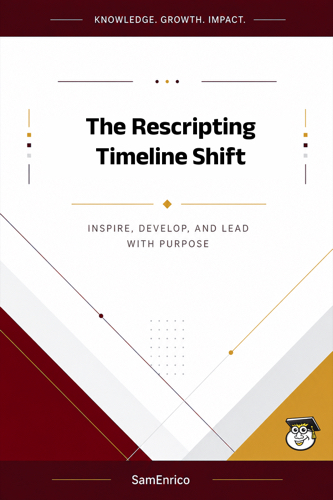
The Rescripting Timeline Shift eBook
Moves nightmare events to different chronological
Moves nightmare events to different chronological position for safety.
Formats
Free sample
Chapter 1: The Broken Arrow...--–- The archer stood at the edge of the forest, bow drawn, arrow aimed at a target fifty yards away. She released. The arrow flew straight, struck the target with a satisfying thud, and stayed there. She could walk up to it, touch it, describe it to a friend, even pull it out and examine it. But the arrow did not move on its own.
It did not chase her. It did not whisper to her in the middle of the night. It did not hijack her body when she smelled rain on asphalt. It stayed exactly where it landed: in the past.Now imagine a different arrow. This one is broken.
It leaves the bow, but instead of sticking in the target, it pierces through time itself. It hits you in the chest—not in the moment of release, but ten years later, while you are buying groceries, while you are lying in bed, while you are laughing at a joke you almost meant. It keeps moving. It moves through your body, your relationships, your sleep, your ability to trust your own perceptions. This is the broken arrow of the nightmare event.
And if you are reading this book, you know exactly what it feels like.This is not a metaphor about memory. This is a description of how traumatic experience actually functions in the human nervous system. The difference between an ordinary bad memory and a nightmare event is not a matter of degree—it is a matter of position. An ordinary bad memory sits in the past where it belongs. You can visit it, but you do not live there.
A nightmare event, however, does not know it is past. It has not received the proper filing paperwork from your brain. And so it lives in your present tense, masquerading as a current threat, activating your survival systems as if the danger were happening right now, in this room, at this moment.This chapter is the first step in understanding why your nightmare feels unshakable. It is not because you are weak. It is not because you are broken.
It is because your brain—in a desperate, intelligent attempt to keep you alive—filed the event in the wrong folder. And once you understand where the nightmare is actually located on your internal timeline, you can begin the work of moving it to a position of safety.The Present Tense Trap Let us name the problem directly. Most people who have survived a nightmare event—whether a single catastrophic incident or a long period of sustained threat—describe the same frustrating phenomenon: they know the event is over. They know, intellectually, that the danger has passed. The calendar says it is 2026.
The abuser is gone. The accident happened years ago. The diagnosis was treated. The war ended. And yet, their bodies do not seem to have received the memo.This is the Present Tense Trap.
It is the experience of being logically certain that you are safe while your nervous system behaves as if you are not. Your heart races at a sound that means nothing. Your breath stops at a smell that no one else notices. Your muscles brace for impact when you are standing in a quiet room. You are here, but some part of you is still there—still inside the nightmare, still running the survival script, still waiting for the next blow.Consider Sarah, a forty-two-year-old teacher who was in a car accident eight years ago.
She knows the accident is over. She knows she survived. She knows she has driven thousands of miles since then without incident. And yet, every time she hears tires squeal—even on a television show, even from two blocks away—her heart pounds, her hands grip the steering wheel (even if she is not driving), and she finds herself holding her breath until the sound fades. Her body does not know the difference between a real threat and a memory.
Her body is stuck in 12 o'clock.The Present Tense Trap is not a moral failure. It is not a lack of faith or willpower or positive thinking. It is a neurobiological fact. And the first step out of the trap is understanding how you fell into it.The Smoke Detector and the Calendar Inside your skull, two structures are locked in a constant negotiation over the nature of reality. One is the amygdala.
Think of the amygdala as the smoke detector of your brain. Its job is simple: detect threat, sound the alarm, mobilize the body for survival. The amygdala does not care about context, nuance, or chronology. It does not ask whether the smoke is from a house fire or a burnt piece of toast. It just screams.The other structure is the hippocampus.
Think of the hippocampus as the calendar and the GPS of your brain. Its job is to record when something happened and where it fits in the sequence of your life. The hippocampus is the reason you know that your fifth birthday party came before your first day of kindergarten. It is the reason you can distinguish between a memory from 2015 and a thought about tomorrow. It is the reason you can say, "That was then, and this is now."Under normal conditions, the amygdala and the hippocampus work together like a well-trained emergency response team.
A threat occurs. The amygdala sounds the alarm. The hippocampus records the date, time, and context. Later, when the threat is gone, the amygdala calms down, and the memory is filed away in the past where it belongs. The arrow sticks in the target.But under conditions of extreme threat—the kind that produces nightmare events—this system breaks down.
The amygdala screams so loudly, so urgently, that the hippocampus essentially shuts down. The brain makes an executive decision: recording when the event is happening is less important than surviving that it is happening. The hippocampus goes offline. The date stamp never gets applied.This was not a mistake. It was a brilliant survival strategy.
Your brain prioritized your immediate survival over your long-term archival system. It chose to keep you alive in the moment rather than ensure that your memories would be neatly organized for the future. That trade-off saved your life. But it left you with a memory that has no expiration date.And without a date stamp, the memory cannot be filed under "past." It sits in a neural folder labeled "NOW." This is why your body reacts as if the nightmare is still happening. As far as your amygdala is concerned, it is still happening.
The alarm has been ringing continuously since the event occurred. You have just learned to live with the sound—or rather, to live despite the sound.Why Logic Does Not Work Here is a truth that will save you years of frustration, thousands of dollars in therapy that focuses on the wrong target, and countless hours of self-recrimination: you cannot think your way out of the Present Tense Trap.Most self-help approaches assume that if you just change your thoughts, your feelings will follow. This is useful for many ordinary problems—anxiety about a presentation, worry…
This is the end of the free sample. Get the eBook to keep going. Buy now
About this book
Details
- Author
- Keegan Valene
- Publisher
- SamEnrico
- Language
- English
- Genre
- Non-Fiction, Self-Help, Chronology
- Released
- 2026-06-07
- Pages (approx.)
- 139
- Available as
- eBook, Audiobook

Read better in the ZLOADR app
Your eBooks on your phone or tablet. Sign in with your SamEnrico account and start reading.
More by Keegan Valene
 Fiverr Promoted Gigs ROI CalculatorKeegan Valene$11.99
 NamUs Unidentified Remains PhotographyKeegan Valene$11.99
 The Self Hypnosis ScriptbookKeegan Valene$11.99
 Refugee To RestaurateurKeegan Valene$11.99
 Kegel Exercise GuideKeegan Valene$11.99
 Resilience for StudentsKeegan Valene$11.99
 Handling Tech FailuresKeegan Valene$11.99
 Ymir's Breath: How the First Giant Shaped the Nine RealmsKeegan Valene$11.99
 The Clash of the Titans: Freddie Mercury and Bruce Dickinson – The Rivalry That Rocked the UKKeegan Valene$11.99
 Growing CastanopsisKeegan Valene$11.99
 A Collector's Handbook to the Singer Vogue IKeegan Valene$11.99
 Franchise International HR GuideKeegan Valene$12.99