
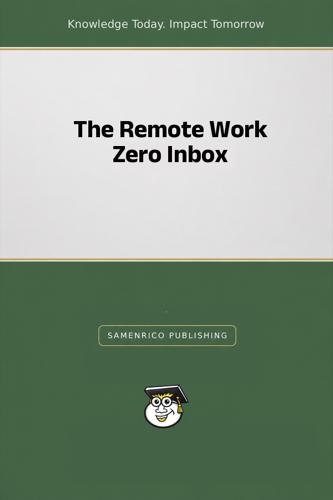
The Remote Work Zero Inbox eBook
Achieves and maintains empty email state daily.
Achieves and maintains empty email state daily.
Formats
Free sample
Chapter 1: The Inbox Lie--You have been lied to about your email.Not by a specific person or company, but by a slow accumulation of workplace myths, productivity gurus, and your own desperate hope that maybe—just maybe—the next notification will be the important one. The lie is simple and seductive: A full inbox means you are busy, and busy means you are valuable.This lie has cost you thousands of hours. It has stolen your mornings, fractured your attention, and followed you from the office into your home. And now that you work remotely, without the physical boundary of a commute or the social pressure of visible colleagues, the lie has grown stronger. Your inbox is no longer just a tool.
It has become a tyrant.I know this because I lived it. For years, I wore my overflowing inbox like a medal. Look at all these unread messages, I told myself. Look at all these people who need me. I am essential.
I am responsive. I am working. The red badge on my phone was a scoreboard, and I was winning.Except I was not winning. I was drowning.Every morning, I opened my email before I opened my eyes. I answered messages while brushing my teeth, while making coffee, while sitting on the couch pretending to listen to my family.
I told myself this was dedication. It was not. It was addiction. And the addiction had a name: the Inbox Lie.The Myth of Busyness The Inbox Lie rests on a foundational myth that most workplaces secretly endorse: that visible activity is the same as productive output. In an office, this myth manifests as the cult of the full calendar—back-to-back meetings, constant interruptions, the performative hustle of walking fast between desks.
In a remote setting, where no one can see you walking, email becomes the primary evidence of your existence.Think about this honestly. When was the last time you felt good about your email? Not relieved that you finally processed it, but genuinely good about the time you spent there. For most people, the answer is never. Email is not a source of satisfaction.
It is a source of anxiety. The relief you feel when you hit zero is not the joy of accomplishment. It is the temporary cessation of pain.This is not an accident. Email is designed to exploit the same psychological mechanisms as slot machines. Every notification is a variable reward—sometimes important, usually not, but always promising the possibility of significance.
The anticipation of a message triggers a small release of dopamine, the same neurotransmitter involved in gambling addiction. You are not checking email because you are productive. You are checking email because you are chasing a high.The Inbox Lie tells you that this chasing is work. It is not. It is avoidance.The Remote Worker's Unique Burden When you worked in an office, you had guardrails.
The commute gave you time to transition. The physical separation of your desk from your home created a natural boundary. And perhaps most importantly, your colleagues could see you. They could see you at your desk, in meetings, walking to the printer. You did not need to prove your existence through email because your presence was visible.Remote work removes these guardrails.
Your colleagues cannot see you. They cannot see you working, thinking, or producing. The only evidence they have of your activity is often your responsiveness to digital communication. This creates a perverse incentive: you must perform your work through email, even when email has nothing to do with your actual output.I have coached hundreds of remote workers, and the pattern is universal. The remote worker opens email first thing in the morning—not because they need to, but because they are afraid of what might happen if they do not.
They fear being seen as lazy, unresponsive, or replaceable. They fear that a delayed reply will be interpreted as disengagement. They fear that silence will be mistaken for absence.These fears are not irrational. They are logical responses to an illogical system. But they are also symptoms of the Inbox Lie.
The lie tells you that your inbox is a measure of your worth. The truth is that your inbox is a measure of nothing except other people's ability to send you messages.What a Full Inbox Actually Means Let us conduct a small experiment together. Open your email right now—not to answer anything, just to look. Look at the unread count. Now ask yourself a question: What percentage of these unread emails are actually important?Be honest.
For most people, the answer is somewhere between 5 and 15 percent. The other 85 to 95 percent are noise: newsletters you never subscribed to, automated alerts from systems you do not use, colleagues who CC'd you for no reason, marketing messages, calendar reminders, and threads where you have no action but remain attached out of politeness.A full inbox, in other words, is not evidence of high demand. It is evidence of poor filtering. It is evidence that you have allowed the world to dump its unfinished business into your brain without your consent.Every unread email is an open loop in your consciousness. The Zeigarnik Effect, a well-documented psychological phenomenon, shows that unfinished tasks occupy more mental bandwidth than completed ones.
Your brain keeps circling back to unread emails, trying to remember to deal with them, consuming cognitive energy even when you are not looking at the screen. This is why you feel tired after a day of email. You have not done heavy lifting. You have been carrying open loops.The Inbox Lie tells you that these open loops are your responsibility. The truth is that most of them are not.
Most emails do not require your input, your approval, or even your attention. They require only one thing: deletion.The Output Fallacy Here is the most dangerous part of the Inbox Lie: it confuses activity with output. Answering email feels productive. You move messages, you type replies, you check items off a list. But what have you actually produced?
Have you written anything? Have you solved a difficult problem? Have you created value for your organization, or have you simply shuffled digital paper?In most knowledge work, the truly valuable output is the work that requires sustained focus: writing code, designing systems, analyzing data, creating strategy, solving complex problems. Email is almost never the source of this value. Email is the interruption that prevents it.The remote worker who spends four hours on email has not done four hours of work.
They have done four hours of reaction. And reaction, no matter how fast or efficient, is not creation. The Inbox Lie convinces you that responding is enough. It is not. Responding is the minimum.
Creating is the work.The Zero Inbox Definition Let me clarify something important before we go further. When I say "Zero Inbox," I am not talking about a personality trait or a productivity trophy. I am not suggesting that you should reply to every email, achieve some mythical state of empty, or spend your life policing your messages. That would be a different kind of tyranny.Zero Inbox…
This is the end of the free sample. Get the eBook to keep going. Buy now
About this book
Details
- Author
- Mccann Marietta
- Publisher
- SamEnrico
- Language
- English
- Genre
- Non-Fiction, Self-Help, Email
- Released
- 2026-06-11
- Pages (approx.)
- 121
- Available as
- eBook, Audiobook

Read better in the ZLOADR app
Your eBooks on your phone or tablet. Sign in with your SamEnrico account and start reading.
More by Mccann Marietta
 Weight Loss Self Hypnosis GuideMccann Marietta$11.99
 Meeting Recap AutomationMccann Marietta$11.99
 Richard Ramirez Mugshot StoryMccann Marietta$11.99
 Calvin Coolidge Silent CalMccann Marietta$11.99
 The Last Letter: A Love Rekindled Across TimeMccann Marietta$11.99
 Black Sunday: The Storm That Stole the PlainsMccann Marietta$11.99
 Understanding Cutis Verticis Gyrata Thyroid Aplasia Mental RetardationMccann Marietta$17.99
 Carbon Capture Tax CreditMccann Marietta$12.99
 Influencer Marketing One PageMccann Marietta$12.99
 Big Data EngineerMccann Marietta$11.99
 How to Start a Hobby in Metal detectingMccann Marietta$11.99
You may also like
 Hong Kong Handover 1997Dunn Johnnie$11.99
 Zumba For Postnatal Recovery CourseNeal Christian$11.99
 Zumba for BeginnersLadner Nikia$11.99
 YouTube Comment Mining GuideHumes Pandora$12.99
 Worry Box MeditationCarlin Rudy$11.99
 Workplace Stress MeditationNguyen Lynn$11.99
 Workplace Stress and Sleep RepairHawley Ivory$11.99
 Workplace Perfectionism CureDelaney Jeffry$11.99
 Workplace Injustice Anger GuideWallen Isabelle$11.99
 Work Addiction and Burnout LinkGreenwood Ester$11.99
 Women in Yoga and WellnessBeattie Galina$11.99
 Women in Stand Up ComedyChun Evangeline$11.99