
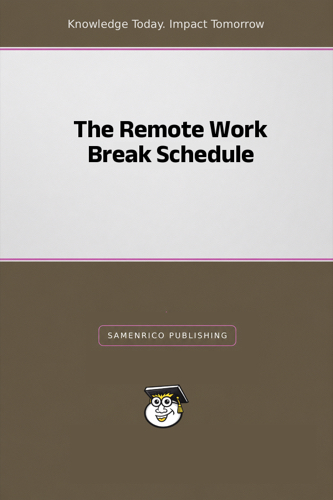
The Remote Work Break Schedule eBook
Optimizes rest intervals to prevent burnout and ey
Optimizes rest intervals to prevent burnout and eye strain.
Formats
Free sample
Chapter 1: The 3 PM Zombie--–- Jess stared at her screen, but she wasn't really seeing it. The cursor blinked on the seventeenth email she had started and abandoned. Her eyes burned. Her neck ached. She had been "working" for seven hours, yet the only task she had completed was a spreadsheet that took forty-five minutes and should have taken fifteen.
It was 3:17 PM on a Tuesday. She was a remote worker, a good one—or at least she had been, before the pandemic blurred every line between her kitchen table and her career. Now, she was something else: a 3 PM zombie. Functioning, but barely. Present, but not productive.
And she had no idea why.This book is for Jess. And for you, if you have ever finished a workday feeling exhausted yet accomplished nothing. If you have ever closed your laptop and felt a headache bloom behind your eyes. If you have ever taken a "break" by opening Instagram, only to feel worse twenty minutes later. You are not lazy.
You are not broken. You are fighting a work model that was designed for a factory floor, not a human brain. And you are losing because no one ever taught you how to stop.The Great Productivity Lie For the past century, productivity advice has been built on a single, seductive lie: that more hours equal more output. The factory worker who stays late stamps more widgets. The accountant who skips lunch processes more forms.
The logic is simple, linear, and wrong for knowledge work—and catastrophically wrong for remote knowledge work.Consider the most famous productivity study of the past decade. In 2014, the Draugiem Group, a technology company, used time-tracking software to analyze the habits of its highest-performing employees. The researchers expected to find that the top 10% worked longer hours. They did not. Instead, they discovered something startling: the most productive workers did not work longer; they worked in shorter, more intense bursts.
The optimal pattern, emerging from hundreds of thousands of hours of data, was 52 minutes of focused work followed by 17 minutes of complete rest. Not 53 minutes. Not 51. Precisely 52 and 17.Let that land. The best workers in the study worked for less than an hour, then stopped for nearly twenty minutes.
They repeated this cycle throughout the day. And they outperformed everyone else.This finding has been replicated in various forms across multiple industries. A 2019 study from the University of Illinois found that brief diversions—as short as five minutes—dramatically improved focus on complex tasks. A 2017 analysis of workplace productivity software data showed that the average worker's focus begins to degrade after just forty minutes. The most productive 10% of workers take breaks seventeen minutes long, on average.
The least productive take breaks of only four minutes.Yet the 52/17 rule remains the exception, not the norm. Most remote workers do the opposite: they work for hours without stopping, then collapse into exhaustion. They take frequent but ineffective "breaks"—checking email, scrolling social media, switching tabs—that provide no real recovery. And they end their days feeling like Jess: burned out, blurry-eyed, and unsure where the time went.The Office Had Invisible Guardrails To understand why remote work has made this problem worse, we need to look at what the office provided for free: social entrainment. This is the psychological term for how our behavior synchronizes with the people around us.
In an office, you did not need a timer to tell you to take a break. You saw your coworker stand up and stretch. You heard the coffee machine hiss. You noticed the lunch crowd migrating to the kitchen. Your brain absorbed these cues unconsciously and adjusted your behavior accordingly.The office also provided structural breaks that you did not choose: the commute, the walk to a meeting room, the five minutes waiting for the elevator, the casual chat at the printer.
These micro-interruptions, which seemed annoying at the time, were actually critical recovery periods. They gave your eyes a chance to refocus at a different distance. They gave your brain a chance to shift from focused to diffuse mode. They gave your body a chance to uncramp its muscles.Remote work removed all of this. Your home office is a cue-less environment.
No one stands up to signal that it is time to stretch. No coffee machine gurgles to remind you to hydrate. No commute forces you to transition from work to home. Instead, you sit in the same chair, look at the same screen, and breathe the same air for nine, ten, eleven hours. Your brain, which evolved to respond to environmental cues, receives no signal to rest.
So it does not rest. You work until your body forces you to stop—which means you work until you are exhausted, not until you are done.The Hidden Cost of Skipping Breaks The consequences of this broken rhythm are not abstract. They are physical, measurable, and accumulating in your body right now. Let me name three that you have probably experienced in the past week.Cognitive fatigue is the first. Your brain runs on glucose and oxygen, both of which deplete during focused work.
After approximately ninety minutes of continuous concentration, your mental processing speed drops by up to 30%. Your working memory—the ability to hold information in your head while you manipulate it—shrinks by nearly half. You become slower, dumber, and more error-prone. But here is the cruel irony: you do not feel dumber. You feel tired, but you still think you are thinking clearly.
This is called the meta-cognitive blind spot, and it is why you send emails at 4 PM that you regret at 9 AM.Physical strain is the second. Every hour you sit without moving, your spinal discs lose fluid and compress. Your hip flexors shorten. Your trapezius muscles knot. Your wrists, held in extension over a keyboard, begin to compress the median nerve.
These are not minor annoyances; they are the precursors to chronic conditions that take months of physical therapy to reverse. The average remote worker sits for 9.5 hours per day. The human body was not designed for this. Your spine is a column of shock-absorbing jelly between bones. That jelly needs movement to stay hydrated.
Without it, you are slowly crushing your own vertebrae.Emotional erosion is the third, and perhaps the most insidious. Isolated work without social breaks triggers a sustained cortisol response. Your body, interpreting the lack of human contact as a threat, keeps your stress hormones elevated. This makes you irritable, anxious, and prone to catastrophic thinking. That small mistake on a spreadsheet feels like proof that you are failing at your job.
That unanswered email feels like evidence that your team has turned against you. Your brain, awash in cortisol, is lying to you. But you believe it anyway.Why This Chapter Is Not Like Other Productivity Advice You have read productivity advice before. You have tried the Pomodoro Technique (twenty-five minutes on, five minutes off). You have attempted to schedule your day in ninety-minute "ultradian cycles." You have downloaded apps that block social media and track your screen time.
And none of it stuck. That is not because you lack discipline. It is because most productivity advice is designed…
This is the end of the free sample. Get the eBook to keep going. Buy now
About this book
Details
- Author
- Nobles Wilhemina
- Publisher
- SamEnrico
- Language
- English
- Genre
- Non-Fiction, Self-Help, Health
- Released
- 2026-06-09
- Pages (approx.)
- 128
- Available as
- eBook, Audiobook

Read better in the ZLOADR app
Your eBooks on your phone or tablet. Sign in with your SamEnrico account and start reading.
More by Nobles Wilhemina
 Disappointment Reprocessing GuideNobles Wilhemina$11.99
 Plant Based Heart Disease Prevention WorkbookNobles Wilhemina$11.99
 The Dancer Flexibility GuideNobles Wilhemina$11.99
 Franchising Your Local Brand Across Borders Culture GuideNobles Wilhemina$11.99
 Frozen Secrets: The Hunt for the Lost Franklin ExpeditionNobles Wilhemina$11.99
 The Last Transmission: The Mysterious Final Broadcast of S.O.S. TitanicNobles Wilhemina$11.99
 Seasonal Housekeeping Team MemberNobles Wilhemina$11.99
 Understanding CroupNobles Wilhemina$17.99
 Late Fee Penalty GuideNobles Wilhemina$12.99
 Low Ticket Sales ScriptNobles Wilhemina$12.99
You may also like
 Hong Kong Handover 1997Dunn Johnnie$11.99
 Zumba For Postnatal Recovery CourseNeal Christian$11.99
 Zumba for BeginnersLadner Nikia$11.99
 YouTube Comment Mining GuideHumes Pandora$12.99
 Worry Box MeditationCarlin Rudy$11.99
 Workplace Stress MeditationNguyen Lynn$11.99
 Workplace Stress and Sleep RepairHawley Ivory$11.99
 Workplace Perfectionism CureDelaney Jeffry$11.99
 Workplace Injustice Anger GuideWallen Isabelle$11.99
 Work Addiction and Burnout LinkGreenwood Ester$11.99
 Women in Yoga and WellnessBeattie Galina$11.99
 Women in Stand Up ComedyChun Evangeline$11.99