
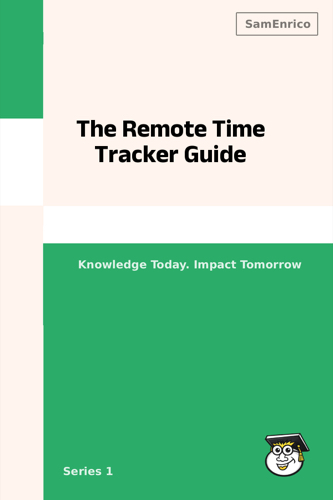
The Remote Time Tracker Guide eBook
Use apps like Toggl or RescueTime to measure produ
Use apps like Toggl or RescueTime to measure productivity.
Formats
Free sample
Chapter 1: The Leaking Vessel--–- Emma stared at her screen, exhausted but confused. It was 6:47 PM on a Tuesday. She had started work at 8:15 AM, skipped lunch, answered forty-three emails, attended three Zoom meetings, and felt like she had run a marathon. Her task list, however, showed only two small items completed. She had worked ten and a half hours.
She had nothing meaningful to show for it.Emma is a senior marketing manager at a mid-sized software company. She transitioned to fully remote work fourteen months ago, after the pandemic forced her office to close permanently. She remembers the early days of remote work fondly: no commute, no interruptions from well-meaning colleagues, no fluorescent lights buzzing overhead. She was supposed to be more productive. Instead, she found herself working longer hours and feeling less effective.
Something was leaking. She just couldn’t see where.This chapter is about that invisible leak. It is about the gap between how many hours you think you work and how many minutes you actually produce. It is about the environmental cues you lost when you left the office—the commute, the chatter, the colleague who packs up at 5:01 PM—and how their absence has silently eroded your focus. And it is about the first, most important step in reclaiming your time: measurement without judgment.If you have ever finished a workday feeling simultaneously exhausted and unaccomplished, you are not lazy.
You are not broken. You are simply missing the data that would reveal where your time is going. This chapter will give you that data—or rather, it will show you how to collect it for yourself.The Myth of the “Full” Workday Let us begin with a simple question: How many productive minutes do you believe you work on an average day?Write down your answer. Seriously. Take a moment.
Most people answer between six and seven hours. Some optimists say eight. A rare few admit to four or five.Now here is the uncomfortable truth, drawn from tens of thousands of Rescue Time users: the average knowledge worker spends only two hours and forty-eight minutes on productive tasks each day. The rest is context-switching, email, meetings, social media, logistics, and what researchers call “pseudo-work”—activities that feel like work but produce no tangible output.Two hours and forty-eight minutes.That is not a typo. In a standard eight-hour workday, the average person is genuinely productive for less than three hours.
The remaining five hours and twelve minutes leak away into the cracks of the digital workplace, unnoticed and unmeasured. And here is the cruelest part: most people have no idea this is happening to them.Emma, our marketing manager, guessed she worked six productive hours per day. When she finally ran a time tracker for three days without changing her behavior, her actual productive minutes averaged two hours and nineteen minutes. She was off by a factor of nearly three. The gap between her perception and reality was not a lie—it was a blind spot.This gap exists for nearly everyone.
It is not a character flaw. It is a feature of how the human brain works in the absence of environmental structure.The Lost Cues of Office Life To understand why your time is leaking, you must first understand what remote work took away that you never noticed.In a traditional office, your environment constantly nudges you toward focus and away from distraction—not through willpower, but through simple physics and social pressure.The commute served as a transition ritual. Whether twenty minutes or an hour, your drive or train ride gave your brain time to shift from “home mode” to “work mode.” By the time you sat at your desk, you were already partially primed for focus. Remote work collapses that transition to thirty seconds—the time it takes to walk from your bedroom to your home office. Your brain never fully switches gears.The open office chatter (yes, even the annoying kind) provided a low-grade accountability layer.
When colleagues could see your screen, you were less likely to open Twitter. When someone could walk by your desk, you were more likely to stay on task. Not because you feared punishment, but because humans are social animals who adapt to the expectations of those around them. Remote work removes that social gaze entirely.The end-of-day exodus—colleagues packing up, lights dimming, janitorial staff appearing—signaled that work had ended. Even if you stayed late, the environmental cues told you that you were an exception.
Remote work has no such cues. Your laptop remains open. Slack keeps pinging. The workday bleeds into the evening, and the evening bleeds into the next morning.The physical separation between work and home meant that leaving the office literally shut the door on your tasks. Remote work collapses that boundary.
The laptop is always there. The inbox is always three clicks away. You never truly leave.These lost cues are not minor conveniences. They are the scaffolding that held up your attention. Remove them, and your focus does not just weaken—it scatters.Attention Residue: The Hidden Tax You Pay Every Switch Sophie Leroy, a professor at the University of Washington Bothell, coined one of the most important concepts in modern productivity research: Attention Residue.Here is the idea.
When you work on Task A and then switch to Task B, a portion of your attention does not fully transfer. It remains stuck on Task A, like a drop of water clinging to a glass after you pour it out. That residual attention—the “attention residue”—reduces your performance on Task B, sometimes dramatically.Leroy’s research found that people who switch tasks before completing the first one perform significantly worse on the second task, even when the tasks are completely unrelated. Worse, the more cognitively demanding the first task, the more residue it leaves behind.Now consider the average remote worker’s day. You are writing a report (Task A, high cognitive load).
A Slack notification appears. You switch to Slack to answer a quick question (Task B). Even if the answer takes thirty seconds, you have now left attention residue on Slack when you return to the report. Your report writing slows. You make more errors.
You take longer to refocus. And crucially, you do not feel the slowdown—you just feel tired.Multiply this by the average number of daily task switches. Gloria Mark, a researcher at the University of California, Irvine, found that knowledge workers switch tasks an average of every three minutes and five seconds. That is more than fifteen switches per hour. Each switch leaves a trail of attention residue.
By midday, your brain is wading through a swamp of half-attached thoughts.Time trackers like Rescue Time and Toggl reveal this hidden tax not by measuring residue directly (impossible), but by measuring the cost of switching. When you look at your tracker data, you will see that the first fifteen minutes after an interruption are your slowest. You will see that days with many short tasks produce less output than days with a few long blocks. You will see the residue, reflected in the clock.Emma’s tracker showed that…
This is the end of the free sample. Get the eBook to keep going. Buy now
About this book
Details
- Author
- Weir Nathanial
- Publisher
- SamEnrico
- Language
- English
- Genre
- Non-Fiction, Self-Help, Tracking
- Released
- 2026-06-10
- Pages (approx.)
- 147
- Available as
- eBook, Audiobook

Read better in the ZLOADR app
Your eBooks on your phone or tablet. Sign in with your SamEnrico account and start reading.
More by Weir Nathanial
 Personal Brand for LegalWeir Nathanial$11.99
 Alcohol Withdrawal Fever GuideWeir Nathanial$11.99
 Working Memory For Chess PlayersWeir Nathanial$11.99
 LGBTQ Relationship Self WorthWeir Nathanial$11.99
 Emotion Coaching GuideWeir Nathanial$11.99
 Window of Tolerance ExpansionWeir Nathanial$11.99
 Premium Calculation FactorsWeir Nathanial$11.99
 The Last Heist of the Silver FoxWeir Nathanial$11.99
 The Architects of the Sky: How the Nubians Built the Monuments of the NileWeir Nathanial$11.99
 How to Produce Fireman's MasksWeir Nathanial$11.99
 Freemium Pricing Inflation ShieldWeir Nathanial$12.99
 JEE Parent Support GuideWeir Nathanial$12.99
You may also like
 The Teen Accomplishment LogCallaway Yesenia$11.99
 Listening Log JournalKeeler Georgann$11.99
 Emotion Diary CardStaley Norberto$11.99
 DBT Emotion Diary CardLoper Rebekah$11.99
 The DBT Skill TrackerSwanson June$11.99
 Emotion Log MethodMireles Lane$11.99
 The Pain Monitoring DiaryCottrell Russell$11.99
 Noticing Hypnosis EffectsZeigler Rayna$11.99
 Gambling Urge Log and TrackerSpring Billi$11.99
 Habit Tracking JournalPrentice Dotty$11.99
 Emotion Diary Card WorkbookBraswell Janell$11.99
 Anger Trigger Pattern LogBertram Malinda$11.99