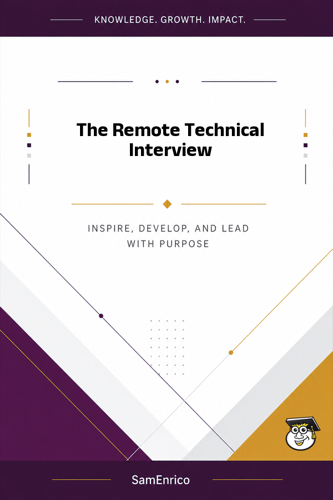
The Remote Technical Interview eBook
Hire engineers and specialists effectively through
Hire engineers and specialists effectively through screens.
Formats
Free sample
Chapter 1: The Frozen Screen--–- The video froze at exactly 14 minutes and 23 seconds. On my screen, the candidate—let’s call her Priya—was mid-sentence, her mouth frozen in an awkward half-smile, her hand hovering over a whiteboard diagram that I couldn’t quite make out through the compression artifacts. I waited. Three seconds. Five.
Ten. Then I did what most interviewers do: I filled the silence. “It looks like we lost you,” I said, even though I wasn’t sure if she could hear me. “Let me repeat the question.”But Priya hadn’t lost me. Her video had frozen, but her audio was still transmitting.
She heard everything I said, including my impatient sigh and the quiet “here we go again” I muttered to myself. When her video resumed thirty seconds later, she had lost her train of thought, her confidence, and—as I would learn weeks later—any interest in working for my company. She finished the interview politely, solved the coding problem correctly, and then declined our offer. When I asked for feedback, she wrote: “Your team seemed frustrated with me before I even started typing.”I was the frustrated one. And I was wrong.That was my wake-up call.
For five years, I had conducted technical interviews the same way: in-person, whiteboard, gut feeling. I had convinced myself that I was a good judge of engineering talent. My hires had a 70% retention rate at 12 months—above industry average, I told myself. But when my company went fully remote in 2021, everything fell apart. My false positive rate (hiring someone who failed within six months) jumped from 15% to 34%.
My false negative rate (rejecting someone who would have succeeded) was impossible to measure, but I could feel it in the quality of our candidate pipeline—it was drying up, because word had spread that our interview process was “unpredictable” and “unfair.”I spent the next two years interviewing every failed candidate I could find, studying the research on remote hiring, and rebuilding my process from scratch. This book is what I learned. But before we get to the solutions, we need to talk about the problem—and the problem isn’t remote work. The problem is that your in-person interview process was never as good as you thought it was.The Illusion of the Whiteboard Let me tell you a story that will make every hiring manager uncomfortable. In 2019, a team of researchers at North Carolina State University conducted a study that should have changed technical interviewing forever.
They gave the same coding problem to 48 professional engineers, half of whom were asked to solve it on a whiteboard while being watched, and half of whom were asked to solve it on their own laptop with no observation. Then they had independent reviewers evaluate the solutions without knowing which condition produced which.The results were devastating: the whiteboard condition produced code that was 40% more likely to have syntax errors, 55% more likely to have logic flaws, and—most damning—was rated as “lower quality” by the independent reviewers, even when the code was functionally identical to the laptop condition. The presence of an audience, the pressure of the whiteboard, the lack of a compiler—all of it combined to create a performance environment that had almost nothing to do with actual engineering ability.But here’s the part that should scare you: the researchers also surveyed the interviewers who watched the whiteboard sessions. Those interviewers consistently rated the whiteboard candidates as “more competent” than the laptop candidates—even though the whiteboard code was objectively worse. Why?
Because the whiteboard candidates talked more. They gestured. They filled the silence with verbal processing. They performed confidence, and the interviewers mistook that performance for ability.That’s the illusion of the whiteboard. It rewards theater, not engineering.Now transfer that illusion to a remote setting.
Remove the physical whiteboard. Remove the ability to see the candidate’s scratch paper. Remove the ambient cues of posture and eye contact. What’s left? For most interviewers, the answer is panic.
They feel like they’re flying blind. So they overcorrect—they demand more structure, more tests, more evidence—and in doing so, they filter out the very candidates who would thrive in a remote environment.The Three Lies We Tell Ourselves About Remote Interviews Before we can fix remote interviewing, we need to name the lies that are keeping us stuck. I’ve heard these from hundreds of hiring managers, and I’ve told them to myself. They feel true. They are not.Lie #1: “I can tell within five minutes if someone is good.”No, you can’t.
What you can tell within five minutes is whether someone is charismatic, well-rested, and comfortable on video. Those traits have zero correlation with engineering ability. In fact, research from the Journal of Applied Psychology shows that first-impression accuracy in interviews is barely above chance—about 54%, which is statistically indistinguishable from flipping a coin. But our brains hate uncertainty, so we latch onto those first five minutes and then spend the rest of the interview looking for evidence that confirms our initial judgment. This is called confirmation bias, and it’s the enemy of good hiring.In a remote setting, confirmation bias becomes even more dangerous because the first five minutes are dominated by technical setup issues.
Is the candidate’s camera angle flattering? Did they figure out how to share their screen? Did they remember to unmute? These are signals of preparation, maybe, but not of engineering talent. Yet I’ve watched hiring managers reject candidates because they “seemed distracted” when the real problem was a slow internet connection.Lie #2: “Remote interviews make it easier to cheat.”This is the fear that keeps recruiters up at night.
The rise of Chat GPT, Copilot, and other AI tools has convinced many hiring managers that every candidate is secretly googling the answers. But here’s what the data actually shows: cheating rates in remote interviews are nearly identical to cheating rates in in-person interviews. Why? Because the same people who would cheat remotely would also cheat in person—they’d sneak a phone into the bathroom, or ask a friend to feed them answers via earpiece. Cheaters cheat.
Remote work just changes the method.More importantly, the fear of cheating leads to a much worse problem: defensive interviewing. When you assume the candidate is cheating, you start asking trick questions, obscure algorithms, and gotcha puzzles. You make the interview harder, not to assess ability but to catch dishonesty. And in doing so, you guarantee that the only candidates who pass are the ones who have memorized every edge case—which has nothing to do with real engineering work.*Lie #3: “In-person interviews give me better signal.”*Do they? Let’s look at the evidence.
A meta-analysis published in the journal Personnel Psychology reviewed 50 years of interview research and found that unstructured in-person interviews (the kind most of us do) have a predictive validity of just 0.20 for job performance. That’s barely above zero. Structured interviews—whether in-person or remote—have a validity of 0.51, which is meaningfully better. The medium doesn’t matter nearly as much as the structure.What does change in…
This is the end of the free sample. Get the eBook to keep going. Buy now
About this book
Details
- Author
- Mcwhorter Madie
- Publisher
- SamEnrico
- Language
- English
- Genre
- Non-Fiction, Business Brief, Hiring
- Released
- 2026-06-09
- Pages (approx.)
- 145
- Available as
- eBook, Audiobook

Read better in the ZLOADR app
Your eBooks on your phone or tablet. Sign in with your SamEnrico account and start reading.
More by Mcwhorter Madie
 Step Four Resentment WorksheetMcwhorter Madie$11.99
 Herbal Hair Loss RemediesMcwhorter Madie$11.99
 Stress and Interracial CouplesMcwhorter Madie$11.99
 The Golden Quill of the Nile: The Literary Majesty of Ancient Egypt's PoetsMcwhorter Madie$11.99
 How to Start a Oil Platform Structural Sections Business (Beginners Guide)Mcwhorter Madie$11.99
 Call Center Representative InboundMcwhorter Madie$11.99
 Ecommerce Translation EngineMcwhorter Madie$12.99
 How to Produce Body Paint and FoundationMcwhorter Madie$11.99