
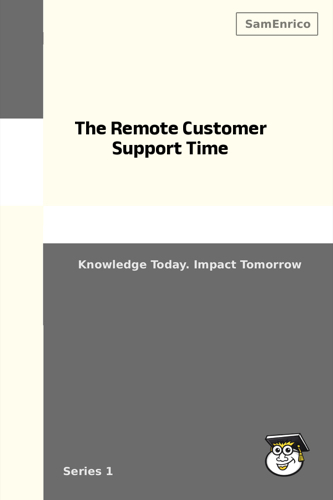
The Remote Customer Support Time eBook
Manage ticket volume and response times while work
Manage ticket volume and response times while working from home.
Formats
Free sample
Chapter 1: The Invisible Queue--–- You are not lazy. You are not bad at your job. You are fighting a ghost.Every morning, you open your laptop, log into the ticketing system, and feel it before you see it. That low-grade dread. That sense that somewhere, in a queue you cannot see, customers are waiting.
Not patiently. Not kindly. Waiting with the particular frustration that only digital silence can create.You pour your coffee. You open the queue. And there it is: forty-seven tickets.
Forty-seven separate humans, each wanting something different. Each convinced their problem is the one that should jump to the front of the line.By 10:00 AM, you have answered twelve. By noon, twenty-three. By 4:00 PM, you are staring at the same number you started with. Forty-seven.
Because while you answered twenty-three, twenty-three more arrived. The queue is not a line. It is a leaky bucket.This is the invisible queue. And it is lying to you.The Great Misunderstanding When customer support teams worked in offices, the queue was physical. You could see your coworkers.
You could hear the phones. You could glance across the room and know, without asking, whether everyone was drowning or just you. That ambient awareness calibrated your urgency. If Sarah was calmly sipping tea while typing, the queue was probably fine. If three people were on hold and Jim was pacing, you knew to speed up.Remote work removed that calibration.
Now, you sit alone. The queue is just numbers on a screen. And because you cannot see anyone else working, your brain assumes the worst: everyone else is fine, and you are the only one struggling.This is not a personality flaw. It is a neurological response to missing data.Consider what happens when you hear a siren but cannot see where it is going. Your heart rate increases.
You look around. You brace for impact. The unknown is more stressful than the known, even when the known is bad. Psychologists call this ambiguity aversion. Your brain would rather know you have ninety tickets than wonder if you have ninety tickets.The remote queue exploits this.
You do not know how deep it goes. You do not know if your teammates are ahead or behind. You do not know if that customer who has been waiting three hours is about to escalate or quietly cancel. So your brain does the only thing it can: it treats every ticket as equally urgent. Every ding.
Every notification. Every new arrival.And that is how you end the day exhausted, having accomplished less than you did in the office.The Two Types of Fire Let me tell you about a support agent named Priya.Priya worked for a mid-sized Saa S company that sold project management software. Before the remote shift, she was a top performer. She closed tickets efficiently, her customer satisfaction scores were excellent, and she was promoted twice in three years.Then the team went remote.Within six months, Priya was miserable. Her ticket count had dropped by twenty percent, but she was working two hours longer each day.
She felt constantly behind. She started dreading Sunday nights. She told her manager she was overwhelmed, and her manager said, “You’re closing fewer tickets than before. What changed?”What changed was the queue. In the office, Priya had learned to distinguish between two kinds of urgent:Fire: A down system.
A billing failure. A locked account. A customer who cannot work.Fuel: A feature request. A complex troubleshooting question. A relationship-building reply.
A “how do I” that is not blocking anyone.In the office, Priya could see fires. When the system went down, everyone’s phone rang. When a billing failure occurred, the finance team ran down the hall. The urgency was visible, shared, and temporary.At home, everything looked the same. Every ticket was just text on a screen.
A password reset request looked exactly like a “my company is losing money” escalation. Because there was no ambient awareness, her brain stopped distinguishing between them. Everything felt like fire.This is the invisible queue anxiety. And it is the single biggest reason remote support agents burn out.Why Customers Actually Care (And What They Don’t)Here is something that will surprise you: customers do not need you to be fast.Jay Baer, in his book Hug Your Haters, analyzed millions of customer service interactions across hundreds of companies. His finding was counterintuitive but consistent.
Customers do not hate waiting. They hate being ignored.There is a difference.A slow but honest reply—“I need two hours to research this, and I will get back to you by 3:00 PM”—is almost always acceptable. Customers understand complexity. They understand that some problems take time. What they cannot tolerate is silence.
Silence feels like abandonment. Silence makes them wonder if anyone is home.But here is the twist: remote agents do not fear slow answers. They fear the unknown size of the workload.In the same way customers hate being ignored, agents hate not knowing how many customers are waiting. A queue of fifteen visible tickets feels manageable. A queue that says “15+ tickets” with no upper bound feels terrifying.
Your brain fills the gap with worst-case scenarios. You imagine fifty tickets. A hundred. An endless stream of angry humans.This mismatch—customers want acknowledgment, agents want visibility—is the central psychological tension of remote support.The Urgency Matrix (Remote Edition)To fix this, you need a framework. Not a theory.
Not a vague suggestion to “stay calm.” A literal, actionable decision tool that you can tape to your monitor or keep as a browser bookmark.Introducing the Urgency Matrix for remote support agents. It has four quadrants. Every incoming ticket belongs to exactly one.Quadrant One: FIRE (High Urgency + High Importance)These tickets are actual emergencies. A system is down. A customer cannot log in and has a deadline.
A billing error charged someone twice. A security issue has been reported.Fire tickets require immediate action. They are rare—usually less than five percent of your daily volume—but they demand your full attention. When a fire appears, drop everything else. Solve it.
Communicate clearly. Do not let it spread.Quadrant Two: TRAP (High Urgency + Low Importance)These tickets are the enemy. They feel urgent because they are new, because the customer used the word “ASAP,” because the subject line is in all caps. But they are not actually important.Examples: A customer asking a question that is answered in the first paragraph of your knowledge base. A “quick question” that requires no research.
A feature request that is nice to have but not blocking work. A customer who is impatient but not actually prevented from using the product.Trap tickets are dangerous because they hijack your brain. They arrive with the same notification sound as fires. They sit in the same queue. And because you cannot see your teammates, you have no way to know that this is just noise.The solution: kill the traps first.
Not because they are important. Because they are exhausting. Every trap ticket you answer is a tiny victory that costs you disproportionate mental energy. Answering…
This is the end of the free sample. Get the eBook to keep going. Buy now
About this book
Details
- Author
- Castro Geoffrey
- Publisher
- SamEnrico
- Language
- English
- Genre
- Non-Fiction, Self-Help, Support
- Released
- 2026-06-07
- Pages (approx.)
- 117
- Available as
- eBook, Audiobook

Read better in the ZLOADR app
Your eBooks on your phone or tablet. Sign in with your SamEnrico account and start reading.
More by Castro Geoffrey
 Snapchat FOMO Mastery GuideCastro Geoffrey$11.99
 Phosphate Alcohol Detox GuideCastro Geoffrey$11.99
 Persuasion Science For LeadersCastro Geoffrey$11.99
 Golf Putting Self HypnosisCastro Geoffrey$11.99
 Writer Imposter SyndromeCastro Geoffrey$11.99
 Pregnancy Loss TriggersCastro Geoffrey$11.99
 Pediatric Burn CareCastro Geoffrey$11.99
 The Last Song of the Samurai: The Hidden Art of War and Beauty in Medieval JapanCastro Geoffrey$11.99
 The Mad Trapper of British Columbia: Canada's Most Elusive Fugitive (1952)Castro Geoffrey$11.99
 Belgian Sheepdog: GroenendaelCastro Geoffrey$11.99
 WIPO Madrid vs NationalCastro Geoffrey$12.99
 Odd Even Pricing Inflation ManualCastro Geoffrey$12.99
You may also like
 Hong Kong Handover 1997Dunn Johnnie$11.99
 Zumba For Postnatal Recovery CourseNeal Christian$11.99
 Zumba for BeginnersLadner Nikia$11.99
 YouTube Comment Mining GuideHumes Pandora$12.99
 Worry Box MeditationCarlin Rudy$11.99
 Workplace Stress MeditationNguyen Lynn$11.99
 Workplace Stress and Sleep RepairHawley Ivory$11.99
 Workplace Perfectionism CureDelaney Jeffry$11.99
 Workplace Injustice Anger GuideWallen Isabelle$11.99
 Work Addiction and Burnout LinkGreenwood Ester$11.99
 Women in Yoga and WellnessBeattie Galina$11.99
 Women in Stand Up ComedyChun Evangeline$11.99