
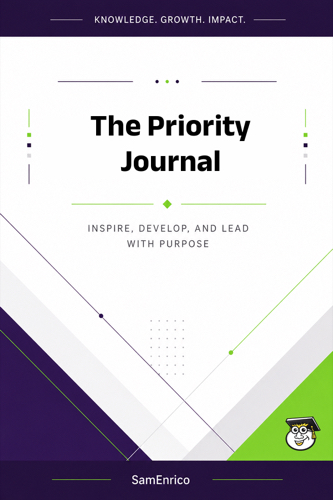
The Priority Journal eBook
Track daily priority decisions and reflect on effe
by Vargas Ricky
Track daily priority decisions and reflect on effectiveness.
Formats
Free sample
Chapter 1: The Knowing-Doing Gap...--–- You already know how to prioritize.Let me say that again, because it sounds like a compliment, but it is actually an indictment.You have read the books. You have highlighted the passages. You have downloaded the apps, color-coded the calendars, and set the reminders. You can explain the Eisenhower Matrix to a stranger. You know what “Quadrant II” means.
You have tried time blocking, time boxing, the Pomodoro Technique, and the 80/20 rule. You have a Pinterest board full of bullet journal spreads you will never actually draw.You are not failing because you lack knowledge.You are failing because knowledge does not stick when the world punches you in the face at 10:32 AM.This is the Knowing-Doing Gap. It is the chasm between what you know you should do and what you actually do when reality intervenes. You can have perfect clarity about what matters most when you are sitting alone with a cup of coffee at 6:00 AM. By 10:32 AM, after three emails, a Slack notification, a colleague stopping by your desk, and a sudden realization that you forgot to reply to your boss, that perfect clarity is gone.
It did not evaporate. It was actively demolished.Every productivity book on the planet teaches you how to plan your priorities. None of them teach you how to defend them in real time. Planning is a lonely, quiet activity. Defense happens in the chaos, under fire, while your phone buzzes and your calendar dings and a voice in your head whispers, “Just check it really fast.
It will only take a second.”That whisper is a lie. And this book is your witness.The Invention of Overwhelm-Abundance We live in an age that has no historical precedent. Not just overwhelm—people have always been overwhelmed. Farmers facing drought. Factory workers facing assembly lines.
Middle managers facing TPS reports. Overwhelm is not new.What is new is abundance.Fifty years ago, distraction was scarce. You had a telephone that was attached to a wall. You had mail that arrived once per day. You had three television channels.
If someone wanted to interrupt you, they had to physically walk to your office or call your landline, and if you did not answer, they simply… waited.Now? You carry a supercomputer in your pocket whose entire business model is to capture and resell your attention. Email arrives in tsunamis, not drips. Slack and Teams and Whats App and i Message and Instagram DMs and Linked In messages and calendar invites and push notifications from weather apps, news apps, game apps, and fitness apps all compete for the same limited resource: your next three seconds.This is not overwhelm. Overwhelm is too much to do.
This is overwhelm-abundance—too much coming at you.The distinction matters because the traditional solutions to overwhelm (to-do lists, prioritization matrices, time management systems) assume that the problem is volume. If you just organize your tasks better, the thinking goes, you will be fine. But overwhelm-abundance is not a volume problem. It is a velocity problem. Things are coming at you so fast that you do not have time to consult your matrix.
You do not have time to open your planner. You make decisions on instinct, and your instinct—your beautiful, ancient, lizard brain—is catastrophically bad at prioritizing the strategic over the urgent.The Lizard Brain Is Not Your Friend Let us talk about your amygdala. It is a small, almond-shaped cluster of neurons deep in your brain, and it has one job: keep you alive. It does not care about your quarterly goals. It does not care about your career trajectory.
It does not care about the novel you have been meaning to write. It cares about right now. Is there a threat? Is there a loud noise? Is there a social signal (a face, a name, a notification from another human) that requires immediate attention?Your amygdala is not stupid.
It is very good at its job. The problem is that its job was designed for the savanna, not the server farm.On the savanna, a sudden noise meant a predator. Immediate attention was survival. On the savanna, a social signal from another human meant either alliance or threat. Immediate attention was survival.
On the savanna, there were no quarterly strategic plans. There was only now.Email, Slack, and push notifications are explicitly designed to hijack your amygdala. The ping, the badge, the vibration—these are not neutral features. They are engineered triggers. Every time your phone buzzes, your amygdala releases a small amount of cortisol and dopamine.
Cortisol says “pay attention, this might be important.” Dopamine says “that felt good, do it again.” This is the same neurological cocktail involved in slot machines.You are not weak for checking your phone. You are human. And you are being exploited by trillion-dollar companies whose entire business model depends on you failing to protect your priorities.This book is not here to shame you. Shame does not work. Shame makes you feel bad, and when you feel bad, you seek dopamine, and dopamine comes from your phone.
That is a death spiral.Instead, this book is here to measure you. Because what gets measured gets managed. And what gets managed, eventually, gets mastered.The Reactive-Spectrum: A New Framework Let me introduce a simple but profound distinction that will appear on every page of this journal. It is the Reactive-Spectrum.Imagine a straight line. On the far left end, write the word STRATEGIC.
On the far right end, write the word REACTIVE.Strategic choices are decisions you make deliberately, aligned with your long-term values and priorities. You chose them. You can explain why. They serve your future self.Reactive choices are decisions that are triggered by something external—a notification, a request, a sudden anxiety, a social pressure. You did not choose them so much as you responded to them.
They serve your immediate environment.Here is the uncomfortable truth that most productivity books will not tell you: You are mostly reactive. Not because you are lazy or undisciplined, but because the modern world is a reactive machine. It is designed to trigger you, not to support you.The goal of this book is not to make you 100% strategic. That is impossible. You cannot ignore your boss, your family, or your basic human need for social connection.
The goal is to move you incrementally from right to left on the spectrum. If you are currently 80% reactive and 20% strategic, the goal is 60/40 by Day 30 and 50/50 by Day 90.Half and half is victory. Half and half means you are no longer a pinball bouncing off the bumpers of other people’s emergencies. Half and half means you are a person who chooses at least as often as you react.The Journal Is a Witness, Not a Judge Here is the most important sentence in this chapter: The Priority Journal does not judge you.It does not have a red pen. It does not give you gold stars.
It does not shame you for bad trades. It is a witness. It sits on your desk—or in your bag, or on your phone—and it watches.…
This is the end of the free sample. Get the eBook to keep going. Buy now
About this book
Details
- Author
- Vargas Ricky
- Publisher
- SamEnrico
- Language
- English
- Genre
- Non-Fiction, Self-Help
- Released
- 2026-06-07
- Pages (approx.)
- 128
- Available as
- eBook, Audiobook

Read better in the ZLOADR app
Your eBooks on your phone or tablet. Sign in with your SamEnrico account and start reading.
More by Vargas Ricky
 HBO Prestige TV PressureVargas Ricky$11.99
 The Pharmacist Who Delivered MedsVargas Ricky$11.99
 Alcohol Recovery Feng Shui GuideVargas Ricky$11.99
 Startup Accounting GuideVargas Ricky$11.99
 Mindfulness for Kids GuideVargas Ricky$11.99
 Orphanage Childhood RecoveryVargas Ricky$11.99
 Design Thinking For StartupsVargas Ricky$11.99
 The Gates of Persepolis: Alexander's Fiery TriumphVargas Ricky$11.99
 Salamis: The Naval Gambit That Saved GreeceVargas Ricky$11.99
 A Collector's Handbook to the Ferrari Dino 206Vargas Ricky$11.99
 How to Start a Hobby in AudiophileVargas Ricky$11.99
 How to Produce Handrails and Railing SystemsVargas Ricky$11.99
You may also like
 Hong Kong Handover 1997Dunn Johnnie$11.99
 Zumba For Postnatal Recovery CourseNeal Christian$11.99
 Zumba for BeginnersLadner Nikia$11.99
 YouTube Comment Mining GuideHumes Pandora$12.99
 Worry Box MeditationCarlin Rudy$11.99
 Workplace Stress MeditationNguyen Lynn$11.99
 Workplace Stress and Sleep RepairHawley Ivory$11.99
 Workplace Perfectionism CureDelaney Jeffry$11.99
 Workplace Injustice Anger GuideWallen Isabelle$11.99
 Work Addiction and Burnout LinkGreenwood Ester$11.99
 Women in Yoga and WellnessBeattie Galina$11.99
 Women in Stand Up ComedyChun Evangeline$11.99