
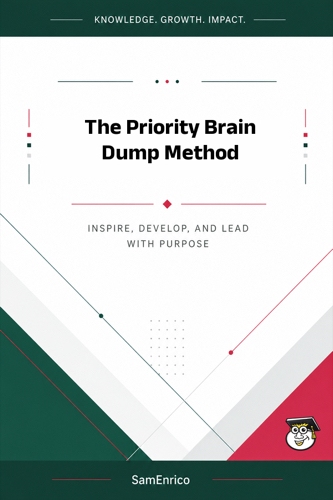
The Priority Brain Dump Method eBook
List all tasks then sort using ABCDE or Eisenhower
by Canales Edie
List all tasks then sort using ABCDE or Eisenhower before planning.
Formats
Free sample
Chapter 1: The Open Loops...--Your brain is lying to you right now. It is telling you that you are too busy, too scattered, and too far behind. It is whispering that you cannot possibly remember everything you need to do, and yet it refuses to let you forget any of it. This constant, low-grade hum of unfinished business is not a personality flaw. It is not a lack of discipline.
It is not a sign that you need a better app, a fancier planner, or a more expensive calendar system. It is a fundamental feature of human neurology, discovered nearly a century ago, that most productivity advice completely ignores.The Zeigarnik Effect, named after the Russian psychologist Bluma Zeigarnik who first documented it in 1927, reveals something uncomfortable about how your brain works. In a series of now-famous experiments, Zeigarnik observed that waiters could remember complex orders with astonishing accuracy—but only until the food was served. Once the bill was paid and the transaction was complete, the details vanished from memory almost instantly. The unfinished orders lingered.
The completed ones disappeared. This is not a quirk of waitstaff. This is how every human brain processes unfinished tasks. Your mind holds onto open loops with a desperate, anxious grip, and it only releases them when they are closed.You have felt this hundreds of times. You lie in bed at night, exhausted, and your brain serves up a random reminder: "Don't forget to email Sarah about the report." Or you are in the middle of a focused work session, and a stray thought intrudes: "I need to buy milk." Or you are trying to enjoy a weekend with your family, and your mind drifts to the presentation you have not finished.
These are not random interruptions. They are open loops. And they are consuming your mental bandwidth whether you realize it or not.This chapter is about understanding why your brain works this way, why traditional to-do lists make the problem worse instead of better, and how a single shift in perspective can transform you from a prisoner of your own memory into the calm, capable manager of a trusted external system. By the time you finish reading, you will have permission to forget. More importantly, you will understand why that permission is the most productive gift you can give yourself.The Weight of Unfinished Business Let us start with a simple experiment.
Right now, without looking at your phone, your calendar, or any notes, try to list everything you need to do today. Not the big strategic goals. Just the small, mundane, nagging tasks. The email you need to send. The phone call you have been avoiding.
The errand you keep pushing to tomorrow. The conversation you know you need to have. Go ahead. Take ten seconds.How many did you come up with? Five?
Maybe ten? Now here is the uncomfortable question: How many are actually in your head right now, pulling at your attention, even though you did not list them? The answer is almost certainly more than you think.Research on cognitive load suggests that the average person carries between fifty and one hundred fifty open loops at any given time. These are not just work tasks. They are personal obligations, health concerns, financial to-dos, relationship maintenance, home repairs, creative ideas, and a thousand other small commitments that never make it onto a formal list but never really leave your mind either.
Each one of these open loops consumes a tiny fraction of your mental processing power. Individually, each loop is negligible. But fifty loops? One hundred loops? That is the equivalent of running dozens of background programs on an overtaxed computer.
Your processor slows down. Your memory fragments. Your attention scatters. You feel exhausted even when you have not done anything.This is not a metaphor. Functional MRI studies have shown that the same brain regions activated by physical pain are also activated by the awareness of unfinished tasks.
Your brain literally hurts when you have too many open loops. The constant, low-level stress response triggered by incomplete obligations elevates cortisol, disrupts sleep, impairs decision-making, and contributes to the feeling of being overwhelmed that has become the background music of modern life.And here is the cruelest part: the more overwhelmed you feel, the less likely you are to write things down. When anxiety is high, your brain defaults to what feels like control—keeping everything in your head where you can mentally rehearse it. But mental rehearsal is not control. It is a coping mechanism that makes the problem worse.
Every time you think about a task without writing it down, you are rehearsing the anxiety, not resolving the loop.The Inventory Lie Most people believe that writing down a task is a form of commitment. They think, "If I write this down, I am promising to do it. And if I promise to do it and then do not do it, I have failed." This belief is so deeply ingrained that it feels like common sense. But it is wrong. And it is the single biggest barrier to effective productivity.Let me offer a different metaphor.
Imagine you manage a grocery store. Every morning, trucks arrive with thousands of items—apples, oranges, milk, bread, cleaning supplies, frozen foods. Your job is not to sell every item immediately. Your job is to take inventory. You count what arrived.
You note where it is stored. You enter it into your system. And then, over the course of the day and week, customers buy some of it. Some items sell quickly. Some sit on the shelves for weeks.
Some never sell at all and eventually get donated or discarded. But you would never look at your inventory and think, "I have failed because not every item sold today." Inventory is not a commitment. It is data.Your to-do list is exactly the same. It is not a commitment to do everything on it. It is an inventory of everything that currently exists in your mental space.
Some tasks will be done today. Some will be done next week. Some will be delegated. Some will be deleted entirely. And that is not just acceptable—it is the entire point of having a system.When you reframe your to-do list as an inventory rather than a promise, two things happen immediately.
First, the guilt disappears. You are no longer failing because you have not finished your list. You are simply taking stock of what exists. Second, the anxiety dissipates. You are no longer holding everything in your head because you have a trusted place where it all lives.
Your brain, which has been desperately trying to remember everything, finally gets permission to let go.This permission is the foundation of the entire Priority Brain Dump Method. Without it, you will continue to use your to-do list as a weapon against yourself. You will continue to feel guilty about what you have not done. You will continue to hold tasks in your head because you do not trust the list. And the open loops will keep multiplying until they crush you.The Trust Contract Here is where most productivity systems fail.…
This is the end of the free sample. Get the eBook to keep going. Buy now
About this book
Details
- Author
- Canales Edie
- Publisher
- SamEnrico
- Language
- English
- Genre
- Non-Fiction, Self-Help
- Released
- 2026-06-07
- Pages (approx.)
- 127
- Available as
- eBook, Audiobook

Read better in the ZLOADR app
Your eBooks on your phone or tablet. Sign in with your SamEnrico account and start reading.
More by Canales Edie
 Anapanasati For Anxiety ReliefCanales Edie$11.99
 TIPP Skills Crisis SurvivalCanales Edie$11.99
 Antwerp Heist MerchandiseCanales Edie$11.99
 Master the Eisenhower Decision MatrixCanales Edie$11.99
 Pelvic Floor Biofeedback TrainingCanales Edie$11.99
 Pomodoro Technique Mastery GuideCanales Edie$11.99
 Matt Kahn GuideCanales Edie$11.99
 Kehinde Wiley: Painting Royalty from the Streets to the SmithsonianCanales Edie$11.99
 Dragonfire: The Jade Spy of the Celestial CourtCanales Edie$11.99
 How to Produce Storage TanksCanales Edie$11.99
 Mastering The Art of KarateCanales Edie$11.99
 CV and Interview Student WorkbookCanales Edie$12.99
You may also like
 Workplace Stress MeditationNguyen Lynn$11.99
 Volcano Monitoring ScientistCox Alexis$11.99
 The Tech Professional NetAguiar Nevada$11.99
 The Morning Metta RitualCanales Anya$11.99
 The Chunking Memory TechniqueClanton Hyacinth$11.99
 The Beginner Mistake FixAmmons Cassondra$11.99
 Surrendering to What IsGrimm Reatha$11.99
 Self Hypnosis for Fear of FireBillups Eli$11.99
 Road Rage for Professional DriversBrackett Janise$11.99
 Psychiatric Ward Nurse StressDunning Wyatt$11.99
 Observation vs Evaluation NVCTimmons Alda$11.99
 Networking for Nonprofit ProfessionalsPoole Jesse$11.99