
Non-FictionHealth & WellnessAffirmations
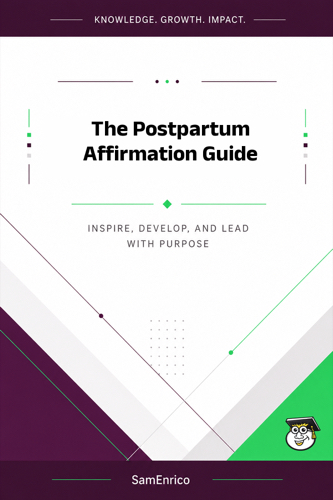
The Postpartum Affirmation Guide eBook
Use daily positive statements to counter negative
Use daily positive statements to counter negative self talk.
Formats
Free sample
Chapter 1: The Loop Trap...--The thought comes to you at 3:17 AM. The baby has been fed, burped, changed, and rocked, but the crying has not stopped for forty-five minutes. Your partner is sleeping in the next room. The dog is sleeping on the couch. The whole world is sleeping except for you and this small, red-faced, furious creature who will not be soothed.
And then it arrives—not as a shout, not as a decision, but as a whisper that feels like fact: I am a bad mother.You did not choose this thought. It chose you. It slid into your exhausted mind like a key turning a lock you did not know you had. And once inside, it loops. Bad mother.
Bad mother. What kind of mother can't stop her own baby from crying? What kind of mother feels angry right now? What kind of mother thinks about walking out the front door?Here is the first truth this book needs you to hear: that thought is not a sign of your failure. It is a sign of your brain doing exactly what human brains evolved to do under conditions of sleep deprivation, hormonal chaos, and constant vigilance.
That thought is not a verdict. It is a symptom. And symptoms can be treated.This chapter is about naming the enemy. Because you cannot fight what you cannot see. And right now, most new mothers are fighting blind—swatting at a swarm of automatic negative thoughts without ever realizing that these thoughts have names, patterns, and predictable triggers.
Once you learn to see them, they lose their power. Not all of it, not all at once, but enough. Enough to breathe. Enough to pause. Enough to start the work of rewriting the loop.What Are Automatic Negative Thoughts (ANTs)?Before we can flip the script, we have to understand what we are flipping.
Automatic Negative Thoughts, or ANTs, are exactly what they sound like: thoughts that arise without conscious effort, feel completely true in the moment, and tend to repeat themselves in a loop. They are not logical conclusions based on evidence. They are reflexes of a brain that is exhausted, overprotective, and trying to keep a tiny human alive with very little fuel.Think of ANTs like pop-up ads on a website you are trying to read. You did not click on them. You do not want them there.
They are distracting, annoying, and sometimes terrifying. But they are not the content of the page. They are not the truth of the situation. They are interruptions. And like pop-up ads, they can be blocked—not by wishing them away, but by installing a new piece of software in your brain.
That software is the Flip and Script method, which we will build together throughout this chapter and practice for the next twelve weeks.Here is what ANTs are not: they are not character flaws, not evidence of mental illness (though they can be worsened by it), not permanent features of your personality, and not things you should feel ashamed of having. Every single mother on this planet has ANTs. The mothers who look like they have it together on Instagram? They have them. The mothers in your prenatal yoga class who seemed so calm?
They have them. Your own mother, grandmother, and the woman checking out at the grocery store with three kids under five? They all have them. The difference between mothers who drown in these thoughts and mothers who learn to surf them is not the absence of ANTs. It is the presence of a method for dealing with them.The Five Most Common Postpartum ANTs After working with thousands of new mothers and reviewing the clinical literature on postpartum mental health, researchers have identified a handful of negative thought patterns that appear again and again.
They show up across cultures, across income levels, across different family structures and birth experiences. If you recognize yourself in any of these five, you are not alone. You are not broken. You are having a completely normal response to an abnormal amount of pressure.1. The Inadequacy ANT: "I don't know what I'm doing."This thought often arrives in the first few days home from the hospital, when the nurses are gone and the sudden silence of your living room feels like an accusation.
You hold the baby. The baby cries. You feed the baby. The baby cries. You change the diaper, check the temperature, sing a lullaby, bounce, sway, walk in circles.
The baby still cries. And the thought comes: I don't know what I'm doing. I am not qualified for this. They gave me a human and I have no training and I am failing.The inadequacy ANT feeds on the gap between expectation and reality. Before the baby arrived, you probably imagined yourself as a certain kind of mother—calm, competent, intuitive.
The reality of postpartum is that no one is calm, competence is learned through failure, and intuition is just pattern recognition that takes months to develop. The inadequacy ANT is not telling you that you are unqualified. It is telling you that you are new. And new is not the same as bad.2. The Resentment ANT: "I hate that my life looks like this."This is the thought that makes mothers feel like monsters.
It often comes in the quiet moments—when you watch your partner leave for work, when you see a childless friend's vacation photos, when you hear about someone's promotion or spontaneous dinner out. The thought is sharp and immediate: I hate this. I hate that my body hurts. I hate that I cannot leave the house. I hate that I am jealous of my own spouse.
I hate that I feel this way.The resentment ANT is dangerous not because it is true but because it feels unforgivable. Mothers are not supposed to hate their lives. They are supposed to be grateful, radiant, and fulfilled. So when resentment appears, many mothers shove it down, pretend it is not there, and then hate themselves for feeling it in the first place. This shoving-down is exactly what gives the ANT more power.
The thought does not go away. It just goes underground, where it grows roots.Here is the reframe you will learn to apply: resentment is not a sign that you are a bad person. It is a sign that you are a tired, overwhelmed, undersupported person who is doing a job that would exhaust anyone. Resentment is data, not damnation. It is telling you that something in your life is unfair or unsustainable.
That is useful information. But we will get to that in later chapters. For now, just name it. I am having the resentment ANT. That is allowed.3.
The Fear of Harm ANT: "What if I hurt the baby?"This is the scariest ANT on the list, and it is also one of the most common. It takes many forms: What if I drop the baby going down the stairs? What if I fall asleep while nursing and smother her? What if I shake him when he won't stop crying? What if I am secretly capable of violence?
These thoughts are terrifying because they feel like evidence of hidden monstrosity. If you are having these thoughts, you may…
This is the end of the free sample. Get the eBook to keep going. Buy now
About this book
Details
- Author
- Caldwell Carlton
- Publisher
- SamEnrico
- Language
- English
- Genre
- Non-Fiction, Health & Wellness, Affirmations
- Released
- 2026-06-07
- Pages (approx.)
- 134
- Available as
- eBook, Audiobook

Read better in the ZLOADR app
Your eBooks on your phone or tablet. Sign in with your SamEnrico account and start reading.
More by Caldwell Carlton
 Shopping Addiction Emergency KitCaldwell Carlton$11.99
 MS Anticipatory Grief WorkbookCaldwell Carlton$11.99
 SMART Personal Goals GuideCaldwell Carlton$11.99
 Student Exam Nap GuideCaldwell Carlton$11.99
 Nonverbal Cues for Flight AttendantsCaldwell Carlton$11.99
 Crime Scene Reconstruction GuideCaldwell Carlton$11.99
 Self Hypnosis for Skin PickingCaldwell Carlton$11.99
 The Healing Hands of the Nile: The Surgeons of Ancient EgyptCaldwell Carlton$11.99
 Shirabyoshi: The Phantom Dancer of EdoCaldwell Carlton$11.99
 Mongooses: Snake-fighting MammalCaldwell Carlton$11.99
 Amazon Variation Listing Best PracticesCaldwell Carlton$12.99
 Alibaba vs Amazon Private LabelCaldwell Carlton$12.99
You may also like
 Hong Kong Handover 1997Dunn Johnnie$11.99
 Zumba For Postnatal Recovery CourseNeal Christian$11.99
 Zumba for BeginnersLadner Nikia$11.99
 YouTube Comment Mining GuideHumes Pandora$12.99
 Worry Box MeditationCarlin Rudy$11.99
 Workplace Stress MeditationNguyen Lynn$11.99
 Workplace Stress and Sleep RepairHawley Ivory$11.99
 Workplace Perfectionism CureDelaney Jeffry$11.99
 Workplace Injustice Anger GuideWallen Isabelle$11.99
 Work Addiction and Burnout LinkGreenwood Ester$11.99
 Women in Yoga and WellnessBeattie Galina$11.99
 Women in Stand Up ComedyChun Evangeline$11.99