
Non-FictionNeurological Disorder
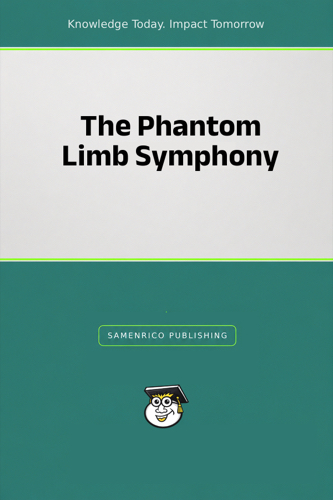
The Phantom Limb Symphony eBook
Unravel the haunting mystery of phantom limb syndr
Unravel the haunting mystery of phantom limb syndrome through the story of a 19th-century surgeon who discovered patients' brains could conjure sensations from missing limbs, reshaping medicine forever.
Formats
Free sample
Chapter 1: The Hand That Remained...--The first time Jimmy Kincaid tried to scratch his nose with a hand that wasn’t there, he realized that God had a sense of humor—and it was a cruel one.The itch arrived at 3:17 AM on a Tuesday, three days after the scaffolding collapsed. It bloomed along the dorsal ridge of his right index finger, that specific sweet spot between the first and second knuckle where summer mosquito bites always landed. Jimmy knew this finger. He had played catch with it, flipped eggs with it, pointed at his daughter Lily when she was being cheeky, and once, memorably, used it to stop a bullet fragment from reaching his femoral artery in a dusty Afghan village called Now Zad. That finger had saved his life.
Now it was gone.But it itched.He lay in the narrow hospital bed at Massachusetts General, the fluorescent lights humming their eternal hum, and stared at the space where his right arm ended. The bandages started just below the elbow, a white stump wrapped in gauze and regret. The surgeons had done their work cleanly—a transverse cut, nerves cauterized, skin flap folded and sutured. From the outside, it looked like a finished job. From the inside, Jimmy’s brain had not received the memo.He lifted his left hand—still there, still functional, still calloused from thirty-four years of construction work and combat—and reached across his chest to scratch the missing itch.
His fingers passed through empty air. The itch did not stop. If anything, it intensified, as though the ghost of the finger was offended by the attempt.“You’ve got to be kidding me,” Jimmy whispered to the ceiling.The morphine drip offered no answers. The nurse who checked his vitals at 4:00 AM offered no comfort. When he told her—voice hoarse, desperate—that his missing finger was on fire, she glanced at his chart, nodded once, and said, “Phantom sensations.
Totally normal. Try not to focus on it.”Try not to focus on it. Jimmy had survived an IED in Helmand Province that turned a Humvee into a confetti cannon. He had watched his best friend bleed out from a neck wound while enemy fire snapped overhead. He had rebuilt a three-story brownstone in South Boston with nothing but a crew of hungover alcoholics and a stubborn refusal to fail.
He had focused through all of it. But this—this invisible hand that would not stop itching, would not stop burning, would not stop insisting on its own existence—was something his focus could not touch.The phantom was not a memory. Memories faded. This was a presence. A living, breathing, tormenting presence that occupied the negative space where his arm used to be.
He could feel the weight of it. The phantom hand lay at his side, palm up, fingers slightly curled, as though waiting for someone to hold it. He could feel the hospital sheets brushing against the phantom knuckles. He could feel the cool air from the vent on the phantom palm. And somewhere in the deep architecture of his brain, the itch continued its maddening dance.He closed his eyes and tried to remember the last time he had used that hand.
The scaffolding collapse. That was the end. But before that? Morning of the accident. He had woken up next to Elena, his wife of eleven years, and rolled over to kiss her shoulder.
His right hand had rested on her hip, warm through the thin cotton of her nightgown. She had murmured something in her sleep—Spanish, probably, she always reverted to Spanish when she was tired—and he had smiled against her skin. That hand had touched his wife’s body. That hand had lifted Lily onto his shoulders at the Topsfield Fair, had thrown a baseball badly but enthusiastically, had hammered nails into two-by-fours with a precision that made younger carpenters jealous.That hand was now a bundle of severed nerves sitting in a medical waste incinerator somewhere in eastern Massachusetts.The itch intensified.The Surgeon and the Soldier Dr. Silas Weir Mitchell first encountered the phantom in the summer of 1863, ninety-two years before Jimmy Kincaid was born, in a hospital that smelled of gangrene and chloroform.
Turner’s Lane Hospital in Philadelphia was not a place of healing. It was a warehouse for the broken. The Battle of Gettysburg had sent a tidal wave of amputees north, men who had left their arms and legs in the wheat fields of Pennsylvania and arrived in the city with nothing but stumps and screams.Mitchell was thirty-three years old, a Philadelphia aristocrat who had traded a life of poetry and privilege for the blood-soaked floors of military surgery. He was small, quick, with eyes that missed nothing and a mouth that rarely smiled. His colleagues thought him cold.
His patients thought him terrifying. But he listened—perhaps the only surgeon in the Union Army who listened—and what he heard made no sense.Private Henry Rodgers, 118th Pennsylvania Infantry, had lost his right leg above the knee. The surgeon had done a fine job: clean bone saw, careful artery ligation, a stump that healed without infection. By all medical metrics of 1863, Rodgers was a success story. But Rodgers would not stop complaining about his foot.“It’s cramped, Doctor,” he said, gripping Mitchell’s sleeve with surprising strength.
“My foot is cramped inside the boot. Can you loosen the laces?”“Private Rodgers,” Mitchell said carefully, “you have no foot.”Rodgers looked down at the empty space where his leg ended. His brow furrowed. Then he looked back at Mitchell with the absolute certainty of a man who knew his own body better than any doctor ever could.“With respect, sir,” he said, “I can feel it. The toe next to the big one is going numb.
And the heel—the heel is sweating. I can feel the sweat running down into the boot. I can feel everything.”Mitchell made a note. He made many notes over the following months. He interviewed hundreds of soldiers, thousands of stumps, cataloging sensations with the precision of a naturalist describing a new species.
There was the man who felt his missing hand slowly clenching into a fist over the course of several weeks, the phantom fingers curling inward until the pain became unbearable. There was the soldier who insisted his missing arm was pinned behind his back, twisted at an impossible angle, and no amount of visual inspection could convince his brain otherwise. There was the young cavalryman who had lost both legs below the knee and still woke screaming from nightmares in which he was running—running faster than he ever had in his life—through fields of wheat that turned to blood.Mitchell gave the phenomenon a name. He called it phantom limb—a deliberate oxymoron, blending the ghostly with the anatomical. The name mattered.
Before the name, the soldiers were dismissed as hysterics, malingerers, weak-willed men who could not accept their new reality. After the name, the experience became real. Legitimate. Worthy of study.But Mitchell could not solve it. He traced the nerves from the stump to…
This is the end of the free sample. Get the eBook to keep going. Buy now
About this book
Details
- Author
- Mcwilliams Audrie
- Publisher
- SamEnrico
- Language
- English
- Genre
- Non-Fiction, Neurological Disorder
- Released
- 2026-06-04
- Pages (approx.)
- 135
- Available as
- eBook, Audiobook

Read better in the ZLOADR app
Your eBooks on your phone or tablet. Sign in with your SamEnrico account and start reading.
More by Mcwilliams Audrie
 NVC Four Step Quick ReferenceMcwilliams Audrie$11.99
 Hybrid Office Space DesignMcwilliams Audrie$11.99
 Divorce Financial Stress SolutionsMcwilliams Audrie$11.99
 Teresa of Ávila Humility Teachings ManualMcwilliams Audrie$11.99
 Nonverbal Assertiveness TrainingMcwilliams Audrie$11.99
 The Thunder Stones of the Andes: Prehistoric Electromagnetism in Ancient South AmericaMcwilliams Audrie$11.99
 Understanding EpidermaMcwilliams Audrie$17.99
 How to Start a Dairy Produce Importer (wholesale) Business (Beginners Guide)Mcwilliams Audrie$11.99
 AI Art Color Palette GuideMcwilliams Audrie$12.99
 Kanban for Elastic StartupsMcwilliams Audrie$12.99
 Home Child Care ProviderMcwilliams Audrie$11.99
You may also like
 Hong Kong Handover 1997Dunn Johnnie$11.99
 Zumba For Postnatal Recovery CourseNeal Christian$11.99
 Zumba for BeginnersLadner Nikia$11.99
 YouTube Comment Mining GuideHumes Pandora$12.99
 Worry Box MeditationCarlin Rudy$11.99
 Workplace Stress MeditationNguyen Lynn$11.99
 Workplace Stress and Sleep RepairHawley Ivory$11.99
 Workplace Perfectionism CureDelaney Jeffry$11.99
 Workplace Injustice Anger GuideWallen Isabelle$11.99
 Work Addiction and Burnout LinkGreenwood Ester$11.99
 Women in Yoga and WellnessBeattie Galina$11.99
 Women in Stand Up ComedyChun Evangeline$11.99