
Non-FictionSelf-HelpPharmacotherapy
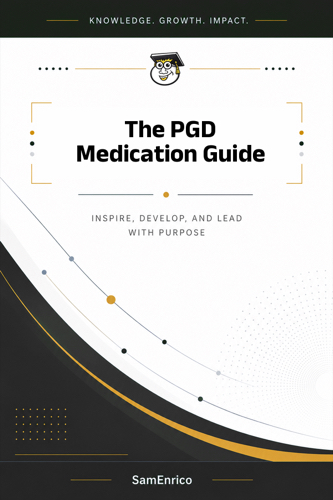
The PGD Medication Guide eBook
Antidepressants for prolonged grief disorder.
Antidepressants for prolonged grief disorder.
Formats
Free sample
Chapter 1: The Frozen Year...--–- Maria had not laughed in fourteen months. Not a real laugh—the kind that rises from the diaphragm and surprises even the person laughing. She had smiled, of course. She had smiled at her daughter’s school play, at the kind neighbor who brought casseroles, at the well-meaning coworker who said “time heals all wounds.” But those smiles were muscular contractions, nothing more. Behind them, Maria’s inner world had become a landscape of ash.Her husband, Daniel, had died on a Tuesday.
A routine commute. A driver running a red light. And just like that, forty-seven years of shared life—the inside jokes, the arguments over thermostat settings, the quiet mornings with coffee and newspapers—collapsed into a single, unbearable fact: he was gone. For the first six months, Maria’s friends rallied. They brought food, organized a memorial garden, insisted she “take all the time she needed.” But around month eight, the visits tapered.
By month eleven, people had stopped asking how she was doing. They had decided, implicitly, that she should be “moving on.”But Maria was not moving on. She was moving in circles. Every morning, she woke up and checked her phone for a text from Daniel. Every evening, she set two plates on the dinner table, then stared at the empty chair until the food grew cold.
She had stopped sleeping in their bed—the indent of his body on the mattress was a wound she could not bear to touch—and instead slept on the couch, clutching his old sweatshirt, which still held a faint ghost of his smell. Her daughter, now a teenager, had stopped asking her mother for help with homework. “You’re not really here anyway,” the girl had said one night, not cruelly but factually. And she was right. Maria was present in body only.
The part of her that could feel—curiosity, warmth, anticipation, love—had gone quiet. Not sad, exactly. Just gone.Her primary care doctor had offered her an antidepressant six months after the accident. “It might help with the depression,” the doctor had said, typing a prescription for sertraline into her tablet. Maria had taken the prescription to the pharmacy, filled it, and then let the orange bottle sit unopened on her nightstand for three months.
She was not depressed, she told herself. She was grieving. And wasn’t grief supposed to hurt? Wasn’t there something almost disrespectful about taking a pill to erase the pain of losing the man she had loved for half her life?By month fourteen, Maria had lost eighteen pounds she could not afford to lose. Her hair had thinned.
She had been placed on leave from her job as a high school teacher after a student reported that “Mrs. K just stares at the wall for entire class periods.” She had stopped answering her sister’s phone calls. And one night, at 3:00 AM, sitting on the bathroom floor with the orange bottle finally opened in her hand, she realized something that would change everything: she was not choosing to grieve. The grief was choosing her. It had colonized her brain like a foreign power, and she had lost the ability to expel it.This book is for Maria.
And for the millions like her—the one in ten bereaved individuals whose grief does not soften with time but hardens into a prison. This book is for the person who has been told to “let go” but cannot find the handle on the door. For the widow who still texts her husband’s phone number two years after his death. For the parent whose child’s empty bedroom has become a shrine they cannot bring themselves to clean. For the survivor who has been offered an antidepressant but is afraid that taking it means they loved “wrong” or are “weak.”This book is called The PGD Medication Guide, and it exists because the current conversation about grief has failed you.
That conversation, popularized by bestsellers like The Grief Cure, tells a compelling story about experimental interventions—laughter therapy, psychedelics, the speculative possibility of memory deletion. These are fascinating ideas. But they are not, for most people, the place to start. The place to start is with what actually works, what is actually available to you tomorrow, what has been tested in dozens of randomized controlled trials involving thousands of patients just like you. The place to start is medication.But not just any medication.
Not the “one-size-fits-all” antidepressant that your primary care doctor prescribes in a seven-minute appointment. This book will teach you how to target your specific symptoms—because PGD is not depression, and treating it like depression often fails. This book will teach you how to distinguish between normal grief (which does not require medication) and Prolonged Grief Disorder (which does). This book will give you the scripts, the protocols, the decision trees, and the scientific literacy to walk into your doctor’s office and say, with confidence, “Here is what I need.”And if you are reading this and thinking, I don’t want to medicate my grief—I want to honor it, I want you to hold that thought. We will return to it.
Because what I am about to show you is that medication does not erase love. Medication does not erase memory. Medication does not make you forget that the person you lost ever existed. What medication does—when it works—is lower the volume on a brain that has become trapped in a loop of yearning and despair. It does not take away the grief.
It takes away the stuckness. It turns the volume down from eleven to three, so that you can finally hear yourself think, so that you can finally sit in a therapy session without dissociating, so that you can finally look at your surviving child and feel something other than numbness.That is the promise of this book. It is not a promise of cure. There is no cure for love. But there is treatment for the disorder that love, when interrupted by traumatic loss, can sometimes become.What This Chapter Will Do For You Before we go any further, let me tell you exactly what you will learn in this chapter:How to tell the difference between normal grief (which does not need medication) and Prolonged Grief Disorder (which often does).
This is not always obvious. Many people with PGD have been told they are “just grieving” by well-meaning friends and even by doctors who have not kept up with the research.The exact DSM-5-TR criteria for PGD. This is the diagnostic manual used by psychiatrists. Knowing these criteria will allow you to self-assess and to advocate for yourself.Why “closure” is a harmful myth—and what to aim for instead. The popular culture tells you to “move on.” This book will tell you that the goal is not to move on but to move forward while carrying what you have lost.A validated self-assessment tool (the PG-13 scale) so you can determine whether your symptoms warrant a professional evaluation.
(See Appendix A for the full scale.)A preview of the medication journey ahead. We will not start drugs in this…
This is the end of the free sample. Get the eBook to keep going. Buy now
About this book
Details
- Author
- Mckeever Lauri
- Publisher
- SamEnrico
- Language
- English
- Genre
- Non-Fiction, Self-Help, Pharmacotherapy
- Released
- 2026-06-06
- Pages (approx.)
- 160
- Available as
- eBook, Audiobook

Read better in the ZLOADR app
Your eBooks on your phone or tablet. Sign in with your SamEnrico account and start reading.
More by Mckeever Lauri
 Healing Shame in Addiction RecoveryMckeever Lauri$11.99
 Loss Aversion InfluenceMckeever Lauri$11.99
 Analytical Creativity FrameworkMckeever Lauri$11.99
 Mediterranean Dining OutMckeever Lauri$11.99
 The Whispering Lanterns of Obon: A Yokai's GuidanceMckeever Lauri$11.99
 How to Start a Cigarette Paper (uncut In Rolls) Business (Beginners Guide)Mckeever Lauri$11.99
 Franchise Exit Strategy AbroadMckeever Lauri$12.99
 African Traction for YC GuideMckeever Lauri$12.99
 Understanding Triphalangeal Thumb Non OpposableMckeever Lauri$17.99
 Cheese MongerMckeever Lauri$11.99
You may also like
 Hong Kong Handover 1997Dunn Johnnie$11.99
 Zumba For Postnatal Recovery CourseNeal Christian$11.99
 Zumba for BeginnersLadner Nikia$11.99
 YouTube Comment Mining GuideHumes Pandora$12.99
 Worry Box MeditationCarlin Rudy$11.99
 Workplace Stress MeditationNguyen Lynn$11.99
 Workplace Stress and Sleep RepairHawley Ivory$11.99
 Workplace Perfectionism CureDelaney Jeffry$11.99
 Workplace Injustice Anger GuideWallen Isabelle$11.99
 Work Addiction and Burnout LinkGreenwood Ester$11.99
 Women in Yoga and WellnessBeattie Galina$11.99
 Women in Stand Up ComedyChun Evangeline$11.99