
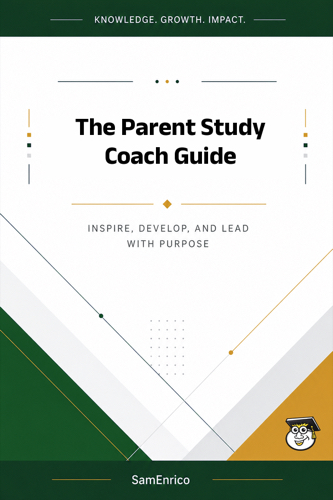
The Parent Study Coach Guide eBook
Help your child develop effective study and memory
Help your child develop effective study and memory habits.
Formats
Free sample
Chapter 1: The Great Unlearning--–- Every parent I have ever coached begins in the same place. They sit across from me at a kitchen table or on a video call, coffee in hand, exhaustion in their eyes, and they say some version of the same thing: “I just want my child to succeed. Why won’t they just do the work?” They have tried the sticker charts. They have tried the grade-based rewards—ten dollars for an A, five for a B, nothing for a C. They have tried taking away the tablet, the phone, the weekend sleepover.
They have tried sitting next to their child for hours, walking them through every problem, re-explaining every concept. And still, the homework battles rage. Still, the test scores plateau or drop. Still, the child says “I’m stupid” or “I hate school” or “What’s the point?” And the parent, despite their best intentions, feels like they are failing.This chapter is not about adding another technique to your already overflowing toolbox. It is not about a new sticker chart or a more creative consequence.
This chapter is about something far more difficult and far more liberating: unlearning. You are about to discover that the most common parental instincts—rewarding good grades, punishing bad ones, hovering over homework, rescuing your child from confusion—are not just ineffective. They are actively undermining the very thing you want to build. They are teaching your child to depend on external validation, to fear challenge, and to confuse effortlessness with intelligence. Before you can become an effective Study Coach, you must first unlearn what you thought you knew about motivation, about struggle, and about what it means to help.The Problem with Pavlov’s Desk Let us begin with a simple question: why do you want your child to get good grades?
Take a moment to answer honestly. Most parents say something like “so they have more opportunities” or “so they learn to work hard” or “so they don’t fall behind.” These are worthy goals. But here is the uncomfortable truth: the strategies most parents use to achieve these goals—rewards and punishments tied directly to grades—actually move the child further away from them.Consider the research of psychologists Edward Deci and Richard Ryan, whose Self-Determination Theory has been validated by hundreds of studies across multiple decades. They discovered that human beings have three innate psychological needs: autonomy (the sense that we are choosing our actions), competence (the sense that we are effective at what we do), and relatedness (the sense that we are connected to others). When these needs are supported, intrinsic motivation flourishes.
When they are thwarted, intrinsic motivation withers, and the person becomes dependent on external rewards and punishments.Here is what that looks like at your kitchen table. When you say “If you get an A on this test, I will buy you that video game,” you are not increasing your child’s love of learning. You are teaching them that learning is a chore to be endured for a prize. The moment the prize is removed or no longer valuable, the motivation vanishes. Worse, children who are rewarded for grades learn to take the shortest possible path to the reward.
They cheat. They cram. They avoid challenging material because a difficult A is no better than an easy A in a reward system. They become grade hunters, not learners.The same logic applies to punishment. When you say “If you get a C, you are grounded,” you are not teaching responsibility.
You are teaching fear. The child’s brain, flooded with cortisol, focuses on avoiding punishment rather than understanding material. They will hide bad grades, lie about tests, and develop a profound anxiety around any academic challenge. The grade becomes a threat, and the subject becomes associated with dread.I have worked with a ninth grader named Marcus who perfectly illustrates this dynamic. His parents had a strict policy: any grade below a B- meant no phone for a week.
Marcus was bright and capable, but by the time I met him, he had developed elaborate systems of deception. He intercepted progress reports. He texted friends for answers during online quizzes. He begged teachers to bump his borderline grades. His parents thought they were holding him accountable.
In reality, they had trained him to be a brilliant little liar who cared only about the letter on the page and nothing about the biology he was supposed to be learning.The solution is not to abandon standards or expectations. It is to shift what you reward. Stop rewarding the grade. Start rewarding the strategy. Instead of “Great job on that A,” try “I noticed you used your flashcards every day this week—that’s why you felt prepared.” Instead of “Why did you get a C?” try “What strategy did you try that didn’t work?
What will you do differently next time?” This single shift—from outcome to process—is the foundation of everything that follows in this book.Metacognition: The Secret Weapon No One Told You About There is a word that appears nowhere in most parenting books but predicts academic success more powerfully than IQ, more powerfully than socioeconomic status, and more powerfully than prior achievement. That word is metacognition. It means thinking about thinking. A metacognitive child can observe their own learning process, evaluate what is working and what is not, and adjust their strategies accordingly. They can say “I don’t understand this chapter yet” without shame.
They can say “I need to reread the summary and then quiz myself” without being told. They can say “That study method didn’t work for me—I will try a different one tomorrow.”Contrast this with the typical child. The typical child studies by re-reading the textbook or their notes, not because research shows this is effective—it is not—but because no one ever taught them an alternative. They highlight entire pages, confusing the physical act of moving a marker with the cognitive act of learning. They cram the night before a test because immediate repetition feels productive, even though the information will be forgotten within days.
They have no vocabulary for describing their own confusion. They just know they feel “stupid” or “lost” or “bored.”Metacognition can be taught. It is not a personality trait or a gift bestowed at birth. It is a set of habits, and habits can be built. The most powerful tool for building metacognition is something called the language shift.
Your words as a parent are the primary architect of your child’s internal dialogue. When you change what you ask, you change what they think about.Here is a before-and-after script. Use these phrases until they become automatic.Instead of “Did you study?” ask “What strategy did you use to learn that material?”Instead of “Do you understand this chapter?” ask “What part of this chapter feels clearest? What part feels fuzziest?”Instead of “Why did you get that problem wrong?” ask “What was going through your mind when you solved it? Where did your thinking take a wrong turn?”Instead of “You’re so smart!” (which sounds positive but actually creates fear of failure—if I…
This is the end of the free sample. Get the eBook to keep going. Buy now
About this book
Details
- Author
- Grubb Annemarie
- Publisher
- SamEnrico
- Language
- English
- Genre
- Non-Fiction, Self-Help, Parenting
- Released
- 2026-06-09
- Pages (approx.)
- 122
- Available as
- eBook, Audiobook

Read better in the ZLOADR app
Your eBooks on your phone or tablet. Sign in with your SamEnrico account and start reading.
More by Grubb Annemarie
 Sheppard Case Juror InterviewsGrubb Annemarie$11.99
 King Montgomery Improvement AssociationGrubb Annemarie$11.99
 Nap Pink Noise GuideGrubb Annemarie$11.99
 Hydration and Cognition for ExamsGrubb Annemarie$11.99
 Sleep Solutions During MenopauseGrubb Annemarie$11.99
 Mel Blanc Man of Thousand VoicesGrubb Annemarie$11.99
 Morning Routine for CodersGrubb Annemarie$11.99
 Turtle Ships and Samurai: Admiral Yi Sun-sin's Last StandGrubb Annemarie$11.99
 The Silk and Gold Empire: Madam C.J. Walker's Rise to Industrial MagnificenceGrubb Annemarie$11.99
 Asset Repatriation GuideGrubb Annemarie$12.99
 Proof of Funds Exemption for CECGrubb Annemarie$12.99
 Service Providers Guide to Association ManagementGrubb Annemarie$11.99
You may also like
 Hong Kong Handover 1997Dunn Johnnie$11.99
 Zumba For Postnatal Recovery CourseNeal Christian$11.99
 Zumba for BeginnersLadner Nikia$11.99
 YouTube Comment Mining GuideHumes Pandora$12.99
 Worry Box MeditationCarlin Rudy$11.99
 Workplace Stress MeditationNguyen Lynn$11.99
 Workplace Stress and Sleep RepairHawley Ivory$11.99
 Workplace Perfectionism CureDelaney Jeffry$11.99
 Workplace Injustice Anger GuideWallen Isabelle$11.99
 Work Addiction and Burnout LinkGreenwood Ester$11.99
 Women in Yoga and WellnessBeattie Galina$11.99
 Women in Stand Up ComedyChun Evangeline$11.99