
Non-FictionSelf-HelpQuestioning Skills
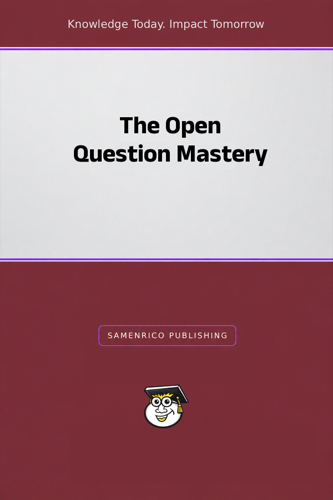
The Open Question Mastery eBook
Focuses on using who, what, where, when, why, and
by Scanlon Rema
Focuses on using who, what, where, when, why, and how to draw out deeper conversation.
Formats
Free sample
Chapter 1: The Silence Beneath...--–- The first time I realized I had been asking the wrong questions my entire life, I was sitting across from a man who had just been told he had three months to live.His name was Leonard. He was seventy-four, a retired civil engineer, and he had the kind of quiet dignity that made you want to earn his attention rather than demand it. I was a young consultant at the time, brought in by his family to help "manage communications" during his final months. A polite way of saying they didn't know how to talk to him anymore.I walked into his living room, sat down on the leather armchair across from his recliner, and asked the question I had been trained to ask. The question everyone asks.
The question that feels safe, professional, and appropriate."How are you feeling today, Leonard?"He looked at me for a long moment. Then he said, "Fine."That was it. The conversation was over before it began. I sat there, notepad in hand, watching a dying man pretend everything was fine because I had handed him a question that demanded nothing less than a lie. I had asked a closed question disguised as an open one.
And Leonard, being polite, had closed the door in my face.I left that afternoon with exactly zero useful information and a nagging sense of failure I couldn't quite name. It wasn't until three days later, when I heard Leonard's daughter ask him a completely different kind of question, that I understood what had gone wrong.She didn't ask how he was feeling. She asked, "What was the hardest part of today?"He talked for twenty minutes.That moment cracked something open in me. I spent the next decade studying everything I could about questions—not the kind you find in textbooks or journalism primers, but the kind that actually change how people think, feel, and relate to one another. I read the research on cognitive science, conversational analysis, negotiation tactics, and therapeutic communication.
I interviewed hostage negotiators,顶尖 therapists, trial lawyers, and undercover detectives. And I discovered a disturbing truth.Almost all of us are asking the wrong questions almost all of the time.We are drowning in closed questions disguised as conversation. We ask "How are you?" and expect honesty. We ask "Does that make sense?" and expect critical thinking. We ask "Are you okay?" and expect vulnerability.
These questions look open on the surface, but they are designed—whether we know it or not—to shut people down. They are efficient, low-risk, and socially approved. And they are quietly starving our relationships of the depth they need to survive.This book is the result of that decade of discovery. It is called The Open Question Mastery, and it will teach you how to replace the Closed Question Reflex—the automatic habit of asking questions that end thought—with a deliberate, strategic, and compassionate practice of asking questions that open doors. You will learn how to use who, what, where, when, why, and how not as journalistic data-gathering tools, but as psychological levers to de-escalate conflict, foster vulnerability, and architect meaningful connection in any situation.But before we get to the tools, we have to understand the problem.
And the problem begins with a simple, devastating fact about the human brain.The Brain's Craving for Completion Neuroscientists have known for decades that the human brain is a pattern-completion machine. Your brain is constantly predicting what will happen next—in a sentence, in a conversation, in a relationship—and rewarding you with small hits of dopamine when its predictions are correct. This is why finishing a puzzle feels good. This is why guessing the end of a movie feels satisfying. This is why a well-timed punchline lands so hard.Closed questions exploit this feature of your brain.
When you ask a closed question—one that can be answered with a single word, a yes, or a no—you are essentially handing the other person a period. Their brain completes the pattern, delivers the answer, and stops. The cognitive work is done. The neural reward is delivered. The conversation, from a neurological perspective, is over.Let me give you an example.
If I ask, "Did you have a good day?" your brain immediately scans for a yes/no evaluation. It delivers an answer—"yes" or "no" or the coward's "fine"—and then waits for the next stimulus. You might add more if you are feeling generous, but the question itself does not require it. The period is baked in.Now compare that to an open question: "What was the most surprising thing that happened today?" Your brain cannot answer that with a single word. It must search for a candidate, evaluate it against others, construct a narrative, and deliver something with texture.
The question acts like a comma—it invites continuation. Your brain stays engaged because the pattern is not yet complete.This is not a metaphor. Functional MRI studies have shown that open questions activate the brain's default mode network—the same regions associated with creativity, memory retrieval, and self-reflection. Closed questions, by contrast, activate primarily the task-positive network—the regions associated with decision completion and cognitive closure. In other words, closed questions tell the brain to stop thinking.
Open questions tell the brain to keep going.The implications are staggering. Every time you ask a closed question, you are not just getting a shorter answer. You are actually training the other person's brain to disengage from you. You are signaling that you want efficiency over depth, control over curiosity, safety over truth. And the other person, being a pattern-matching social animal, will oblige you every single time.The Illusion of Connection Here is where it gets really uncomfortable.
Most of us believe we are asking open questions when we are actually asking closed ones. We have confused the form of a question with its function.Consider these common questions:"Does that make sense?" (Closed. Expects yes/no.)"How are you?" (Closed disguised as open. Expects a ritualized script.)"Are you okay with that?" (Closed. Expects reassurance.)"What do you think?" (Appears open but is often closed by tone and context.)In each case, the question looks open on the surface—it starts with a question word like "how" or "what"—but the social script around it has turned it into a closed question.
We ask "How are you?" not because we want a real answer but because we want to perform politeness. We ask "Does that make sense?" not because we want to check understanding but because we want validation. We ask "Are you okay?" not because we are prepared for a truthful no but because we want to discharge our own anxiety.And the other person knows this. They have been socialized into the same scripts. So they give you the answer you are asking for, not the truth.
They say "fine" when they are drowning. They say "makes sense" when they are confused. They say "I'm okay" when they are falling apart.This is what I call the Illusion of Connection. You walk away from the conversation believing…
This is the end of the free sample. Get the eBook to keep going. Buy now
About this book
Details
- Author
- Scanlon Rema
- Publisher
- SamEnrico
- Language
- English
- Genre
- Non-Fiction, Self-Help, Questioning Skills
- Released
- 2026-06-09
- Pages (approx.)
- 134
- Available as
- eBook, Audiobook

Read better in the ZLOADR app
Your eBooks on your phone or tablet. Sign in with your SamEnrico account and start reading.
More by Scanlon Rema
 The Student Note Taking GuideScanlon Rema$11.99
 Incubating Solutions For Writer Block CourseScanlon Rema$11.99
 The Email Automation Workflow GuideScanlon Rema$11.99
 DBT For Incarceration ReentryScanlon Rema$11.99
 The Star Charts of the Dogon: Astronomy Before the StarsScanlon Rema$11.99
 Madrid Fees Calculation GuideScanlon Rema$12.99
 Green Retrofit Credit MaximizerScanlon Rema$12.99
 Understanding TeratomaScanlon Rema$17.99
 How to Start a Academic Consultancy Business (Beginners Guide)Scanlon Rema$11.99
 Monetization AnalystScanlon Rema$11.99
You may also like
 Hong Kong Handover 1997Dunn Johnnie$11.99
 Zumba For Postnatal Recovery CourseNeal Christian$11.99
 Zumba for BeginnersLadner Nikia$11.99
 YouTube Comment Mining GuideHumes Pandora$12.99
 Worry Box MeditationCarlin Rudy$11.99
 Workplace Stress MeditationNguyen Lynn$11.99
 Workplace Stress and Sleep RepairHawley Ivory$11.99
 Workplace Perfectionism CureDelaney Jeffry$11.99
 Workplace Injustice Anger GuideWallen Isabelle$11.99
 Work Addiction and Burnout LinkGreenwood Ester$11.99
 Women in Yoga and WellnessBeattie Galina$11.99
 Women in Stand Up ComedyChun Evangeline$11.99