
Non-FictionHealth & WellnessOCD
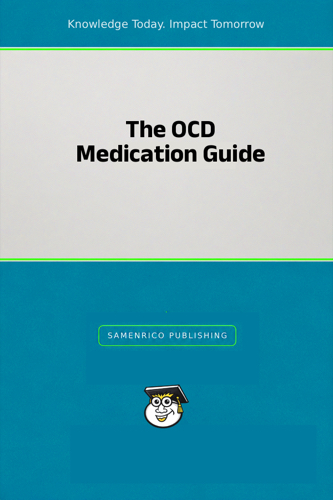
The OCD Medication Guide eBook
SSRIs like fluoxetine and sertraline for symptoms.
SSRIs like fluoxetine and sertraline for symptoms.
Formats
Free sample
Chapter 1: The Stuck Circuit--–- Sarah had spent twenty-three years believing she was secretly a terrible person. Not because she had done anything wrong, but because her brain would not stop telling her that she might. Every morning, she woke to the same thought: Did you leave the stove on? She would check. Then check again.
Then drive home from work to check a third time. The thought was not a suggestion. It was an accusation. And no amount of reassurance, no amount of checking, no amount of pleading with herself to just stop thinking about it ever made the accusation go away. Her therapist had told her she had a chemical imbalance.
Her priest told her she had anxiety. Her mother told her she was just a worrywart. But Sarah knew, with the bone-deep certainty that only someone with OCD can know, that something in her brain was broken in a way that willpower could not fix. She was right. And this chapter is about why.The Most Misunderstood Brain Disorder Obsessive-Compulsive Disorder is one of the most widely recognized and yet deeply misunderstood psychiatric conditions in the world.
Ask someone on the street what OCD means, and they will likely say something about being neat, organized, or particular about how the towels are folded. They might joke that they are “a little OCD” about their desk arrangement. This casual mischaracterization is not merely annoying to those who actually suffer from the disorder. It is actively harmful. It reduces a severe, often disabling neurobiological condition to a personality quirk.
It suggests that OCD is something you can laugh off, talk yourself out of, or simply decide to stop doing.The reality is vastly different. OCD is a chronic, often lifelong disorder characterized by two core features: obsessions and compulsions. Obsessions are recurrent, persistent, unwanted thoughts, urges, or images that feel intrusive and deeply distressing. Compulsions are repetitive behaviors or mental acts that a person feels driven to perform in response to an obsession, according to rigid rules, or to achieve a sense of completeness. The classic example is contamination fears leading to hand washing.
But OCD is far more creative and cruel than that single presentation allows. Some people are plagued by violent obsessions—recurring images of harming a loved one, despite having no desire to do so. Others struggle with sexual obsessions that directly contradict their moral values. Some experience scrupulosity, a form of religious OCD that convinces them they have committed an unforgivable sin. Others are tormented by relationship obsessions, constantly doubting whether they truly love their partner.
The common thread is not the content of the thought. It is the brain’s inability to recognize the thought as irrelevant and let it go.This chapter serves as the foundation for everything that follows in this book. Before we can understand how medications like fluoxetine and sertraline work, before we can discuss dosing strategies, side effects, or combining pills with therapy, we must first understand what OCD actually is—and what it is not. We must understand the brain circuits involved, the role of serotonin, and why the old “chemical imbalance” slogan, while not entirely wrong, is dangerously oversimplified. Most importantly, we must understand why you cannot simply think your way out of OCD, and why that fact does not make you weak.
It makes you human with a brain that has learned the wrong lesson—and can, with the right tools, unlearn it.The Anatomy of a Stuck Thought To understand OCD, we must leave the realm of psychology for a moment and enter the realm of neuroanatomy. The brain is not a single, unified machine. It is a collection of interconnected circuits, each responsible for a different function. One circuit handles vision. Another handles movement.
And one particular circuit, known as the cortico-striatal-thalamo-cortical loop—abbreviated as the CSTC loop—handles something called error detection.Let us simplify that. Deep in the center of your brain lies a small structure called the thalamus. One of its many jobs is to act as a filter. It takes in sensory information, thoughts, and impulses from lower brain regions and decides what is important enough to send up to the cortex—the thinking, conscious part of your brain. The striatum sits nearby and helps regulate this filter.
The cortex, meanwhile, generates predictions about the world. When your cortex predicts one thing and reality delivers another, the CSTC loop fires an alarm. That alarm is the feeling of something is wrong here. It is the same feeling you get when you realize you have left your phone on the bus or when you cannot remember if you locked the front door. That feeling is adaptive.
It is useful. It prompts you to check, to correct, to avoid danger.In a healthy brain, the CSTC loop fires briefly, you address the issue, and the alarm shuts off. You check the door. It is locked. The thought fades.
You move on with your day. In the OCD brain, something goes wrong with this circuit. The alarm does not shut off. It keeps firing, and firing, and firing, long after the threat has been addressed. The door is locked, but the brain keeps asking: Are you sure?
Really sure? What if you unlocked it by accident? What if you dreamed that you checked? What if the lock is broken? The initial thought—Did I lock the door?—was a normal error detection signal.
The endless repetition of that thought, long after the question has been answered, is the pathology. That is the stuck circuit.Neuroimaging studies have confirmed this model repeatedly. When people with OCD are exposed to their triggers, the CSTC loop shows dramatically increased activity compared to healthy controls. The orbitofrontal cortex, the anterior cingulate cortex, the caudate nucleus, and the thalamus all light up in a synchronized, pathological loop. These findings are so consistent that they have become one of the most replicated findings in all of psychiatry.
OCD is not a disorder of weak character or poor coping skills. It is a disorder of a specific brain circuit that has become hyperactive and, for reasons we are still unraveling, lost its ability to recognize when a problem has been solved.The Serotonin Hypothesis: What It Gets Right and Wrong For decades, the public has been told that depression and anxiety disorders, including OCD, are caused by a “chemical imbalance” in the brain—specifically, low levels of a neurotransmitter called serotonin. This slogan, popularized in the 1980s and 1990s by pharmaceutical marketing campaigns, was a useful simplification for its time. It helped destigmatize mental illness by framing it as a biological problem rather than a moral failing. It helped patients understand why a pill might help.
And it was not entirely false. But it was, and remains, a profound oversimplification.Here is what we actually know. Serotonin is one of the brain’s primary chemical messengers, or neurotransmitters. It is produced in a small cluster of neurons deep in the brainstem called the raphe nuclei, and it projects outward to virtually every region of the brain, including the CSTC loop. Serotonin’s role is not to make you happy, despite the popular nickname…
This is the end of the free sample. Get the eBook to keep going. Buy now
About this book
Details
- Author
- Miranda Athena
- Publisher
- SamEnrico
- Language
- English
- Genre
- Non-Fiction, Health & Wellness, OCD
- Released
- 2026-06-05
- Pages (approx.)
- 137
- Available as
- eBook, Audiobook

Read better in the ZLOADR app
Your eBooks on your phone or tablet. Sign in with your SamEnrico account and start reading.
More by Miranda Athena
 Orchestral Manager Behind ScenesMiranda Athena$11.99
 HIIT Nutrition Fueling GuideMiranda Athena$11.99
 Empathetic Listening Skills GuideMiranda Athena$11.99
 Narcotics Anonymous Step WorkbookMiranda Athena$11.99
 The Blood of Sedan: Love and Valor in the Franco-Prussian WarMiranda Athena$11.99
 How to Become a Oxygen-furnace OperatorMiranda Athena$11.99
 Usage Based Retention GuideMiranda Athena$12.99
 Cloud Storage Free to PaidMiranda Athena$12.99
 The Breeder's Guide to Holland ChickensMiranda Athena$11.99
 Hanksite MiningMiranda Athena$11.99
You may also like
 Hong Kong Handover 1997Dunn Johnnie$11.99
 Zumba For Postnatal Recovery CourseNeal Christian$11.99
 Zumba for BeginnersLadner Nikia$11.99
 YouTube Comment Mining GuideHumes Pandora$12.99
 Worry Box MeditationCarlin Rudy$11.99
 Workplace Stress MeditationNguyen Lynn$11.99
 Workplace Stress and Sleep RepairHawley Ivory$11.99
 Workplace Perfectionism CureDelaney Jeffry$11.99
 Workplace Injustice Anger GuideWallen Isabelle$11.99
 Work Addiction and Burnout LinkGreenwood Ester$11.99
 Women in Yoga and WellnessBeattie Galina$11.99
 Women in Stand Up ComedyChun Evangeline$11.99