
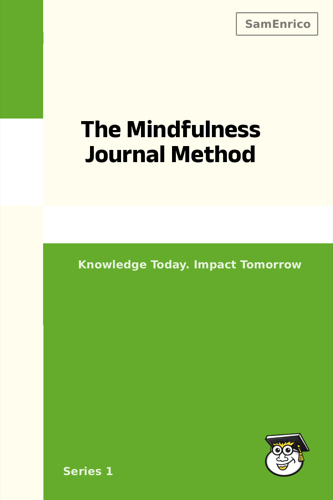
Non-FictionSelf-HelpJournaling
The Mindfulness Journal Method eBook
Combines MBSR practices with structured journaling
Combines MBSR practices with structured journaling prompts for stress processing.
Formats
Free sample
Chapter 1: The Autopilot Audit...--–- You are driving home from work. The route is so familiar that you cannot remember the last three turns. You arrive in your driveway with no memory of the journey. You were not asleep. You were not unconscious.
You were somewhere else entirely—and that somewhere else is where most of your stress lives.This is the autopilot. And before you can change a single stress habit, you have to see it.Most people believe they are already paying attention. They believe they know what they are doing, feeling, and thinking from moment to moment. The research suggests otherwise. Studies using experience-sampling methods—where researchers ping people at random times during the day and ask, “What are you doing right now, and is your mind on it?”—have found that the human mind wanders from its present activity nearly forty-seven percent of the time.
That is not a minority of your waking life. That is nearly half of it. You are somewhere other than where you are for almost fifty percent of your existence.And here is the part that matters for stress: when the mind wanders, it does not wander to neutral places. It tends to wander to the past (regret, resentment, rumination) or to the future (worry, planning, catastrophizing). Both are factories for stress hormones.
You cannot be stressed about something happening right now, in this exact moment, unless a tiger is actually eating you. But you can be very stressed about an email you sent six hours ago that you are replaying on a loop. And you can be very stressed about a meeting tomorrow that has not happened yet. The autopilot is the delivery system for that stress. It carries you out of the present and drops you directly into the narrative generator of your suffering.This chapter is called The Autopilot Audit.
It is not about fixing anything yet. It is not about changing your habits or becoming a more mindful person overnight. It is about one thing only: seeing. You cannot change what you do not notice. And most of what drives your stress happens in the gap between your ears when you are not looking.Before we go any further, let us establish the practice that will begin every single chapter in this book.
It will take thirty seconds. Do not skip it. The Pen-as-Anchor warm-up is not a suggestion or a nice-to-have. It is the mechanical core of this entire method. Without it, you are just writing in a diary.
With it, you are rewiring your brain.The Pen-as-Anchor Warm-Up Take your pen. Hold it. Do not write anything yet. Just feel it. Notice the temperature of the barrel against your skin.
Is it cool? Warm from your hand? Notice the texture. Is it smooth? Grip-textured?
Metallic? Plastic? Notice the weight. Is it heavy or light? Now place the tip against the page.
Feel the resistance. Drag it slowly in a small circle. Hear the sound—the scratch, the glide, the pressure.Now, for the next thirty seconds, whenever you notice your mind has wandered to a thought about something else—what you need to do later, what someone said yesterday, whether this is working—gently return your attention to the sensation of the pen moving against the page. That is it. That is the anchor.
You are not trying to stop thoughts. You are not trying to clear your mind. You are simply training your brain to come back to a physical sensation in the present moment.Why does this matter? Because stress is not the thought. Stress is the fusion with the thought.
The moment you can feel the pen in your hand and notice that a stressful thought is happening at the same time—without needing to follow it—you have created a gap. That gap is the beginning of every stress reduction you will learn in this book.Now, with your pen warm and your attention slightly more grounded than it was three minutes ago, let us audit the autopilot.The Cost of Not Seeing Let me tell you about a woman I will call Sarah. (She is a composite of dozens of people I have worked with; her story is not one person’s confidential information but a pattern I have seen repeated.) Sarah came to mindfulness journaling because she was exhausted. She described her life as “running on a treadmill that keeps getting faster.” She had panic attacks in the car. She snapped at her children.
She lay awake at night rehearsing conversations that had not happened.When I asked her to describe a typical morning, she said: “I wake up, I brush my teeth, I make coffee, I get the kids up, I check my phone, I leave for work.” When I asked her to describe one sensation from that morning—the taste of the toothpaste, the sound of the coffee maker, the weight of the phone in her hand—she could not remember a single one. Not one. Her entire morning had happened without her being there.This is not a character flaw. It is not laziness or stupidity or a lack of willpower. It is the default mode of the human brain.
The brain evolved to automate routine activities because automation saves energy. If you had to consciously attend to every step of brushing your teeth—the angle of the brush, the pressure, the duration, the taste—you would never get out of the bathroom. Automation is efficient. But efficiency has a cost. When you automate your life, you also automate your stress responses.
You are not there when the trigger happens. You are not there when the thought arises. By the time you notice you are stressed, you are already halfway through the meltdown.The autopilot audit is designed to interrupt that automation just enough for you to see it. You are not trying to eliminate autopilot—that would be impossible and exhausting. You are simply trying to notice when you are on it.
Because once you notice, you have a choice.The Raisin Exercise: From Mindfulness to Journaling In classic Mindfulness-Based Stress Reduction (MBSR), the very first practice is the raisin exercise. A raisin is placed in your hand. For five minutes, you explore it with all of your senses. You look at it. You touch it.
You smell it. You place it in your mouth and feel it on your tongue. You bite into it slowly, noticing the burst of sweetness, the texture, the sound inside your head. By the end of five minutes, you have experienced a single raisin more fully than you have experienced most of your meals in the past year.The point of the raisin exercise is to show you what full attention feels like. Most people have never experienced it.
They have eaten thousands of meals while thinking about something else. They have had conversations while scrolling on their phones. They have driven hundreds of thousands of miles while lost in thought. The raisin is a shock to the system because it proves that attention is not something you either have or do not have—it is something you can…
This is the end of the free sample. Get the eBook to keep going. Buy now
About this book
Details
- Author
- Gillespie Yoshiko
- Publisher
- SamEnrico
- Language
- English
- Genre
- Non-Fiction, Self-Help, Journaling
- Released
- 2026-06-10
- Pages (approx.)
- 133
- Available as
- eBook, Audiobook

Read better in the ZLOADR app
Your eBooks on your phone or tablet. Sign in with your SamEnrico account and start reading.
More by Gillespie Yoshiko
 MBSR for New Parents GuideGillespie Yoshiko$11.99
 Ayurvedic Kidney Health GuideGillespie Yoshiko$11.99
 Healthcare Worker Global Flow ForecastGillespie Yoshiko$11.99
 Teen Self Esteem and GriefGillespie Yoshiko$11.99
 The Goldsmiths of Ife: Sculpting Divinity in BronzeGillespie Yoshiko$11.99
 Understanding Methylmalonicaciduria, Vitamin B12 Unresponsive, Mut-0Gillespie Yoshiko$17.99
 Contract Renewal AutomationGillespie Yoshiko$12.99
 China Ghana Supply Chain Backup PlansGillespie Yoshiko$12.99
 A Beginners Guide to Clay pigeon shooting (Volume 1)Gillespie Yoshiko$11.99
 Ultimate FrisbeeGillespie Yoshiko$11.99
You may also like
 Hong Kong Handover 1997Dunn Johnnie$11.99
 Zumba For Postnatal Recovery CourseNeal Christian$11.99
 Zumba for BeginnersLadner Nikia$11.99
 YouTube Comment Mining GuideHumes Pandora$12.99
 Worry Box MeditationCarlin Rudy$11.99
 Workplace Stress MeditationNguyen Lynn$11.99
 Workplace Stress and Sleep RepairHawley Ivory$11.99
 Workplace Perfectionism CureDelaney Jeffry$11.99
 Workplace Injustice Anger GuideWallen Isabelle$11.99
 Work Addiction and Burnout LinkGreenwood Ester$11.99
 Women in Yoga and WellnessBeattie Galina$11.99
 Women in Stand Up ComedyChun Evangeline$11.99