
Non-FictionSelf-HelpMicro-Habits
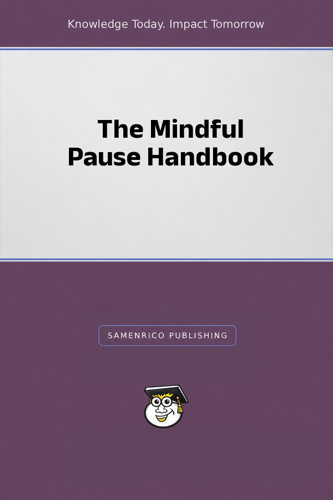
The Mindful Pause Handbook eBook
Teaches inserting short mindful moments into daily
Teaches inserting short mindful moments into daily transitions like doors, elevators, and stoplights.
Formats
Free sample
Chapter 1: The Dead Zone Discovery--You are not lazy. You are not distracted. You are not broken.You are neurologically exhausted from constant task-switching, and no amount of "trying harder" will fix it. This is not a character flaw. This is biology.
Every time you shift your attention from one thing to another—email to conversation, driving to phone notification, cooking to worrying about tomorrow—your brain pays a tax. That tax is measured in milliseconds of delay, grams of cortisol, and drops of mental energy. Over the course of a day, those tiny taxes add up to a state of chronic, low-grade depletion that feels like life.But here is what the productivity gurus will never tell you: the solution is not to eliminate the gaps between activities. The solution is to transform them.Let me prove it to you in the next ten seconds.Stop reading. Look at the top corner of this page.
Notice its color. Notice the way the light hits the edge. Notice the tiny imperfections in the paper or the faint glow of the screen. Now come back.Congratulations. You just took your first mindful pause.
It lasted about three seconds. You probably feel nothing extraordinary, and that is exactly the point. You do not need to feel different. You need to notice what you just did: you stopped doing one thing (reading) and inserted a micro-moment of awareness before continuing.That simple act—stopping, noticing, resuming—is the entire premise of this book. And it will change your life not because it is dramatic, but because it is tiny.
Because you can do it hundreds of times a day. Because the spaces between your activities are not voids. They are power stations. And you have been treating them like garbage disposals.The Great Lie of Busyness We have been sold a story that productivity means filling every moment. The most successful people, we are told, have no gaps.
They batch tasks. They double-speed their podcasts. They answer emails while walking to meetings. They scroll social media while waiting for coffee to brew. They treat every second of downtime as a resource to be optimized, monetized, or eliminated.This story is not just wrong.
It is dangerous.The human brain was not designed for continuous task-switching. In fact, the very act of switching comes with a measurable cost that neuroscientists call the "switching cost." Every time you shift attention from Task A to Task B, your brain must:First, disengage from Task A. This takes a fraction of a second, but during that fraction, you are not processing anything. Second, activate the neural networks associated with Task B. This takes another fraction of a second.
Third, reorient yourself to where you left off in Task B. This takes the longest—sometimes several seconds.Researchers at the University of California, Irvine, conducted a landmark study on workplace interruptions. They found that it takes an average of twenty-three minutes and fifteen seconds to fully refocus after a distraction. Twenty-three minutes. One glance at your phone during a dead zone costs you nearly half an hour of deep focus.But here is the kicker.
You are not even aware of most of your task-switching. It happens automatically, beneath the threshold of consciousness. Your brain, seeking efficiency, defaults to the path of least resistance. When you encounter a gap—even a three-second gap between finishing a work call and starting the next one—your brain says, "Ah, free time. Let's use this to worry about that meeting.
Or check Instagram. Or replay that argument from three days ago. Or plan tonight's dinner. Or remember that embarrassing thing I said in 2017."This automatic reaction is what I call your Transition Footprint.Your Transition Footprint is the thing you do automatically when you hit a dead zone. For some people, it is reaching for the phone.
For others, it is starting to plan the next task. For many, it is replaying a conversation or worrying about the future. For a few, it is simply dissociating—staring into space without actually resting.Your Transition Footprint is not a bad habit. It is a survival mechanism that has outlived its usefulness. Thousands of years ago, a gap in activity was a moment to scan for predators.
Your brain is still scanning. But the predators are now emails, deadlines, and social obligations. The scanning no longer protects you. It exhausts you.The good news? You can change your Transition Footprint.
Not by trying harder—willpower is a finite resource that fails when you are already exhausted. But by inserting something else into that gap. Something so small, so frictionless, so achievable that you cannot argue yourself out of doing it.That something is the mindful pause.The Pause Length Spectrum Before we go any further, we need a shared vocabulary. Throughout this book, we will talk about three different kinds of pauses. They are not interchangeable.
Each serves a different purpose and fits into different parts of your day. Understanding this spectrum will prevent the confusion that plagues most mindfulness books—the sense that a "pause" could mean anything from a three-second breath to a twenty-minute meditation.Micro-pause (3 to 5 seconds).This is the blink-and-you-miss-it pause. The kind you just took when I asked you to look at the corner of the page. The kind that happens before you turn a doorknob or after someone finishes speaking. Micro-pauses are for transitions that happen constantly throughout the day: doorways, conversation pivots, pre-decision moments.Micro-pauses cost you nothing.
They feel like almost nothing. You might not even register that you did them. But over a hundred micro-pauses a day, they rewire your nervous system. Each micro-pause is a tiny repetition of a new neural pathway. And neural pathways that are repeated become default pathways.Mini-pause (10 to 30 seconds).This is the "waiting for the toaster" pause.
The loading screen pause. The brief elevator ride between floors three and seven. The time it takes for your coffee to brew or your laptop to wake up.Mini-pauses are long enough to feel slightly awkward. That awkwardness is the signal that you are doing it right. Most people fill mini-pauses with phones or with planning because the silence feels uncomfortable, the stillness feels foreign.
The practice is to stay in the discomfort. To notice it without fixing it. To let the ten seconds be ten seconds.Macro-pause (30 seconds to several minutes).This is the red light pause. The queue at the grocery store. The long elevator ride from the lobby to the twenty-second floor.
The waiting room before an appointment. The time between finishing one meeting and the next one starting.Macro-pauses are long enough that you might feel genuine impatience or even frustration. That impatience is not a problem to solve; it is a sensation to notice. Macro-pauses are where the deep resets happen—where your nervous system has enough time to actually shift from sympathetic (fight-or-flight) to parasympathetic (rest-and-digest).For the rest of this book, every practice will specify which kind of pause it uses. You do not need to memorize the spectrum now.
Just know that a three-second doorway breath and a ninety-second red light anchor are both valid. They are just different…
This is the end of the free sample. Get the eBook to keep going. Buy now
About this book
Details
- Author
- Redding Kenyatta
- Publisher
- SamEnrico
- Language
- English
- Genre
- Non-Fiction, Self-Help, Micro-Habits
- Released
- 2026-06-10
- Pages (approx.)
- 149
- Available as
- eBook, Audiobook

Read better in the ZLOADR app
Your eBooks on your phone or tablet. Sign in with your SamEnrico account and start reading.
More by Redding Kenyatta
 MBSR for IBS WorkbookRedding Kenyatta$11.99
 Teen Self Esteem After DivorceRedding Kenyatta$11.99
 Ayurvedic Heart Health GuideRedding Kenyatta$11.99
 Navigating Political Divides in FamilyRedding Kenyatta$11.99
 Ashoka's Redemption: The Kalinga War That Changed an EmpireRedding Kenyatta$11.99
 Understanding Methylmalonicacidemia With Homocystinuria, Cbl DRedding Kenyatta$17.99
 How to Start a Cement Articles for Use In Construction Business (Beginners Guide)Redding Kenyatta$11.99
 Ghana Ecommerce Fraud PreventionRedding Kenyatta$12.99
 Expense Report Processing GuideRedding Kenyatta$12.99
 Turnips HarvestingRedding Kenyatta$11.99
You may also like
 Hong Kong Handover 1997Dunn Johnnie$11.99
 Zumba For Postnatal Recovery CourseNeal Christian$11.99
 Zumba for BeginnersLadner Nikia$11.99
 YouTube Comment Mining GuideHumes Pandora$12.99
 Worry Box MeditationCarlin Rudy$11.99
 Workplace Stress MeditationNguyen Lynn$11.99
 Workplace Stress and Sleep RepairHawley Ivory$11.99
 Workplace Perfectionism CureDelaney Jeffry$11.99
 Workplace Injustice Anger GuideWallen Isabelle$11.99
 Work Addiction and Burnout LinkGreenwood Ester$11.99
 Women in Yoga and WellnessBeattie Galina$11.99
 Women in Stand Up ComedyChun Evangeline$11.99