
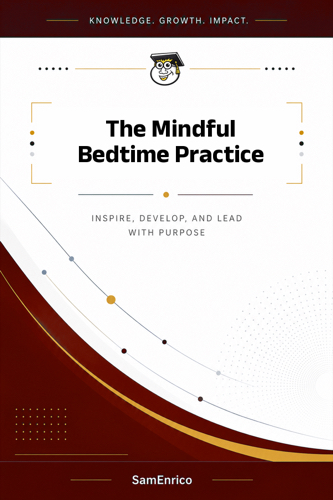
Non-FictionSelf-HelpBedtime Mindfulness
The Mindful Bedtime Practice eBook
Ends day with body scan to release accumulated str
by Garvin Corey
Ends day with body scan to release accumulated stress.
Formats
Free sample
Chapter 1: The Storage Lie--You have been told a lie about stress. It is a kind lie, well-intentioned, repeated by therapists, wellness influencers, and well-meaning friends who have read the same articles you have. The lie is this: stress is in your head. If you can just think differently, reframe your thoughts, practice positive self-talk, or "get perspective," the stress will dissolve. This lie is seductive because it places everything within your control.
If stress is just a thought problem, then you are only one good mindset shift away from peace. But here is the truth that no amount of positive thinking can erase: stress is not primarily a thought problem. Stress is a body storage problem.Your body is not a passive vehicle that carries your brain around. Your body is an active record-keeper. Every tense commute, every email you drafted and deleted, every frustration you swallowed at dinner, every time you said "I'm fine" when you were not fine—your body wrote all of it down.
Not in a journal. Not in a memory you can access and analyze. It wrote it down in your fascia, the web of connective tissue that holds every muscle, organ, and bone in place. It wrote it down in your diaphragm, the dome-shaped muscle beneath your lungs that tightens when you brace for impact. It wrote it down in your jaw, where unspoken words lodge like splinters.
It wrote it down in your gut, where five hundred million neurons form what scientists now call the enteric nervous system—your second brain, which feels everything your first brain tries to ignore.This chapter will introduce you to a radical reframe that will underpin every practice in this book. You will learn why your bedtime anxiety is not a failure of willpower, why counting sheep has never worked for anyone except cartoon characters, and why the solution to your sleep problems is not in your head at all. You will conduct your first Bedtime Inventory, a simple physical ritual that will reveal where your accumulated stress actually lives. And you will begin to understand a concept that will change how you see every sleepless night you have ever had: accumulated somatic debt.The Body as Ledger Think of your body as a ledger, like the kind an accountant uses. Every stressor you experience—every frustration, every fear, every moment of suppressed anger or swallowed grief—is entered as a debit on one side of the ledger.
But here is the problem: most people never make the corresponding deposit on the other side. They never actively release the tension. So the debits pile up. Week after week, year after year, the body's ledger grows more and more imbalanced. This is what we call accumulated somatic debt.
And just like financial debt, somatic debt compounds interest. A small tension ignored today becomes a slightly larger tension tomorrow, not because the original stressor is still present, but because your nervous system learned a pattern of bracing and never learned to let it go.You can observe this in yourself right now, without moving from wherever you are reading this. Take a breath. Now notice: where is your jaw? Are your teeth touching?
Is your tongue pressed against the roof of your mouth? Is there a subtle but constant clenching, the kind you have stopped noticing because it has been there for so long? Now notice your shoulders. Are they creeping up toward your ears, even slightly? Now your belly.
Is it soft and expandable, or is there a subtle holding, a gentle bracing, as if you are preparing for something unpleasant? Most people, when they do this quick inventory for the first time, discover that their body is holding tension in at least two of these three locations. That tension is not new. It has been there for hours, days, or years. You just stopped feeling it because feeling it would be exhausting.
Your nervous system adapted by turning down the volume on your internal sensors. This adaptation is efficient for survival, but it is catastrophic for sleep.The Nervous System's Silent Alarm To understand why accumulated somatic debt destroys sleep, you need to understand a little bit about your autonomic nervous system. Do not let the fancy term intimidate you. The autonomic nervous system is simply the part of your nervous system that runs automatically, without your conscious control. It has two main branches, and they work like a seesaw.The first branch is the sympathetic nervous system.
This is your accelerator. It is often called the "fight or flight" system, though that name misses the most common state most modern humans live in. Most of us are not fighting or fleeing. We are simply bracing. The sympathetic nervous system activates when you perceive a threat, whether that threat is a literal predator or a passive-aggressive email from your boss.
It raises your heart rate, diverts blood flow to your large muscles, slows digestion, and tenses your body for action. This is a brilliant system when you actually need to run from a tiger. It is a disaster when you are trying to fall asleep while your body is still acting like a tiger is hiding under the bed.The second branch is the parasympathetic nervous system. This is your brake. It is often called the "rest and digest" system.
It lowers your heart rate, relaxes your muscles, stimulates digestion, and signals to your entire body that you are safe. Sleep is a parasympathetic-dominant state. You cannot fall asleep while your sympathetic accelerator is pressed to the floor. It is physiologically impossible, like trying to park a car while pressing the gas.Here is the problem that no one tells you: the sympathetic and parasympathetic systems are not a light switch. They are a dimmer.
And accumulated somatic debt keeps the sympathetic dimmer set slightly higher than it should be, all the time. You may not feel anxious. You may not be consciously worried. But your jaw is still clenched, your diaphragm is still slightly tight, your gut is still subtly braced. Your nervous system is not waiting for you to think about safety.
It is waiting for your body to feel safe. And as long as your body is holding onto yesterday's stress, it will never fully believe that this moment is safe enough for sleep.The Bedtime Inventory Now we will move from theory to practice. I am going to guide you through something called the Bedtime Inventory. This is not a meditation. It is not a relaxation technique.
It is simply a diagnostic tool—a way to discover where your accumulated stress is living right now. You will need to be lying down to do this properly. If you are reading this during the day, bookmark this page and return to it tonight when you are in bed. If you are reading this in bed right now, close the book after you finish this paragraph and lie on your back with your arms at your sides.Begin by placing your right hand on your belly, just below your navel. Place your left hand on your jaw, with your fingers resting along your jawline and your palm…
This is the end of the free sample. Get the eBook to keep going. Buy now
About this book
Details
- Author
- Garvin Corey
- Publisher
- SamEnrico
- Language
- English
- Genre
- Non-Fiction, Self-Help, Bedtime Mindfulness
- Released
- 2026-06-11
- Pages (approx.)
- 121
- Available as
- eBook, Audiobook

Read better in the ZLOADR app
Your eBooks on your phone or tablet. Sign in with your SamEnrico account and start reading.
More by Garvin Corey
 Elementary Dream PatternsGarvin Corey$11.99
 Postpartum Hydration GuideGarvin Corey$11.99
 FODMAP And Disordered EatingGarvin Corey$11.99
 Bipolar Disability GuideGarvin Corey$11.99
 Transcendental Meditation Daily LogGarvin Corey$11.99
 Pollution Skin Damage Protection WorkbookGarvin Corey$11.99
 Carbon Monoxide SurvivorGarvin Corey$11.99
 Arthritis Driving TipsGarvin Corey$11.99
 The Ghosts of the Flintlock: The Birth of the American Revolution's Deadliest WeaponGarvin Corey$11.99
 The Pythagorean Theorem: A Love Letter to Numbers in Ancient GreeceGarvin Corey$11.99
 Silicon Valley's Secret Weapon: The Untold Story of Sequoia CapitalGarvin Corey$11.99
 Growing Tetradium (Bee Tree)Garvin Corey$11.99
You may also like
 Hong Kong Handover 1997Dunn Johnnie$11.99
 Zumba For Postnatal Recovery CourseNeal Christian$11.99
 Zumba for BeginnersLadner Nikia$11.99
 YouTube Comment Mining GuideHumes Pandora$12.99
 Worry Box MeditationCarlin Rudy$11.99
 Workplace Stress MeditationNguyen Lynn$11.99
 Workplace Stress and Sleep RepairHawley Ivory$11.99
 Workplace Perfectionism CureDelaney Jeffry$11.99
 Workplace Injustice Anger GuideWallen Isabelle$11.99
 Work Addiction and Burnout LinkGreenwood Ester$11.99
 Women in Yoga and WellnessBeattie Galina$11.99
 Women in Stand Up ComedyChun Evangeline$11.99