
Non-FictionTechnologyFinanceModern Culture
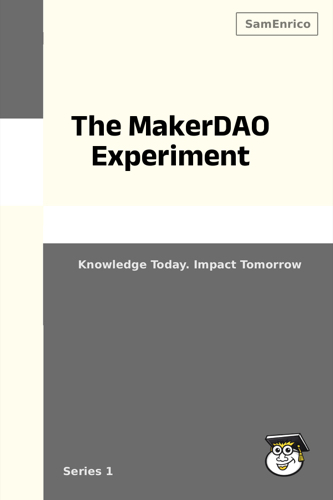
The MakerDAO Experiment eBook
A documentary examining decentralized governance,
A documentary examining decentralized governance, stablecoin design, and the delicate balance between code and community decision-making.
Formats
Free sample
Chapter 1: The Stability Triangle...–- In the beginning, there was volatility. Bitcoin had proven that a borderless, censorship-resistant digital currency was possible, but it had also proven something else: no one would ever use it to buy coffee. The dream of a decentralized financial system, free from banks and governments, crashed against the hard reality of 50% price swings. If crypto wanted to become a global economy rather than a speculative casino, it needed something that had never existed before: a digital dollar that no single person, company, or country could control.Rune Christensen, a soft-spoken Danish entrepreneur with a background in supply chain management and international economics, became obsessed with this problem in 2014. He had watched the first wave of stablecoin experiments fail.
Bit USD, built on the Bit Shares network, had collapsed when its collateral proved insufficient. Nu Bits had promised stability and delivered a spectacular death spiral. The pattern was always the same: someone would propose an algorithmic solution, the market would test it, and within months, the peg would shatter.What made Christensen different was his willingness to abandon pure theory. He was not an academic writing white papers from an ivory tower. He was a builder who had learned hard lessons running a startup called Try Shell, which attempted to use blockchain technology for international shipping logistics.
That venture had failed, but it taught him something crucial: trust is not binary. You cannot simply declare a system "trustless" and expect humans to use it. Instead, you must engineer trust in layers, replacing human intermediaries with incentives so aligned that betrayal becomes economically irrational.The insight that became Maker DAO emerged from a deceptively simple question: What if we stopped trying to create stability from nothing and instead borrowed it from the future?The Volatility Problem To understand why Maker DAO matters, you must first understand why stablecoins are the most difficult problem in cryptocurrency. It is tempting to think of stability as the default state of money. A dollar is a dollar.
A euro is a euro. But fiat currencies are stable only because of centuries of institutional scaffolding: central banks, deposit insurance, lender-of-last-resort facilities, and the implicit threat of state violence. Take away that scaffolding, and any asset becomes volatile.Bitcoin maximalists had a clean answer to this problem: volatility is the price of freedom. If you want stable purchasing power, they argued, you should hold dollars and accept the censorship risk. But this answer was unsatisfying to anyone who actually wanted to use crypto.
You cannot build a lending market on a volatile asset. You cannot offer predictable salaries to DAO contributors. You cannot create a decentralized prediction market when the settlement currency might lose half its value overnight.The centralized stablecoin solution emerged first. Tether launched in 2014, claiming each USDT was backed by one dollar in a bank account. Circle followed with USDC in 2018.
These worked perfectly for trading—fast, liquid, cheap—but they reintroduced exactly what crypto was supposed to eliminate: counterparty risk, regulatory seizure, and the need to trust a company. In 2019, the New York Attorney General revealed that Tether had been unbacked for months. In 2023, Silicon Valley Bank's collapse briefly froze USDC redemptions. The promise of decentralization had been traded for convenience.Christensen wanted neither the chaos of Bitcoin nor the captivity of Tether. He wanted a third path: algorithmic stability backed by crypto-native collateral, governed by a community of stakeholders with aligned economic incentives.
The question was whether such a system could be built on mathematical principles alone.The Overcollateralization Insight The core innovation of Maker DAO, the one that distinguishes it from every failed stablecoin experiment that came before, is overcollateralization. The concept is simple enough to explain in a sentence but deep enough to sustain an entire economic system.Here is the basic mechanism: To generate Dai, a user must lock up a larger amount of another cryptocurrency—initially only Ethereum, later dozens of assets—into a smart contract called a Vault (originally known as a Collateralized Debt Position, or CDP). If the user wants 100 Dai, they might need to deposit $150 worth of ETH. That 50% buffer absorbs price fluctuations. If ETH drops by 30%, the Vault is still safely overcollateralized.
Only if ETH drops below the liquidation ratio—typically 150% collateralization, meaning a 33% drop from deposit—does the system intervene.That intervention is where the genius lies. When a Vault becomes undercollateralized, the protocol does not simply wait for the user to add more collateral or beg for forgiveness. It automatically triggers a liquidation: the collateral is sold at auction to bring the Vault back into health. The user loses their excess collateral but keeps the Dai they generated. The system remains solvent.
The peg holds.This mechanism solves the problem that killed Bit USD and Nu Bits: undercollateralization cascades. In those earlier systems, when collateral values fell, there was no automatic mechanism to restore stability. The protocol relied on users to voluntarily add collateral or on market makers to absorb losses. When the panic came, no one stepped forward. The algorithms predicted rational behavior; human panic delivered the opposite.Overcollateralization is not a technical solution.
It is an incentive solution. It aligns the user's self-interest with the protocol's survival. If you want to borrow Dai, you must put real value at risk. If you let your Vault become undercollateralized, you will be liquidated. There is no bailout, no negotiation, no human discretion.
The code enforces the rules with mechanical cruelty.But this cruelty is also a kindness. Because the system is predictable, participants can plan around it. Liquidation bots—automated programs called Keepers—monitor the blockchain for undercollateralized Vaults, competing to buy the collateral at auction. Their profit motive ensures liquidations happen quickly and efficiently. The market, not a committee, sets the price of distressed collateral.Introducing the Stability Triangle To understand how overcollateralization creates stability, it helps to visualize the system as a triangle with three interdependent corners.
This Stability Triangle will appear throughout this book as a recurring framework. The three corners are:Collateral: The volatile asset locked in a Vault. This is the raw material of the system. It carries all the market risk. If collateral prices crash, the entire structure shakes.Debt: The Dai generated from the Vault.
This is the stable output. The goal of the entire system is to keep Debt stable even as Collateral swings wildly.Equity: The MKR token held by governance participants. This is the shock absorber. If the system accrues bad debt (Collateral insufficient to cover all issued Dai), the protocol mints and sells new MKR to cover the loss, diluting existing holders.The triangle is not static. It is a dynamic system of forces.
Collateral pushes toward volatility. Debt pulls toward stability. Equity absorbs the difference. When the system works, these three forces reach equilibrium: the peg holds, MKR holders earn fees, and users borrow Dai without fear of collapse.When the system fails, as it nearly did on Black Thursday, the triangle collapses. Collateral evaporates (ETH price crash), Debt becomes unbacked (bad debt accumulates), and Equity is diluted (MKR printed to cover losses).
The crisis in one corner propagates to the others. The only way to restore equilibrium is through governance intervention—humans voting…
This is the end of the free sample. Get the eBook to keep going. Buy now
About this book
Details
- Author
- Salisbury Keesha
- Publisher
- SamEnrico
- Language
- English
- Genre
- Non-Fiction, Technology, Finance, Modern Culture
- Released
- 2026-06-03
- Pages (approx.)
- 110
- Available as
- eBook, Audiobook

Read better in the ZLOADR app
Your eBooks on your phone or tablet. Sign in with your SamEnrico account and start reading.
More by Salisbury Keesha
 Public Speaking Glossophobia FixSalisbury Keesha$11.99
 Residential Treatment PreparationSalisbury Keesha$11.99
 Gaming and NeurodiversitySalisbury Keesha$11.99
 Bankruptcy And Subordination AgreementSalisbury Keesha$11.99
 The Public Speaking CalmSalisbury Keesha$11.99
 Intensive Care Unit Stress GuideSalisbury Keesha$11.99
 The Security Guard HostageSalisbury Keesha$11.99
 Commuter Student Stress GuideSalisbury Keesha$11.99
 The Lost Symphony of Zanzibar: The 19th-Century Heist of a Musical MasterpieceSalisbury Keesha$11.99
 Raven’s Trickster Fire: The Great Salmon of the Celilo FallsSalisbury Keesha$11.99
 Growing DelaireaSalisbury Keesha$11.99
 Cloud Computing FundamentalsSalisbury Keesha$11.99
You may also like
 Hong Kong Handover 1997Dunn Johnnie$11.99
 Zumba For Postnatal Recovery CourseNeal Christian$11.99
 Zumba for BeginnersLadner Nikia$11.99
 YouTube Comment Mining GuideHumes Pandora$12.99
 Worry Box MeditationCarlin Rudy$11.99
 Workplace Stress MeditationNguyen Lynn$11.99
 Workplace Stress and Sleep RepairHawley Ivory$11.99
 Workplace Perfectionism CureDelaney Jeffry$11.99
 Workplace Injustice Anger GuideWallen Isabelle$11.99
 Work Addiction and Burnout LinkGreenwood Ester$11.99
 Women in Yoga and WellnessBeattie Galina$11.99
 Women in Stand Up ComedyChun Evangeline$11.99