
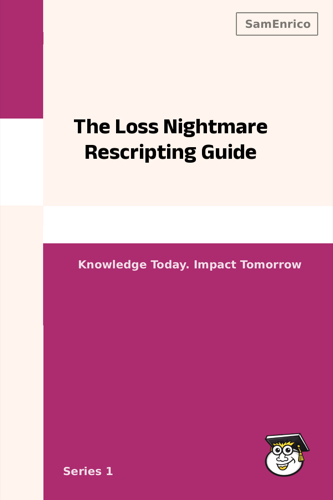
Non-FictionSelf-HelpGrief Dreams
The Loss Nightmare Rescripting Guide eBook
Changes endings where loved ones die into rescue o
Changes endings where loved ones die into rescue or reunion.
Formats
Free sample
Chapter 1: The Stuck Image...--–- The dream always ends the same way. You wake up gasping, or crying, or perfectly silent because your body has learned that screaming changes nothing. The image is still there—the phone call, the hospital room, the empty chair, the moment you knew. It plays again, the same frame, the same sound, the same absence. You have watched this reel hundreds of times.
You know how it ends. And yet your brain forces you to watch it again.This is not weakness. This is not a failure to "move on." This is your brain doing exactly what it evolved to do when faced with something it cannot file away as finished.Before we change the ending, you need to understand why the ending is stuck. This chapter is not a neuroscience lecture. You will not be tested on vocabulary.
But you will learn three things: why the nightmare repeats, the difference between grief that heals and grief that loops, and the name of the tool that will become your way out. That tool is called rescripting, and by the end of this chapter, you will know why it works—not as denial, but as the most loving form of memory repair available to you.The Three Faces of This Pain Every grief book makes promises. This one makes only one: you will meet three people in these pages who are not you, but who will sound familiar. They will appear in every chapter, not as case studies to be analyzed but as companions walking alongside you. Their names are Ann, Marcus, and Elena.
Their losses are different. Their nightmares are different. But the shape of the stuck image—the frame that will not advance—is the same.Ann is sixty-two years old. Fourteen months ago, she came home from grocery shopping to find her husband of thirty-nine years, David, collapsed on the kitchen floor. He had died of a massive heart attack approximately twenty minutes before she walked in.
The image that plays for Ann is not David's life—the way he laughed, the way he made coffee, the way he held her hand at stoplights. The image that plays is his face against the tile floor, his glasses knocked askew, his hand still reaching toward the phone that fell from the counter. She has tried to replace this image with memories of their wedding, their children's births, their anniversary trip to Maine. None of it works. The kitchen floor is stronger.Marcus is twenty-eight.
His older brother, Danny, died by suicide three years ago. Marcus was the last person to speak to him—a seven-minute phone call the night before, during which Danny said he was tired and Marcus said he should get some sleep. Marcus has replayed those seven minutes thousands of times, searching for the word he should have said, the question he should have asked, the tone he should have used. The image that plays for Marcus is not a visual one. It is the sound of the phone ringing the next morning, his mother's voice, and then a silence that has never ended.
He has told himself a thousand times that he could not have known. But the Accuser—the voice that lives in his chest—answers: You should have known.Elena is forty-five. Her mother, Carmen, died after a five-year battle with Alzheimer's disease. By the end, Carmen did not recognize Elena. She sometimes became agitated, sometimes violent, sometimes wept for her own mother who had been dead for thirty years.
Elena's nightmare is not a single image but a collage: her mother calling her by the wrong name, her mother eating with her fingers, her mother looking at Elena with the polite confusion of a stranger asked a question she cannot answer. The relief Elena felt when her mother finally died is the source of her deepest guilt. What kind of daughter feels relief? she asks herself. What kind of daughter is glad it's over?Ann, Marcus, and Elena are not real names.
But the people behind them are real. They are every person who has written to grief therapists, every person who has sat in support groups and said "I can't get the image out of my head," every person who has wondered if they are going crazy because the same terrible moment plays on repeat no matter how hard they try to think of something else.You have your own version of the kitchen floor, the phone ringing, the stranger's face. You have your own stuck image. This chapter will not ask you to name it yet—that comes in Chapter 2. But this chapter will ask you to understand why it is stuck, and why the usual advice—"just think positive," "focus on the good memories," "time heals all wounds"—has not worked.Why the Usual Advice Fails If you have been grieving for more than a few weeks, you have almost certainly heard some version of the following: "Try to remember the good times." "Don't dwell on the end." "They wouldn't want you to be sad." "You need to let go."These statements are not malicious.
They come from people who love you and want your pain to stop. But they are neurologically useless. Telling a brain that is stuck on a traumatic image to "think of something else" is like telling someone whose hand is on a hot stove to "consider the pleasantness of ice." The brain does not work that way.Here is what actually happens when a traumatic death occurs.Your brain has two structures that matter for this conversation: the amygdala and the hippocampus. The amygdala is your alarm system. It scans the environment for threats and, when it finds one, floods your body with stress hormones so you can fight, flee, or freeze.
The hippocampus is your filing system. It takes experiences and stamps them with a timestamp: this happened in the past, it is over, and you are safe now.When you experience something ordinary—a minor argument, a pleasant meal, a routine drive—your hippocampus does its job. It files the memory away with a clear marker: finished.When you experience something traumatic—finding a loved one dead, receiving the phone call, watching someone decline into unrecognizability—your amygdala takes over. It screams at your hippocampus: DANGER. And your hippocampus, overwhelmed, fails to stamp the memory as past.
The memory stays in a kind of neurological present tense. It does not feel like something that happened then. It feels like something that is happening now.This is why you can be washing dishes or driving to work or lying in bed and suddenly feel as though the death just occurred. Your brain has accessed the memory, but the memory still has a "present danger" flag attached to it. The amygdala activates.
Your heart rate increases. Your palms sweat. You feel the same horror you felt the moment it happened.This is not a character flaw. This is not a lack of faith or strength or gratitude for the good times. This is your brain's threat-detection system operating exactly as it evolved to operate when faced with an event…
This is the end of the free sample. Get the eBook to keep going. Buy now
About this book
Details
- Author
- Waugh Tamekia
- Publisher
- SamEnrico
- Language
- English
- Genre
- Non-Fiction, Self-Help, Grief Dreams
- Released
- 2026-06-06
- Pages (approx.)
- 158
- Available as
- eBook, Audiobook

Read better in the ZLOADR app
Your eBooks on your phone or tablet. Sign in with your SamEnrico account and start reading.
More by Waugh Tamekia
 Routine Interruption Anger HandbookWaugh Tamekia$11.99
 Caregiver Burnout In MS CareWaugh Tamekia$11.99
 Anger at Technology GlitchesWaugh Tamekia$11.99
 Fertility and Environmental ToxinsWaugh Tamekia$11.99
 The Diamond of Doom: The Heist That Turned DeadlyWaugh Tamekia$11.99
 Understanding Oculomotor Nerve PalsyWaugh Tamekia$17.99
 Channel Partner ManagerWaugh Tamekia$11.99
 Chinese University Agent Warning GuideWaugh Tamekia$12.99
 GSK SWOT GuideWaugh Tamekia$12.99
 How to Become a Concaving-machine OperatorWaugh Tamekia$11.99
You may also like
 Hong Kong Handover 1997Dunn Johnnie$11.99
 Zumba For Postnatal Recovery CourseNeal Christian$11.99
 Zumba for BeginnersLadner Nikia$11.99
 YouTube Comment Mining GuideHumes Pandora$12.99
 Worry Box MeditationCarlin Rudy$11.99
 Workplace Stress MeditationNguyen Lynn$11.99
 Workplace Stress and Sleep RepairHawley Ivory$11.99
 Workplace Perfectionism CureDelaney Jeffry$11.99
 Workplace Injustice Anger GuideWallen Isabelle$11.99
 Work Addiction and Burnout LinkGreenwood Ester$11.99
 Women in Yoga and WellnessBeattie Galina$11.99
 Women in Stand Up ComedyChun Evangeline$11.99