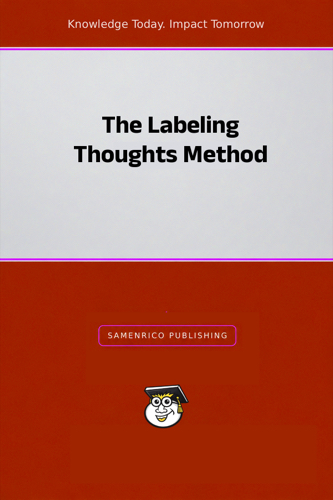
The Labeling Thoughts Method eBook
Teaches beginners to label thoughts as planning, r
Teaches beginners to label thoughts as planning, remembering, or judging.
Formats
Free sample
Chapter 1: The 3 AM Trap--–- You are lying in bed. The clock reads 3:17 AM. The room is dark, the house is silent, and your brain is screaming.You have been here before. Perhaps last week. Perhaps last night.
Perhaps you have spent years of your life in this exact position—staring at the ceiling, watching the minutes tick by, while your mind runs a marathon it did not sign up for.What is the thought? It does not matter. The content shifts from night to night, but the shape is always the same. A memory from seven years ago, the one where you said something awkward at a party and still cringe when you think about it. A worry about tomorrow's presentation, the one you have already rehearsed twelve times but your brain insists is a ticking time bomb.
A to-do list that somehow grew legs and started chasing you. A judgment about your own worth, whispered in a voice that sounds like yours but speaks with a cruelty you would never direct at a friend.You try to push the thought away. You tell yourself, "Stop thinking about it." You clench your jaw. You pull the pillow over your head. You count backward from one hundred.
You recite a mantra. You try to replace the bad thought with a good one—a tropical beach, a happy memory, a compliment someone gave you in 2019.Nothing works. The thought grows louder. It multiplies. One anxious thought becomes three.
Three become ten. Ten become a swarm.By 4:00 AM, you are exhausted, ashamed, and convinced that something is fundamentally wrong with you.Here is the truth that will change everything: The problem is not the thought. The problem is not you. The problem is the fight.The Great Lie of Positive Thinking We have been sold a seductive promise. The promise says that if you think positive thoughts, negative thoughts will disappear.
If you just try hard enough, believe strongly enough, and affirm yourself loudly enough, the bad thoughts will pack their bags and leave.This is a lie.Not because positive thinking is bad. Positive thinking can be lovely. Optimism correlates with better health outcomes. Gratitude practices have genuine psychological benefits. But the idea that you can erase a thought by fighting it—that is not just false.
It is dangerous.The lie begins with a misunderstanding of what a thought actually is. Most people believe that a thought is a command. When the brain says, "You are going to fail," they react as if a general has issued an order. They feel compelled to obey, to argue, or to panic. They do not realize that a thought is simply a puff of linguistic air.
It is a whisper. It is a scribble on a mental blackboard. It has no power except the power you give it.The lie continues with the assumption that the opposite of a bad thought is a good thought. If you are anxious about a meeting, just think about a puppy. If you are sad about a breakup, just think about sunshine.
This is not psychology; it is a Hallmark card. The brain does not work like a light switch where one bulb replaces another. The brain works like a river. You cannot push the water upstream. You can only learn to float.And the lie ends with shame.
When positive thinking fails—and it will fail, because thought suppression always fails—the person blames themselves. "I must not have tried hard enough." "I must be broken." "Everyone else can do this, why can't I?" The shame becomes another thought. And now you are not just anxious. You are anxious about being anxious. You are judging yourself for judging yourself.
The spiral deepens.This book exists because the lie has caused enough suffering. You do not need to think better thoughts. You need a better relationship with the thoughts you already have.The White Bear That Ruins Everything In 1987, a social psychologist named Daniel Wegner ran a simple experiment that changed how we understand the mind. He asked participants to do one thing: do not think about a white bear.That was it. Just avoid the image of a white bear for five minutes.
Every time the bear appeared in their mind, they were to ring a bell.You can guess what happened. The bells rang constantly. The white bear was everywhere. Participants could not escape it. The act of trying not to think about the bear guaranteed that they would think of nothing else.Then Wegner asked a different group of participants to do something else: think about a white bear.
Deliberately. Intentionally. For five minutes, just let the white bear come and go.These participants thought about the white bear, yes. But they did not struggle. They did not panic.
They did not ring bells with frustrated urgency. They simply noticed the bear, observed it, and moved on.This is the White Bear Problem. When you try to suppress a thought, you must first monitor for that thought to know whether it has appeared. And that monitoring keeps the thought active. The very act of pushing away creates a constant checking-in.
The bouncer at the door cannot stop thinking about the person he just kicked out. He is waiting for them to come back.Wegner called this ironic process theory. The more you try to control a thought, the more it controls you. Suppression fails 100% of the time. Not 99%.
Not "sometimes." Always. The white bear always returns.Now apply this to your 3 AM spiral. Every time you told yourself "Stop worrying about the meeting," you were ringing the bell. Every time you tried to replace the memory with a happy thought, you were feeding the bear. Your effort was not the solution.
Your effort was the problem.This is not your fault. Your brain is working exactly as evolution designed it. The brain's alarm system is not built for comfort; it is built for survival. A thousand years ago, the person who could not stop thinking about the rustling in the bushes survived the saber-toothed tiger. The person who shrugged and went back to sleep became lunch.
Your brain is not broken. It is just operating on outdated software.The good news is that you can update the software. But not by fighting. By labeling.What Is a Thought, Really?Before we go any further, we need to agree on something fundamental. What is a thought?Most people act as if a thought is a fact.
When the brain says "I am going to fail," they treat that as a prediction from an all-knowing oracle. When the brain says "I am stupid," they treat that as a verdict from a supreme court. They do not question the source. They do not ask for evidence. They simply believe.This is called cognitive fusion in Acceptance and Commitment Therapy (ACT).
Fusion is the state where you are so tangled in a thought that you cannot tell the difference between the thought and reality. You are not having the thought "I am a failure." You are a failure. The thought becomes a physical weight, an identity, a life…
This is the end of the free sample. Get the eBook to keep going. Buy now
About this book
Details
- Author
- Barba Racheal
- Publisher
- SamEnrico
- Language
- English
- Genre
- Non-Fiction, Self-Help, Labeling
- Released
- 2026-06-09
- Pages (approx.)
- 134
- Available as
- eBook, Audiobook

Read better in the ZLOADR app
Your eBooks on your phone or tablet. Sign in with your SamEnrico account and start reading.
More by Barba Racheal
 Grief Relationship Self WorthBarba Racheal$11.99
 NA Basic Text GuideBarba Racheal$11.99
 Assertiveness For PsychologistsBarba Racheal$11.99
 Growing Up in a BasementBarba Racheal$11.99
 AI Image Generation SlidesBarba Racheal$11.99
 Online Support Groups GriefBarba Racheal$11.99
 Kids Dream Journal MethodBarba Racheal$11.99
 Reformation Augsburg Confession BattleBarba Racheal$11.99
 Hashtag Revolution: The Viral Uprising That Toppled a GovernmentBarba Racheal$11.99
 Whispers of the Dreaming SandsBarba Racheal$11.99
 The Silent War: How a 1980s Cold War Hacker Almost Triggered Nuclear ArmageddonBarba Racheal$11.99
 The Complete Guide to the Brazilian Bikini Body ProgramBarba Racheal$11.99