
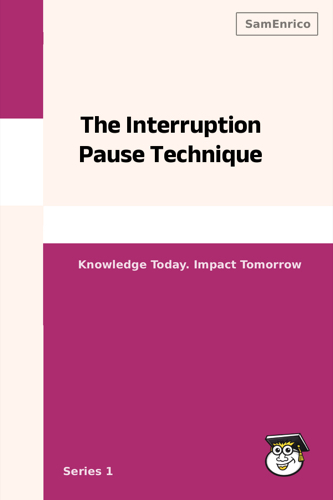
The Interruption Pause Technique eBook
Master the three-second pause before responding to
Master the three-second pause before responding to any disruption to maintain cognitive control.
Formats
Free sample
Chapter 1: The Autopilot Trap...--–- It starts like this: someone asks you a question you weren’t expecting. Or your phone buzzes with an email that makes your jaw tighten. Or your partner walks in and says something that lands like a paper cut—small, but sharp. And before you know it, you’ve answered. You’ve replied.
You’ve snapped. The words are already out of your mouth, already flying across the screen, already hanging in the air between you and another human being. And the moment they leave you, you feel it: the tiny, sickening drop in your gut that says, I shouldn’t have said that.You tell yourself you’ll do better next time. You promise to pause. You vow to think before you speak.
But the next interruption comes—a critical boss, a crying child, a sudden request—and the same thing happens. The words fly out before your brain has caught up. Again. And again. And again.This is not a character flaw.
It is not a lack of willpower. It is not because you’re a bad person, a bad partner, a bad employee, or a bad parent. It is because your brain is wired to react faster than it can think—and the modern world has turned that wiring into a weapon aimed at your own peace of mind.Welcome to the autopilot trap.The Illusion of the Rational Mind Most of us walk around with a quiet, comfortable assumption: that we are in control of our own responses. We believe that when someone says something to us, we hear it, we process it, we consider it, and then we decide how to reply. This feels true.
It feels like the sequence of events. But neuroscience has a different story to tell—and it is not a flattering one.The truth is that your brain responds to most interruptions before you have any conscious awareness of what is happening. The sequence is not: interruption → hearing → thinking → responding. It is: interruption → amygdala activation → hormonal cascade → physical reaction → and then, if you are lucky, your prefrontal cortex catches up and tries to put the brakes on. But by then, the train has often left the station.
The words are already out. The email is already sent. The sarcastic comment is already airborne.This chapter is about that gap. That tiny, explosive window of time between the interruption and your response. In that window—which lasts about three seconds—your entire future with the person in front of you, or the situation you are in, can be shaped for better or worse.
The Interruption Pause Technique is the deliberate training of that window. It is the difference between being driven by your biology and driving it.The Anatomy of a Snap Let’s walk through what happens when you get interrupted. Not the theoretical, textbook version. The real, messy, sweaty-palmed version that happens in your actual life.You are focused on something. Maybe it is an email you are trying to finish.
Maybe it is a conversation with your child. Maybe it is just the quiet hum of your own thoughts while you drink your morning coffee. Then, without warning, something breaks that focus. A colleague taps your shoulder. A notification lights up your phone.
A family member asks a question. A client sends a terse message.In the first half-second, your amygdala—an ancient part of your brain that has not gotten the memo about modern life—categorizes this interruption as a threat. It does not matter if the interruption is a toddler asking for juice or a boss asking for a report. The amygdala treats both the same way: as a disruption to safety. It cannot distinguish between a tiger and a text message.
It only knows that something has changed, and change is dangerous.In the next half-second, your body responds. Stress hormones flood your system. Your heart rate increases. Your breathing becomes shallow. Your muscles tense.
Your field of vision narrows. You are now in fight, flight, or freeze mode. This is not a metaphor. It is a physiological reality. Your body is preparing to defend itself against a threat.Now, here is the cruel irony: in the time it has taken your body to prepare for battle, your prefrontal cortex—the part of your brain responsible for logic, empathy, long-term thinking, and self-control—has barely started its engine.
It takes about two to three seconds for the prefrontal cortex to fully activate after an interruption. Two to three seconds. That is all the time you have to catch yourself before your biology makes your decisions for you.If you have ever said something and immediately thought, Where did that come from?—that was your amygdala talking and your prefrontal cortex arriving just late enough to witness the car crash.The Cost of the Automatic Yes We pay for our un-paused responses in ways that compound silently, like interest on a credit card we forgot we had. The cost is financial, relational, physical, and existential. And most of us never stop to add it up.Let’s start with money.
In the workplace, miscommunication—most of which begins with an un-paused reaction to an interruption—costs companies an average of $4,200 per employee per year. That number comes from aggregated data on lost productivity, rework, turnover, and conflict resolution. For a team of fifty people, that is over $200,000 a year. For a company of a thousand, it is over $4 million. All of it, or most of it, traceable back to moments when someone answered before they paused.But the financial cost is only the beginning.
The relational cost is harder to quantify but far more devastating. Every time you snap at someone—every time you answer a question with irritation, respond to a request with sarcasm, or shoot off an email in anger—you make a withdrawal from what we will call your Emotional Bank Account with that person. A single snap can be repaired. But repeated snaps, like repeated overdrafts, eventually close the account. The person stops bringing you problems.
Stops asking for help. Stops being honest with you. Stops trusting you. The relationship becomes a hollow shell of what it could have been, not because of any single disaster, but because of hundreds of tiny, un-paused moments.And then there is the physical cost. The stress hormones that flood your body during every un-paused reaction are designed for short bursts of acute danger.
When they are triggered dozens of times a day, week after week, year after year, they wear your body down. Chronically elevated cortisol is linked to high blood pressure, weakened immune function, weight gain, anxiety, depression, and sleep disorders. Your body does not know you are just answering email. It thinks you are running from a predator. And it is paying the price.Finally, there is the existential cost: the quiet sense that you are not the person you want to be.
That you are reactive instead of responsive. That you are driven by circumstances instead of driving them. That the best version of you—the patient, thoughtful, kind version—only shows up when life is easy. And…
This is the end of the free sample. Get the eBook to keep going. Buy now
About this book
Details
- Author
- Lavigne Alyson
- Publisher
- SamEnrico
- Language
- English
- Genre
- Non-Fiction, Self-Help, Mindfulness
- Released
- 2026-06-10
- Pages (approx.)
- 135
- Available as
- eBook, Audiobook

Read better in the ZLOADR app
Your eBooks on your phone or tablet. Sign in with your SamEnrico account and start reading.
More by Lavigne Alyson
 Second Generation WeddingsLavigne Alyson$11.99
 White Noise Sleep MemoryLavigne Alyson$11.99
 Paleo Dessert Recipes GuideLavigne Alyson$11.99
 Imposter Syndrome Voice DialogueLavigne Alyson$11.99
 Anger Management for New CouplesLavigne Alyson$11.99
 Howlin Wolf HowlLavigne Alyson$11.99
 Preferred Stock IncomeLavigne Alyson$11.99
 Nadia Laramy: The First Supermodel of the Middle EastLavigne Alyson$11.99
 The Lion's Ink: How African Poets Tamed the Wild WordsLavigne Alyson$11.99
 How to Produce Skateboarding PadsLavigne Alyson$11.99
 A Collector's Handbook to the Buick Riviera (1973-76)Lavigne Alyson$11.99
 Satire and Irony Essay PromptsLavigne Alyson$12.99
You may also like
 Metta Self Compassion FirstFellows Petrina$11.99
 The Observation Lead HandbookToliver Vivien$11.99
 The Noticing Comparison ExerciseAugustine Onita$11.99
 The Four Phrases Metta MethodForrester Harriette$11.99
 The Eight Week MBSR WorkbookLudwig Norah$11.99
 Spending Urge Surfing HandbookFredericks Refugia$11.99
 Mindfulness of EmotionsStegall Serita$11.99
 Mindfulness for Urge ControlMessenger Tamela$11.99
 Mindfulness for Students HandbookEgan Ira$11.99
 Mindfulness for Relationship RageBranham Elfriede$11.99
 Mindful Sleep InductionHeck Sherril$11.99
 Mindful Parenting for Stressed MomsDugas Tracee$11.99