
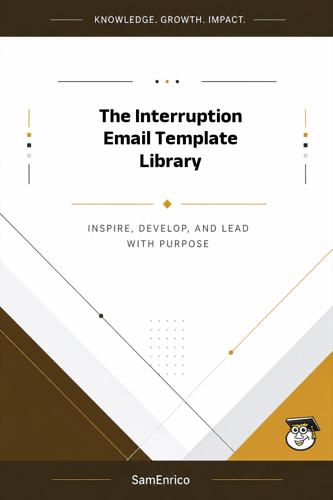
Non-FictionSelf-HelpEmail Management
The Interruption Email Template Library eBook
Provides 40 copy-paste email responses to handle c
by Guerin Trinh
Provides 40 copy-paste email responses to handle common interruptions asynchronously.
Formats
Free sample
Chapter 1: The 23-Minute Theft...--–- Every morning, Sara opens her email at 8:47 AM. By 8:48, she has replied to three messages. By 9:15, she has answered twelve. At 5:30 PM, she closes her laptop with 47 emails sent, 23 meetings attended, and exactly zero hours of uninterrupted work completed. She tells herself tomorrow will be different.
Tomorrow, she will finally finish the proposal. But tomorrow comes, and the same inbox greets her like a hungry animal that was never really fed.Sara is not lazy. She is not disorganized. She is not bad at her job. Sara is a victim of the most expensive force in modern knowledge work: the hidden cost of interruption.
And she has no idea it is costing her 23 minutes every single time she glances at her inbox.This chapter is not about email. Email is merely the delivery mechanism. This chapter is about attention, the only resource you truly own, and how it is being stolen from you in micro-threads so small you do not feel the theft until you look up and realize your entire day has vanished. By the time you finish reading this chapter, you will understand why replying "faster" is a trap, why silence is not a strategy, and why the very template you are about to copy-paste tomorrow morning might be the most important professional habit you ever install.The Physics of a 30-Second Glance Let us start with a number that will sound false. Repeat it until it feels true: twenty-three minutes.
That is how long it takes the average knowledge worker to fully return to a state of deep focus after a single interruption. Not 23 seconds. Not 2.3 minutes. Twenty-three minutes of cognitive recovery for every single interruption that pulls your brain away from its primary task.Here is what happens inside your skull. When you are working on a complex task, your brain builds what neuroscientists call an "attention network" – a temporary assembly of neural pathways that hold together the context, variables, and next steps of your work.
Think of it as a house of cards made of focus. Each card represents a piece of context: where you were in the document, what numbers you were checking, what sentence you were about to write, what problem you were about to solve.Then your email chimes. Or you glance at your inbox "just to see." Or a Slack notification flashes. That 30-second glance does not just pause your work – it demolishes the house of cards. When you look away, your brain does not preserve your context in a perfect state.
It resets. It assumes the threat (the email) requires full attention. It dismantles the attention network to process the new input.When you return to your original task, you do not simply resume. You rebuild. And rebuilding takes an average of 23 minutes.
During those 23 minutes, you are working at perhaps 40% cognitive capacity. You re-read the same paragraph three times. You re-check numbers you already checked. You remember what you were about to do, but the flow state is gone.Now multiply 23 minutes by the number of times you check email in a typical day. The average professional checks email 77 times per day.
Even if only half of those are true interruptions (not batch-checking), you are losing nearly nine hours per week to recovery time alone. That is not a busy schedule. That is a cognitive car crash you drive yourself to every morning and call it "being responsive."The cruelest part of this math is that the interruption itself – the glance, the click, the quick reply – feels nearly free. It costs 30 seconds. But the true cost is 23 minutes, which you never see.
You only feel the vague exhaustion at 5:00 PM, the sense that you worked hard but accomplished nothing, the guilt that follows you home.The Two Schedules That Explain Everything Paul Graham, the co-founder of Y Combinator, wrote an essay in 2009 that should be required reading for every knowledge worker. It is called "Maker's Schedule, Manager's Schedule," and it explains why your days feel so broken.The manager's schedule is the default operating system of most offices. It divides the day into hour-long blocks. If you are on a manager's schedule, you can handle an hour-long meeting at 10 AM, another at 11 AM, lunch, then meetings at 1 PM and 2 PM, and still have time to "catch up" on email between them. The manager's schedule is designed for people whose job is to talk to other people – to make decisions, approve requests, and coordinate work.
Interruptions are not a bug. They are the feature.The maker's schedule is something else entirely. Makers – writers, programmers, designers, strategists, engineers, anyone who produces complex output – need blocks of at least half a day to do their best work. A maker cannot write a chapter in one-hour increments. A maker cannot design a system in 45-minute sprints separated by meetings.
A maker needs to descend into the work, to build that house of cards I described earlier, and to stay there for hours.Here is the problem. Most professionals are on a maker's schedule but trapped in a manager's world. Your actual work requires deep, uninterrupted blocks. Your organization's default communication rhythms (email, Slack, meetings) are designed for managers. And because email is asynchronous, it feels like it should fit anywhere – but it doesn't.
Every email glance destroys your maker's schedule one 23-minute shard at a time.This is why you feel exhausted even when you did nothing "hard." You spent your day context-switching, not working. And context-switching is biologically expensive. Each switch costs glucose, attention residue, and willpower. By 3 PM, you are running on fumes, not because you worked too hard, but because you switched too often.Why Faster Replying Is a Trap The most common response to email overwhelm is to try to reply faster. Shorter emails.
Quicker decisions. Less thinking, more typing. This is the advice of people who do not understand the 23-minute rule. They think the problem is speed. They are wrong.
The problem is frequency.Every time you reply to an email, you do two things. First, you interrupt yourself. Second, you train the sender that you are available for immediate replies. Faster replying creates a vicious cycle. You reply quickly, so people email you more often.
You feel pressure to reply even faster, so you check email more frequently. Your focus fragments further. Your work suffers. You reply faster to compensate. The cycle accelerates until you are answering emails at stoplights and calling it "productivity."The only way out of this trap is to stop trying to reply faster and start designing systems that make interruptions feel unnecessary to the sender.
You do not need to be more responsive. You need to be less interruptible.This is countercultural. Your organization probably measures "responsiveness" as a virtue. Your boss might admire the person who answers emails at 10 PM. Your team might expect instant replies on Slack.
But those expectations are not physics. They are habits. And habits can be retrained.The most effective way to retrain them is to become predictable, not fast. If people know you reply to email in two batches per day (say, 11 AM and 4 PM), they stop…
This is the end of the free sample. Get the eBook to keep going. Buy now
About this book
Details
- Author
- Guerin Trinh
- Publisher
- SamEnrico
- Language
- English
- Genre
- Non-Fiction, Self-Help, Email Management
- Released
- 2026-06-10
- Pages (approx.)
- 135
- Available as
- eBook, Audiobook

Read better in the ZLOADR app
Your eBooks on your phone or tablet. Sign in with your SamEnrico account and start reading.
More by Guerin Trinh
 Recording Hypnotic PacingGuerin Trinh$11.99
 Goal Tracking DashboardGuerin Trinh$11.99
 Growth Hormone and IGF 1 TestingGuerin Trinh$11.99
 DoorDash Drive Orders GuideGuerin Trinh$11.99
 Norwegian Defense of NarvikGuerin Trinh$11.99
 Grief and Exercise After Child LossGuerin Trinh$11.99
 Burnout Recovery Hydration PlanGuerin Trinh$11.99
 The Iron Masters of Meroë: Forging an Empire in the Sands of KushGuerin Trinh$11.99
 The Midnight Tunnels: The Great Breakout of Alcatraz’s Forgotten PrisonersGuerin Trinh$11.99
 How to Start a Film and Photo Club Business (Beginners Guide)Guerin Trinh$11.99
 Week Two Launch Execution PlanGuerin Trinh$12.99
 Halal Certification B2B SellingGuerin Trinh$12.99
You may also like
 Hong Kong Handover 1997Dunn Johnnie$11.99
 Zumba For Postnatal Recovery CourseNeal Christian$11.99
 Zumba for BeginnersLadner Nikia$11.99
 YouTube Comment Mining GuideHumes Pandora$12.99
 Worry Box MeditationCarlin Rudy$11.99
 Workplace Stress MeditationNguyen Lynn$11.99
 Workplace Stress and Sleep RepairHawley Ivory$11.99
 Workplace Perfectionism CureDelaney Jeffry$11.99
 Workplace Injustice Anger GuideWallen Isabelle$11.99
 Work Addiction and Burnout LinkGreenwood Ester$11.99
 Women in Yoga and WellnessBeattie Galina$11.99
 Women in Stand Up ComedyChun Evangeline$11.99