
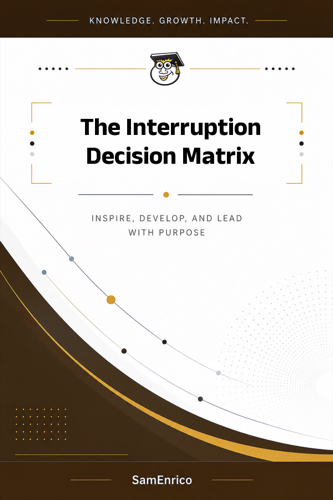
Non-FictionSelf-HelpDecision FrameworksProductivity
The Interruption Decision Matrix eBook
A simple 2x2 grid to instantly decide whether to h
by Foley Hilde
A simple 2x2 grid to instantly decide whether to handle, defer, or delegate a distraction.
Formats
Free sample
Chapter 1: The Open Loop Epidemic--Imagine for a moment that every time your phone buzzed, someone reached into your wallet and removed a twenty-dollar bill. You would disable notifications within the hour. You would put the phone in a drawer. You might even throw it away. And yet, something far more valuable than money is being extracted from you hundreds of times per day—not in twenty-dollar increments, but in minutes, then hours, then entire days that you will never get back.This chapter is not about how annoying interruptions are.
You already know they are annoying. This chapter is about the hidden mathematics of attention: why a ten-second interruption costs twenty-three minutes of your life, why your brain cannot actually multitask no matter how good you think you are at it, and why the term "open loop" will forever change how you see your inbox, your Slack channel, and your own distracted mind.By the end of this chapter, you will be able to calculate your personal "interruption tax" to the dollar. More importantly, you will understand why every previous attempt to fix this problem has failed—and why the Interruption Decision Matrix exists as the only logical solution.The Twenty-Three-Minute Ghost In 2005, a team of researchers at the University of California, Irvine, led by Gloria Mark, did something deceptively simple. They followed knowledge workers through their normal days and recorded every single time they switched tasks. Then they measured how long it took those workers to return to their original task at the same depth of focus.The results were staggering.After a typical office interruption—a coworker stopping by, a phone call, an email notification—it took an average of twenty-three minutes and fifteen seconds for the worker to fully re-engage with their original task.
Not two minutes. Not five. Twenty-three.Let that number sit with you for a moment. A thirty-second interruption costs twenty-three minutes of recovery time. That is a ratio of forty-six to one.
For every second you spend dealing with an interruption, you spend forty-six seconds just trying to remember where you were.But here is what most people get wrong about that study. The twenty-three minutes is not the time it takes to return to the task. It is the time it takes to return to the same depth of focus. You might physically return to your spreadsheet or your email draft within thirty seconds. But your brain is working at half speed, then three-quarter speed, then full speed again only after nearly half an hour has passed.Mark and her colleagues called this "attention residue." When you switch from Task A to Task B, a portion of your attention stays stuck on Task A.
It is like dragging a boat anchor while trying to sail. You are moving, but you are not moving efficiently. And the more complex Task A is, the heavier the anchor becomes.This is not a matter of willpower or discipline. It is a matter of neurology. The brain does not have a "clear cache" button.
It has to slowly, metabolically dissolve the neural activation patterns of the previous task before it can fully activate the next one. That process takes time, and no amount of wishing it away will speed it up.The $900 Billion Distraction Now let us do the math that will make you angry—productively angry.Let us assume you are a reasonably compensated knowledge worker earning fifty dollars per hour. That is approximately one hundred thousand dollars per year. Not wealthy, but comfortable.Let us also assume you are interrupted ten times per day. That is a conservative estimate.
Most studies put the number between fifteen and thirty interruptions per day for office workers, but we will use ten to keep the numbers simple.Each interruption, we now know, costs twenty-three minutes of recovery time. Ten interruptions cost two hundred thirty minutes of recovery time per day. That is three hours and fifty minutes. Nearly four hours of every eight-hour workday are lost not to the interruptions themselves, but to the recovery from them.At fifty dollars per hour, four hours cost two hundred dollars. Per day.
Over a two-hundred-fifty-day work year, that is fifty thousand dollars in lost productivity. Half your salary. Gone. Not to vacations, not to taxes, not to retirement savings. To the simple, unobserved act of recovering from interruptions.Now multiply that by the approximately ninety million knowledge workers in the United States alone.
You get roughly $4.5 trillion in annual lost productivity. Even if we cut that estimate by eighty percent to account for variations in salary and interruption frequency, you are still looking at nearly nine hundred billion dollars.Nine hundred billion dollars. Every year. Vanished.This is not a productivity problem. This is an economic catastrophe hiding in plain sight.But here is the thing you will not hear in any corporate training video: most of these interruptions are not emergencies.
They are not even important. They are simply there—arriving by email, by chat, by phone, by a coworker leaning over a cubicle wall—and we respond to them not because we have to, but because we have never been taught another way.The Myth of the Multitasking Genius You have heard someone say it. Maybe you have said it yourself. "I am great at multitasking." It is said with pride, as if splitting attention across multiple streams of work is a superpower rather than a confession.The research on multitasking is brutally clear. The human brain cannot process two cognitive tasks simultaneously.
Not "it is difficult." Not "it takes practice." Cannot. As in, neurologically impossible.What we call multitasking is actually task-switching. Your brain rapidly shifts attention from Task A to Task B and back again. Each shift incurs a cost: a small lag, a small loss of accuracy, and a small accumulation of attention residue. Do this enough times, and you are not doing two things at once.
You are doing two things poorly, sequentially, with a tax on every transition.In a landmark study published in the Journal of Experimental Psychology, researchers asked participants to perform two simple tasks simultaneously: sorting shapes by color and sorting letters by vowel status. When done separately, participants were nearly one hundred percent accurate. When done simultaneously, accuracy dropped by nearly forty percent, and completion time more than doubled.Now imagine those tasks are not simple sorting exercises but writing a proposal, debugging code, analyzing a spreadsheet, or thinking strategically about a quarter-end report. The cost of task-switching scales with the complexity of the tasks. The harder the work, the more expensive the switch.This is why the most creative and productive people in the world—writers, scientists, software engineers, strategic executives—guard their focus like endangered species.
They are not being antisocial. They are being mathematically correct. Every interruption is a tax, and they have decided to stop paying it.Introducing the Open Loop There is a concept from productivity psychology that you need to remember for the rest of this book. In fact, it is the single most important idea in these first three chapters. That concept is the open loop.An open loop is any task, obligation…
This is the end of the free sample. Get the eBook to keep going. Buy now
About this book
Details
- Author
- Foley Hilde
- Publisher
- SamEnrico
- Language
- English
- Genre
- Non-Fiction, Self-Help, Decision Frameworks, Productivity
- Released
- 2026-06-10
- Pages (approx.)
- 127
- Available as
- eBook, Audiobook

Read better in the ZLOADR app
Your eBooks on your phone or tablet. Sign in with your SamEnrico account and start reading.
More by Foley Hilde
 Emotionally Unavailable Parent GuideFoley Hilde$11.99
 Confronting Harassment At Work GuideFoley Hilde$11.99
 Chunking for Daily RoutineFoley Hilde$11.99
 Storming Bastille Revolution GuideFoley Hilde$11.99
 Anger and Intimacy GuideFoley Hilde$11.99
 Pelvic Floor for WomenFoley Hilde$11.99
 CRE Mezzanine Debt GuideFoley Hilde$11.99
 Self Esteem For MenFoley Hilde$11.99
 The Silent Codebreaker: Alan Turing’s Secret War Beyond EnigmaFoley Hilde$11.99
 Summits and Shadows: The Indomitable Women Who Conquered the Southern SkiesFoley Hilde$11.99
 Code of the Pharaohs: The DNA Secrets of Ancient EgyptFoley Hilde$11.99
 Understanding Amelia X LinkedFoley Hilde$17.99
You may also like
 Hong Kong Handover 1997Dunn Johnnie$11.99
 Zumba For Postnatal Recovery CourseNeal Christian$11.99
 Zumba for BeginnersLadner Nikia$11.99
 YouTube Comment Mining GuideHumes Pandora$12.99
 Worry Box MeditationCarlin Rudy$11.99
 Workplace Stress MeditationNguyen Lynn$11.99
 Workplace Stress and Sleep RepairHawley Ivory$11.99
 Workplace Perfectionism CureDelaney Jeffry$11.99
 Workplace Injustice Anger GuideWallen Isabelle$11.99
 Work Addiction and Burnout LinkGreenwood Ester$11.99
 Women in Yoga and WellnessBeattie Galina$11.99
 Women in Stand Up ComedyChun Evangeline$11.99