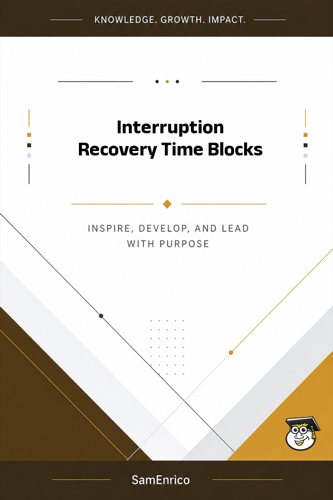
The Interruption Buffer Strategy eBook
Build scheduled buffers to absorb unexpected deman
by Dunlap Mei
Build scheduled buffers to absorb unexpected demands and delays.
Formats
Free sample
Chapter 1: The 9:00 AM Lie--–- Let me tell you something that every productivity book dancing around the topic is afraid to admit: your calendar is a liar. Not a harmless, white-lie kind of liar. Not the “I’m five minutes away” when you haven’t left the house kind of liar. Your calendar is the kind of liar that has cost you weeks of your life, hundreds of hours of lost focus, and a quiet, background hum of guilt that you’ve learned to call “being busy.”You know the scene. It’s 9:00 AM.
You’ve got a beautiful, color-coded schedule. From 9:00 to 10:30, you’ve blocked out “Deep Work: Quarterly Report.” You feel a little thrill of competence just looking at it. This is the day you finally get ahead. You pour your coffee, open your laptop, and take a deep breath.Then it happens. Always.
Your Slack pings. It’s your manager with a “quick question” about a client from yesterday. You answer. Three minutes pass. You try to dive back into the report, but you can’t remember the exact phrasing you were about to use.
You scroll back up. Then your email dings. It’s a meeting invite for a last-minute “sync” in twenty minutes. You accept. Now you’re anxious about that meeting, so you start prepping for it instead of writing the report.
Then a colleague stops by your desk to ask about a shared doc. Then you remember you forgot to submit your timesheet. Then it’s 10:30 AM. The report has not been touched. The block is over.
You close your laptop, sigh, and tell yourself, “I’ll get to it tomorrow.”Tomorrow will be exactly the same.This isn’t a failure of willpower. It’s not that you’re lazy, disorganized, or bad at your job. It’s that you are operating under a catastrophic, unspoken assumption that has been baked into every time management course, planner, and calendar app you’ve ever used. The assumption is this: the world is predictable.The Myth of the Predictable Day Let’s name the enemy. It’s not your boss.
It’s not your ADHD. It’s not your “addiction” to your phone. The enemy is what I call the Perfect Plan Fallacy. This is the deeply ingrained belief that if you just create a detailed enough schedule—assigning every task to a specific 30-minute slot—you can control the flow of your day.Here’s the brutal reality: dependent events and statistical fluctuations will destroy any plan that lacks slack.I know those words sound like engineering jargon, but stick with me. They are the single most important concepts you will learn in this book.Dependent events simply mean that Task B cannot start until Task A is finished.
You can’t send the email until you write the email. You can’t submit the expense report until you find the receipt. You can’t launch the marketing campaign until the legal team approves the copy. In knowledge work, almost everything is a chain of dependencies.Statistical fluctuations mean that no task takes the same amount of time every time. Writing a standard email might take three minutes one day and fifteen minutes the next if you’re tired, distracted, or the topic is sensitive.
Generating a report might take one hour or four, depending on how clean the data is.Now, here’s the disaster. When you have dependent events, and each event has statistical fluctuations, delays compound forward but savings cannot. If Task A takes five minutes longer than planned, Task B starts five minutes late. And if Task B then takes ten minutes longer than planned, Task C starts fifteen minutes late. But if Task A finishes five minutes early?
You don’t get to start Task B five minutes early, because the person or resource you need for Task B isn’t ready yet. They are scheduled for the original time. You lose those five minutes. You cannot bank early finishes. You can only bank late starts.
This asymmetry is why your day falls apart.The famous business thinker Eliyahu Goldratt, in his book The Goal, demonstrated this with a simple game of dice and matches. But you don’t need a game. You need to look at your own calendar.The Interruption Audit: Meeting Your Chaos Tax You cannot fix what you refuse to measure. So before we build a single buffer, you are going to take a cold, hard look at how much of your day is currently being stolen. I call this calculating your Chaos Tax.For the next five consecutive workdays, you are going to track every unscheduled disruption.
Not the planned meetings. Not the tasks on your to-do list. Only the things that were not on your calendar when the day began. We will use a tool I call the Time Bandit Log, which you can find in the Appendix of this book. But for now, a simple notebook or a note on your phone will work.Here is exactly what to track each time an interruption happens:Time of disruption Source (e.g., Slack message from Sarah, email from client, colleague walking over, own wandering thought, phone notification)Estimated duration of the disruption itself (not the recovery time, just the interruption)Urgency (Was this a true emergency?
System down? Safety issue? Or could it have genuinely waited 30 minutes?)Do not change your behavior. Do not try to be more “focused” just because you’re tracking. Act normally.
Let yourself get interrupted. This is a diagnostic, not a performance review.At the end of each day, add up the total minutes of interruption you tracked. Then divide that by your total working minutes (for example, 480 minutes in an 8-hour day). Multiply by 100. That percentage is your Chaos Tax.I have run this audit with thousands of professionals across software development, marketing, law, medicine, and education.
The results are depressingly consistent. The average knowledge worker loses between 30% and 50% of their scheduled day to unscheduled interruptions.Let that sink in. If you work an eight-hour day, you are losing between two and a half and four hours every single day. That is twelve to twenty hours a week. That is fifty to eighty hours a month.
That is an entire month of working time lost every year to things you never agreed to do.And that is just the raw time. We haven’t even gotten to the hidden costs yet.The Five Hidden Costs of a “One-Minute” Interruption Now, you might be thinking, “Okay, but my interruptions are short. Someone asks a quick question, I answer, I move on. It’s two minutes. No big deal.”That is the most expensive miscalculation you are making.
A one-minute interruption does not cost you one minute. It costs you far more because of what I call the Chain of Cognitive Ruin.Let me break down the five time-loss factors that turn a tiny disruption into a productivity crater.1. The Interruption Itself (1 minute)This is the only cost you see. The notification pops up, the person taps your shoulder, your phone buzzes. You stop what you are doing.
This is the tip of the iceberg.2. The Restart (5–10 minutes)This is the killer. Your brain does not work like…
This is the end of the free sample. Get the eBook to keep going. Buy now
About this book
Details
- Author
- Dunlap Mei
- Publisher
- SamEnrico
- Language
- English
- Genre
- Non-Fiction, Self-Help, Interruption Management
- Released
- 2026-06-11
- Pages (approx.)
- 151
- Available as
- eBook, Audiobook

Read better in the ZLOADR app
Your eBooks on your phone or tablet. Sign in with your SamEnrico account and start reading.
More by Dunlap Mei
 Discussing Palliative Care With FamilyDunlap Mei$11.99
 Postpartum Depression and Secondary InfertilityDunlap Mei$11.99
 IBS Pregnancy Management GuideDunlap Mei$11.99
 Meth Recovery Dental Care HandbookDunlap Mei$11.99
 Pelvic Floor and Sexual FunctionDunlap Mei$11.99
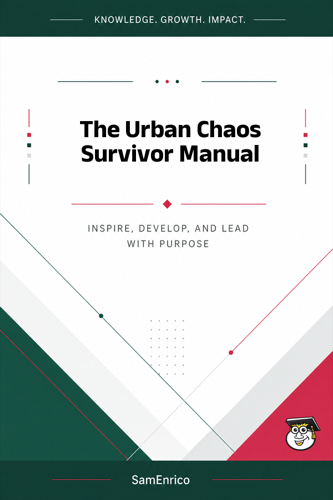 The Urban Chaos Survivor ManualDunlap Mei$11.99
 Authority Persuasion GuideDunlap Mei$11.99
 Body Image For Port Wine StainsDunlap Mei$11.99
 The Vanishing Point: The Unsolved Mystery of the Sodder ChildrenDunlap Mei$11.99
 Mawu-Lisa: The Twin Forces of Day and NightDunlap Mei$11.99
 Shadows of the Red Sparrow: The Double Life of Marta PetrownaDunlap Mei$11.99
 Understanding Angel Shaped PhalangoepDunlap Mei$17.99